
Influence of the use of ICT on the development of reading comprehension in Primary Education
Article Sidebar
Main Article Content

Abstract
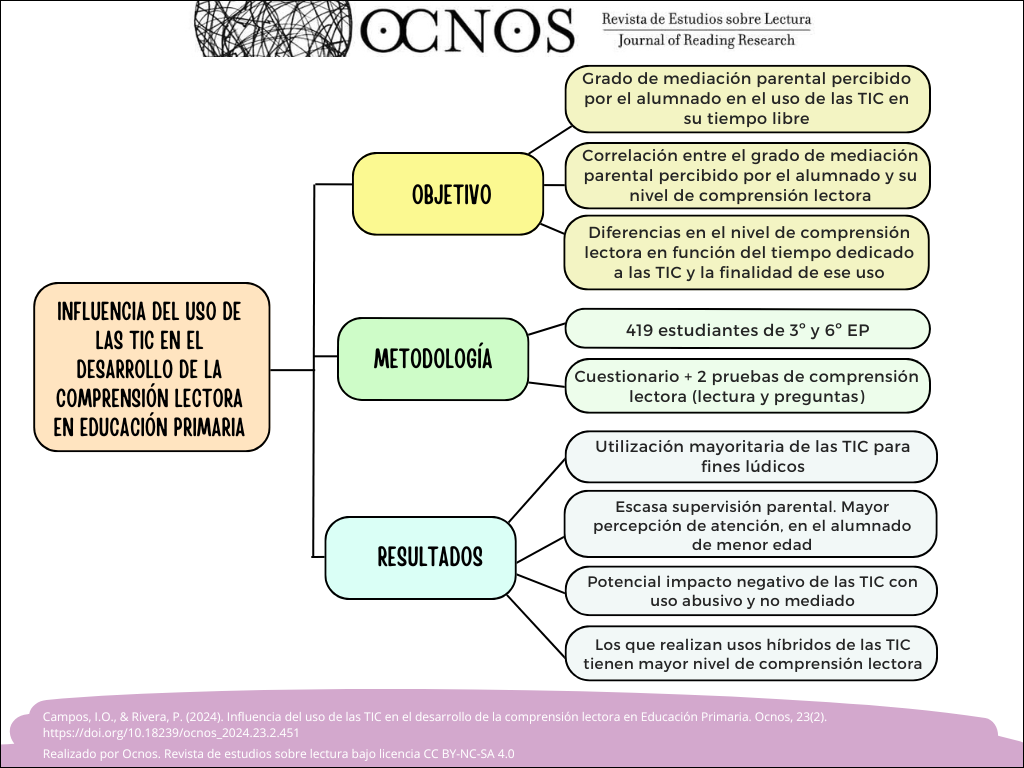
In a context of increasing use of Information and Communication Technologies (ICTs) during childhood, recent research has opened a discussion regarding the potential harmful impact of unmediated overexposure to these tools on the development of reading competence. Given this situation and considering the relevance of the family as a literacy context, a quantitative ex post facto research was conducted with students from the second and third cycles of Primary Education (N= 410). The aim was to explore the level of parental mediation in the use of ICTs by students and analyse the potential link of this variable with their reading comprehension level. The results reveal a predominant use of ICT for recreational purposes and deficiencies in parental mediation, with a higher number of risky situations as the age increases. Additionally, an association is found between the level of parental mediation in the use of ICTs and the level of reading comprehension among sixth-grade students, mainly in inferential and critical levels, thus confirming the potential negative impact of abusive and unmediated use of ICTs on this competence.
Article Details
Introduction
After a period of exaltation of the potential of technological tools in the field of education, scientific progress regarding the contact of children and adolescents with these devices has called into question the conception of this part of the population as “digital natives” (), pointing to the need to implement “digital literacy” processes () based on the development of the already curricularly consolidated “digital competence”. In this sense, argues that, although the term coined by Prensky was widely used two decades ago, his thesis lacked a scientific basis and suggested a kind of “biological determinism” regarding the ability to use Information and Communication Technologies (hereinafter ICTs) by the generations born in the new millennium. Consistent with this discourse, , or have denied the idea that children born in the digital age are per se trained for efficient and appropriate use of ICTs, and studies such as those by , , or have provided solid evidence for the opening of a debate on the potential harmful impact of unmediated overexposure to these devices on the development of different communication skills among the younger population.
Following an extensive review of international research, concludes that, although schoolchildren often show a preference for digital media in reading activities, the comprehension achieved through this medium is lower than when the medium is analogue. In addition, it highlights the results of research conducted between 1992 and 2017 (Singer & Alexander, 2017; cited in ) which lead to the conclusion that comprehension of texts longer than one page in length is superior when the format is in print. In a similar vein, , analysed 54 empirical studies published between 2000 and 2017 with more than 170,000 learners at different educational levels in 19 countries, concluding on the validity of the “Paper Superiority Effect” (ESP, as per its Spanish acronym) thesis, finding that readers achieve better comprehension levels when they read on paper than when they read on screen. For their part, argue that, although the inclusion of ICTs in schools has been a priority for most teachers, recent results from the Programme for International Student Assessment (PISA) () with more than half a million students from the 65 participating countries show that the use of ICT in the classroom is not significantly linked to better academic results and that, moreover, there is sometimes even a negative association between the use of these tools and performance in certain skills.
These discourses, in any case, are not aligned with a negationist stance regarding the inclusion of ICTs in the classroom, but rather, in line with Wolf's discourse (), they appeal to the role of the adult as a mediator in the construction of a brain that the aforementioned author calls “bioliterate”; that is, capable of reading and writing in both analogue and digital contexts, which, in coherence with cognitive development at an early age, requires the achievement of a basic reading competence in analogue media prior to the inclusion of screens under the mediation of the adult. The positive impact of the incorporation of ICTs at ages when reading competence in analogue media has already been achieved, and from a mediated approach, is evidenced in research such as that conducted by with two groups -experimental and control- of students in the third cycle of Primary Education, where it was found that the use of ICTs -interactive whiteboard, laptops, digital players, Internet connection, interactive applications and educational websites- during 25 sessions of Spanish Language and Literature in an active, interactive and dynamic way for the development of teaching-learning tasks reported significant differences in scores in oral and written comprehension in the pre-test and post-test in the experimental group -being higher in the second group-, The results showed significant differences in the scores in oral and written comprehension in the pre-test and post-test in the experimental group -being higher in the second test-, but not in the control group, where only traditional tools had been used.
From an educational point of view, the inclusion of ICTs is linked to the concept of “digital competence”, which not only refers to the skills, knowledge and attitudes with and towards ICT, but also to their effective and critical application for a given purpose (). The curricular consolidation of this competence in recent years has led to a proliferation of studies focused on the analysis of different aspects linked to training in the use of ICTs in the classroom, highlights for the case of Spain that most of the research on ICTs in the pedagogical field has focused on the use of different digital tools for curricular purposes. Nevertheless, it is still necessary to delve into aspects that transcend the school scenario such as, for example, those related to the attitudes of teachers and parents towards this type of tools. Therefore, given the influence of the family as a literacy context (; ) and following in the wake of recent works such as those by or , we are interested in finding out how legal guardians act with respect to the use of ICTs at home by students in the 3rd (N= 142) and 6th (N= 268) years of Primary Education, and also in the potential link between this mediation and their reading comprehension level.
Authors such as or have highlighted the need to study the link between access to ICTs and reading achievement in children and adolescents, taking into consideration both the time spent using these tools and the purpose of their use. In this sense, in a cross-national study with adolescents, found a negative link between the use of ICTs in leisure time and reading achievement, but, however, a positive association between the use of these tools specifically for leisure reading and reading achievement. In the same spirit, found significantly lower performance among Dutch adolescents who used ICTs excessively for leisure-based purposes, but nevertheless found that the highest reading scores were found among those who showed moderate use of ICT at home for schoolwork.
In line with these findings, our study aims at shedding new light in the Spanish context on the previous research by , in which the focus was on exploring the link between the degree of parental mediation in ICT access perceived by sixth-year students and their level of reading comprehension. Using a similar research design, we addressed new variables in order to study comparatively in a wider population -3rd and 6th year of Primary Education- the link between time, purpose and perceived parental mediation in the use of ICTs at home and the degree of reading comprehension achieved by students, paying attention also to their different levels -literal, inferential and critical-.
Method
Objectives and assumptions
The research had three objectives in which the exploration of possible differences according to the grade (3rd or 6th year of Primary Education) was taken into consideration:
-
– To explore the degree of parental mediation perceived by students in the use of ICTs in their free time and to identify the presence of possible risk situations.
-
– To analyse the possible correlation between the degree of parental mediation perceived by students in the use of ICTs in their free time and their level of reading comprehension.
-
– To explore possible differences in the level of reading comprehension according to the time spent using ICTs in their free time and the main purpose -educational, communicative or recreational- of such use by girls and boys.
As for objectives 2 and 3, and in coherence with the revised theoretical framework, the aim was to verify the possibility of rejecting the following null assumptions in reference to the link between the use of ICTs at home and the level of reading comprehension achieved by students:
-
– Null assumption 1. There is no positive link between the degree of parental mediation perceived by students in their access to ICTs and the level of reading comprehension achieved.
-
– Null assumption 2. There are no significant differences in the level of reading comprehension achieved by students according to the main use of ICTs in their free time -educational versus other uses-.
Design and participants
The research was conducted under a quantitative and ex post facto design in which 410 students of 3rd (N= 142) and 6th (N= 268) years of Primary Education from nine schools in Aragón (Spain) participated.
The sampling applied was non-probabilistic and by convenience, following the request for participation sent to different educational centres. The criteria for inclusion in the study were the willingness of the children and their legal guardians to participate in the research and the absence of reading difficulties that could affect both the comprehension of the questions in the questionnaire and the reading comprehension test conducted.
50.6% of the participants were boys and 49.4% were girls. 68.8% attended public schools and 31.2% attended private schools (publicly funded, but privately run).
Data collection instruments and procedure
Data were collected using two validated tools. To analyse the variables linked to student use of ICTs, we applied the questionnaire used by -which, in turn, is an adaptation of the tool by –, and for the measurement of the level of reading comprehension, two tests of linguistic communication competence in Spanish published by the Ministry of Education and Vocational Training of Spain (Ministerio de Educación y Formación Profesional, ; ).
The first questionnaire made it possible to collect data corresponding to: socio-demographic variables, the frequency and purpose of students’ use of ICT sin their free time and the degree of parental mediation perceived in the use of these tools (table 1). Regarding the latter variable, 17 items were presented on a Likert-type scale with five response levels that contemplated different dimensions of parental mediation in the use of ICTs. Table 1 shows in brackets the number of items incorporated for each of the dimensions. The reliability of this scale was calculated using Cronbach’s test, which yielded an alpha value of .862, showing good internal consistency of the scale ().
The reading comprehension tests involved reading an expository text and answering a set of multiple-choice questions that made it possible to assess the application of different cognitive processes involved in reading comprehension competence: the ability to locate and obtain information, the ability to integrate and interpret information, and the ability to evaluate and reflect on it. The tests selected were “Las aventuras de Lucy, la niña pintora” for 3rd year () and “El origen de algunos símbolos tecnológicos” for 6th year ().
Both the questionnaire and the reading comprehension test were completed in analogue format with the presence of one of the researchers, which favoured the control of possible biases. Students were given 60 minutes to respond.
Data analysis procedure
In order to analyse the differences in the dependent variable -reading comprehension- as a function of parental mediation in the use of ICTs, first of all, it was calculated: 1) the score in the reading comprehension test after coding each correct answer with a point and each wrong answer with a zero; 2) the index of parental mediation perceived by students in the use of ICTs during free time, calculated by assigning a code between 0 and 4 to the answer given to each item on the five-level Likert scale -giving the highest score to the most desirable answer- and then obtaining the arithmetic mean of all the items corresponding to this scale. For the interpretation of this index, it was understood that scores below 2 points - the central measure of the scale - implied situations of risk with respect to ICT use.
Once these indices had been calculated, mean comparison tests were applied after analysis of the behaviour of the data in terms of normality and homogeneity of variances in terms of each independent variable, which led to the application of the non-parametric Kruskal Wallis test -and its corresponding post hoc test- and the Mann-Whitney U test. In addition, Spearman’s non-parametric correlation test was also applied to analyse the association between the scale-type variables corresponding to the score obtained in the reading comprehension test, the index of parental mediation in the use of ICTs and the time spent on these tools in free time. The operations were performed with SPSS version 24.00 and the significance level for rejecting the null assumptions was .05.
Results
Perceived parental mediation of ICT use
The first objective was to explore the degree of parental mediation perceived by students in the use of ICTs in their free time and to identify the possible presence of risk situations. As mentioned above, the index of parental mediation in ICT use was calculated by coding the answers given to the 17 items of the scale. Specifically, each response was coded between 0 and 4 points, with the highest score corresponding to the most desirable response. Subsequently, a mean between 0 and 4 was obtained for the set of items and, for qualitative interpretation, it was estimated that scores below 2 points would imply insufficient parental mediation, scores between 2 and 3 points would imply acceptable or average mediation, and scores above 3 points would reflect high or good mediation. Similarly, it was understood that scores below 2 on the different items would indicate risk situations with respect to ICT use.
The parental mediation index among third year students reflects an acceptable value of 2.61 points (SD = 0.658), half a point above the sixth year students (M = 2.13; SD = 0.642), which has a mean of about 2 points, thus at the lower limit of acceptable parental mediation. In order to explore the existence of significant differences between the two groups, the Mann-Whitney U test was applied, the result of which (U= 10014.00; p= < .001) showed a significantly higher index among third year students (Median= 2.735; Range= 3.41) than among sixth year students (Median= 2.176; Range= 2.94).
Consistent with this, and as can be seen in table 2, the responses to the items on the scale of perceived parental mediation in the use of ICTs show a greater number of situations with potential risk among sixth-year students, with scores below 2 points in nine of the 17 items on the scale compared to the five found in third-year students. The analysis of these results shows that the most problematic aspects among third-year students are related to the support of parents in the use of ICTs, its use mainly for recreational purposes and the establishment of hours for its use. However, in the case of sixth-year students, five of the nine items corresponding to access to risky situations or activities through ICTs and inappropriate content for children are also added.
Perceived level of parental mediation in ICT use and reading comprehension
Our second aim was to analyse the possible relationship between the degree of parental mediation perceived by students in the use of ICT and their level of reading comprehension.
The results of the Spearman’s correlation test show, for both third and sixth-year students (table 3), a significant correlation (p= .019 and p= < .001 respectively), although weak (r= .199 and r= . 235 respectively), between the reading comprehension test score and the index of parental mediation in the use of ICTs, so that those who perceive greater parental mediation in the use of these tools in their free time, in turn, have higher scores in reading comprehension.
| ICT parental mediation | Weekday ICT time | Weekend ICT time | Reading comp. score | |||
|---|---|---|---|---|---|---|
| Spearman’s Rho | Reading comp. score 3rd year | Coefficient | .199* | -.130 | -.037 | 1000 |
| Next (bilateral) | .019 | .123 | .659 | . | ||
| Comp. score 6th year | Coefficient | .235** | -.109 | -.096 | 1000 | |
| Next (bilateral) | .000 | .255 | .320 | . | ||
* The correlation is significant at the level of 05 (2-tailed).
** The correlation is significant at .01 level (2-tailed).
For further analysis, three groups were created according to the parental mediation index:
-
– the first group, made up of students who scored less than 2 points, which would correspond to inadequate mediation;
-
– the second group was made up of students who scored between 2 and 3 points - which would correspond to an acceptable or average mediation;
-
– the third group, made up of those who scored above 3 points - reflecting high or good mediation.
Considering this ordinal variable, the Kruskall-Wallis test was used to detect possible differences in the scores obtained in the reading comprehension test. The results show statistically significant differences in the reading comprehension scores of the sixth-year students [H(2)= 14.333, p= .001] between the inadequate mediation group and the acceptable mediation group (p= .001). Furthermore, a comparison of the means of the two groups shows a gap of almost one point (table 4). However, no significant differences were found between the groups for third-year students [H(2)= 4.679, p= .096].
| Level of parental mediation in the use of ICTs | Reading comprehension score |
|---|---|
| Insufficient mediation | M= 5.98; SD= 1.71 |
| Acceptable mediation | M= 6.85; SD= 1.80 |
| High mediation | M= 6.76; SD= 1.60 |
In order to achieve a more detailed analysis of the differences in reading comprehension of sixth-year students according to this variable, the Kruskall Wallis test was applied, considering the mean obtained in the test for each of the cognitive strategies reflected in the questions: 1) locating and obtaining information, 2) integrating and interpreting information and 3) evaluating and reflecting on it. The results show significant differences [H(2)= 15.938, p= < .001] in the dimension corresponding to the integration and interpretation of information, and the post hoc test indicates that both the group with insufficient mediation and the group with acceptable mediation (p= < .001) and the group with high mediation (p= .014) are found among the group with insufficient mediation. On the 4 items corresponding to these questions in the test, we found that those with insufficient parental mediation in ICT use are more than half a point apart (M= 2.31; SD= 1.07) from those with acceptable (M= 2.88; SD= 1.06) and high (M= 2.88; SD= 1.07) mediation.
Time and main purpose of ICT use and reading comprehension level
The third aim of the research was to explore potential differences in the level of reading comprehension according to the time spent at home and the main purpose of reading use - educational, communicative or recreational - by student.
With regard to the time spent using ICTs at home, no significant correlation was found in either group between the score obtained in the reading comprehension test and the minutes spent using ICTs during the week or at the weekend (Table 3).
In order to determine the possible association between the level of reading comprehension and the main objective of ICT use, the answers to the question concerning the first, second and third main activity for the use of these tools, formulated as follows, were considered: “Write down the top three things you use your tablet, smartphone or computer for at home: | First purpose you use them for most: | Second purpose you use them for most: | Third purpose you use them for most:”. The responses were categorised according to the purpose they reflected as shown in tables 5 and 6, i.e., firstly more broadly and then according to the three broad categories: recreational use, school use and educational use. The results show a similar order in the four activities most frequently mentioned as the first, second or third main activity for ICT use by third- and sixth-year students (the first two focused on leisure and the second two on educational activities). However, in the rest of the frequencies, there is a clear difference with regard to the use of ICTs for communication purposes -messaging and video calls-, which is more frequent among older students.
Due to the variability in the responses, two groups were created for each grade to deepen the analysis. The first consisted of students who used ICTs for less desirable purposes as a priority, i.e., those who reported using them exclusively or mainly for leisure purposes, with their responses reflecting only this type of use or doing so in the majority - in two of the three responses. The second group was made up of the remaining cases, which reflected hybrid uses, albeit among one part of the student body primarily educational and among the other primarily communicative. To analyse possible differences between the two groups, the Mann-Whitney U-test was applied.
Among the third-year students - where 83.1% of the cases responded to the group with the highest risk and 16.9% to the other - the test result did not allow us to reject the null assumption of equality in reading comprehension scores between the two groups (U= 1063.500; p= .053).
In the case of the sixth-year students -where 64.4% of the cases responded to the group with the highest risk and 33.6% to the other-, the test result allowed us to reject the null assumption of equality in reading comprehension scores between the two groups (U= 968.500; p= . 014), and we found significantly higher scores among those who make hybrid uses of ICT (Median= 6.666; Range= 8.33) compared to those who make an exclusively or fundamentally recreational use (Median= 5.833; Range= 6.67).
In addition, to further analyse the differences, the test was again applied to each of the cognitive dimensions reflected in the questions of the reading comprehension test: locating and obtaining information, integrating and interpreting information, and evaluating and reflecting on information. The result regarding the dimension of integration and interpretation of information (U= 1001.500; p= .021) shows significantly higher scores among those who make hybrid uses (Median= 0.750; Range= 1.00) compared to those who make an exclusively or fundamentally recreational use of ICTs (Median= 0.500; Range= 1.00). Similarly, significantly different scores are found between the groups in the dimension of reflection and valuation of information (U= 1041.000; p= .043), which are again higher in the case of those who use ICTs in a hybrid way (Median= 0.667; Range= 0.83), compared to those who use them mostly or exclusively in a recreational way (Median= 0.500; Range= 0.83).
Discussion and conclusions
With regard to the habits of ICT use in free time among students in the second and third cycles of Primary School Education, the research conducted shows that most students tend to use ICTs for recreational purposes. Furthermore, in line with previous research (; ; ), the generalised existence of low parental supervision in the use of these tools was found, with the perception of greater attention from legal guardians among younger students. Thus, among third-year students we find a score below the central measure of the scale in five of the 17 items in the questionnaire referring to parental mediation in access to ICTs, while among sixth-year students this situation occurs in more than half of the items, with deficiencies, moreover, in all the dimensions considered.
As for the link between this variable with the reading comprehension competence achieved by the students, the results of the research corroborate those found in the previous work by , although the differences are mainly found among sixth-year students. The evidence is consistent with the thesis of authors such as , and on the potential negative impact of digital tools when abusive and unmediated use occurs.
It is also relevant to highlight the non-existence -both in third- and sixth-year students- of a significant correlation between the reading comprehension test score and the time spent using ICTs at home during the week or at the weekend, which could reinforce the thesis that the purpose and mediation of access to these tools -and not so much the frequency of use- are of paramount importance in terms of their potential negative influence on the development of reading literacy during childhood (; ; ; ). In this sense, the results obtained allow us to conclude that those who make hybrid uses of ICTs, not focused exclusively or fundamentally on leisure purposes, have higher levels of reading comprehension than those who use these tools exclusively or fundamentally for recreational purposes.
On the other hand, it should be stressed that the results obtained point to a greater impact of less mediated and non-academic ICT use on cognitive skills linked to reading comprehension at the higher levels - inferential and critical, as opposed to literal - which is consistent with evidence pointing to impaired concentration skills in analogue reading linked to excessive and unmediated screen use during early childhood ().
In view of these results, we conclude that there is a need to counteract the deficiencies observed in access to ICTs at home with educational actions aimed at achieving a solid digital literacy, fundamentally among students in the third cycle of Primary Education.
As for the limitations of the study, the main one is common in educational research and derives from the type of sampling implemented, non-probability and convenience sampling. Thus, although the sample was large, as it was not probabilistic, caution is required in generalising the results to students in Aragon or in Spain as a whole. On the other hand, as a result of the research design and the statistical tests implemented, the study does not allow us to infer causal relationships, but only associations between variables. As for proposals for future research, in line with work such as that of , it would be of interest to apply multivariate analysis techniques that would allow complex conclusions to be drawn about the relationships between all the variables considered.
Funding
This research is part of the activity of the reference research group ECOLIJ (Educación Comunicativa y Literaria en la Sociedad de la Información (Communicative and Literary Education in the Information Society). Children’s and Young Adult in the construction of identities) through the R&D&I project “Non-fictional readings for the integration of critical citizens in the new cultural ecosystem” (PID2021-126392OB-100) financed by the Ministry of Science and Innovation of the Spanish Government, and through Project S61_20R financed by the Government of Aragon.
References
1
Berrios-Valenzuela, L., Buxarrais-Estrada, M. R., & Garcés, M.S. (2015). Uso de las TIC y mediación parental percibida por niños de Chile. Comunicar, 45, 161-168. https://doi.org/10.3916/C45-2015-17
2
Campos, I. O., & Marco-Sisamón, A. (2021). Exploración de la relación entre la alfabetización familiar, las TIC y la competencia lectoescritora. Tejuelo, 33, 161-184. https://doi.org/10.17398/1988-8430.33.161
3
Campos, I. O., & Arantegui-Benedí, M. (2022). Exploración de la mediación parental en el uso de las TIC y su correlación con la comprensión lectora del alumnado preadolescente. Lenguaje y textos, 55, 43-54. https://doi.org/10.4995/lyt.2022.15948
5
Delgado, P., Vargas, C., Ackerman, R., & Salmerón, L. (2018). Don't throw away your printed books: A meta-analysis on the effects of reading media on reading comprehension. Educational Research Review, 25, 23-38. https://doi.org/10.1016/j.edurev.2018.09.003
6
De-la-Peña, C., Parra-Bolaños, N., & Fernández-Medina, J.M. (2018). Análisis de la alfabetización inicial en función del tipo de familia. Ocnos, 17(1), 7-20. https://doi.org/10.18239/ocnos_2018.17.1.1336
7
Esteve, F., & Gisbert, M. (2013). Competencia digital en la educación superior: instrumentos de evaluación y nuevos entornos. Enl@ce: Revista Venezolana de Información, Tecnología y Conocimiento, 3, 29-43. https://dialnet.unirioja.es/servlet/articulo?codigo=4772632
8
9
Giménez, A. M., Luengo, J. A., & Bartrina, M .J. (2017). ¿Qué hacen los menores en internet? Usos de las TIC, estrategias de supervisión parental y exposición a riesgos. Electronic Journal of Research in Educational Psychology, 15(3), 533-552. https://doi.org/10.25115/ejrep.43.16123
10
Granado, M. (2019). Educación y exclusión digital: los falsos nativos digitales. Revista de Estudios Socioeducativos, 7, 27-41. https://doi.org/10.25267/Rev_estud_socioeducativos.2019.i7.02
11
Gubbels, J., Swart, N. M., & Groen, M. A. (2020). Everything in moderation: ICT and reading performance of Dutch 15-year-olds. Large-scale Assessments in Education, 8(1). https://doi.org/10.1186/s40536-020-0079-0
12
13
Jiménez-Pérez, E., Martínez-León, N., & Cuadros-Muñoz, R. (2020). La influencia materna en la inteligencia emocional y la competencia lectora de sus hijos. Ocnos, 19(1), 80-89. https://doi.org/10.18239/ocnos_2020.19.1.2187
14
Kong, Y., Seo, Y.S., & Zhai, L. (2022). ICT and digital reading achievement: A cross-national comparison using PISA 2018 data. International Journal of Educational Research, 111, 101912. https://doi.org/10.1016/j.ijer.2021.101912
15
Kriscautzky, M. (2019). Lectura y tecnologías de información y comunicación en la primera infancia: ¿una relación productiva? In Dosier Cerlalc / Primera infancia. Lectura digital en la primera infancia (pp. 26-38). Cerlalc y Fundación SM. https://cerlalc.org/wp-content/uploads/2019/04/Dosier-Lectura-digital-_-VF3.pdf
16
L’Ecuyer, C. (2019). El uso de las tecnologías digitales en la primera infancia: entre eslóganes y recomendaciones pediátricas. In Dosier Cerlalc / Primera infancia. Lectura Digital en la primera infancia (pp. 7-25). Cerlalc y Fundación SM. https://cerlalc.org/wp-content/uploads/2019/04/Dosier-Lectura-digital-_-VF3.pdf
17
Li, M., & Wang, M. (2022). Examining the relationship of Information and communication technologies use and reading literacy: a moderated-mediation analysis of metacognition across information and communication technologies use intensity. Frontiers in Psychology, 13. https://doi.org/10.3389/fpsyg.2022.916497
18
19
Macià-Bordalba, M. (2016). La comunicación familia-escuela: el uso de las TIC en los centros de primaria. Revista Electrónica Interuniversitaria de Formación del Profesorado, 19(1), 73-83. https://revistas.um.es/reifop/article/view/245841
20
Marchal-López, F. M., Sánchez-Romero, C., & Martín-Cuadrado, A.M. (2018). Análisis de la competencia lingüística en Primaria a través de las TIC. Píxel-Bit. Revista de Medios y Educación, 53, 123-135. https://doi.org/10.12795/pixelbit.2018.i53.08
21
22
23
OCDE (2017). Marco de Evaluación y de Análisis de PISA para el Desarrollo: Lectura, matemáticas y ciencias. Versión preliminar. OECD Publishing. https://www.oecd.org/pisa/aboutpisa/ebook%20-%20PISA-D%20Framework_PRELIMINARY%20version_SPANISH.pdf
24
Petko, D., Cantieni, A., & Prasse, D. (2017). Perceived quality of educational technology matters: A secondary analysis of students' ICT use, ICT-related attitudes, and PISA 2012 test scores. Journal of Educational Computing Research, 54(8), 1070-1091. https://doi.org/10.1177/0735633116649373
25
Prensky, M. (2001). Digital natives, digital immigrants. On the Horizon, 9(5), 1-6. https://doi.org/10.1108/10748120110424816
26
27
Rojas-Barahona, C. (2019). ¿Es posible una alianza entre los dispositivos digitales y la alfabetización inicial? In Dosier Cerlalc / Primera infancia. Lectura digital en la primera infancia (pp. 59-73). Cerlalc & Fundación SM. https://cerlalc.org/wp-content/uploads/2019/04/Dosier-Lectura-digital-_-VF3.pdf
28
Salmerón, L., & Delgado, P. (2019). Análisis crítico sobre los efectos de las tecnologías digitales en la lectura y el aprendizaje. Cultura y Educación, 31(3), 472-480. https://doi.org/10.1080/11356405.2019.1630958
29
Steffens, K. (2014). ICT use and achievement in three European countries: what does PISA tell us? European Educational Research Journal, 13(5), 553-562. https://doi.org/10.2304/eerj.2014.13.5.553