
Storytelling vs. Digital Storytelling in Primary and Secondary Education. Systematic Review
Article Sidebar
Main Article Content

Abstract
This study presents a systematic review that examined the application and effectiveness of traditional and digital storytelling in Primary and Secondary Education. The methodology used adopted the criteria of the PRISMA 2020 protocol, with a classification and final distribution of 154 studies selected from a search in the Scopus, Web of Science, Dialnet, and Scielo databases. The evolution and trends of both storytelling techniques during the period 2013 to 2025 were examined, as well as their main thematic contributions in the field of education. The results show that traditional storytelling favours the development of socioemotional skills, narrative creativity, and cultural literacy, while digital storytelling has a significant impact on the improvement of digital skills, computational thinking, oral expression, and student motivation. Both forms of narrative represent complementary and valuable resources for contemporary education, being applied across various subject areas and through multiple formats, making their integration into the classroom an effective means to enrich teaching and learning processes and to meet the educational demands of the current school context.
Article Details
Introduction
Today’s educational context demands the integration of innovative methodological strategies that enhance student learning (; ), with traditional storytelling (ST) and its technological version, digital storytelling (DST), standing out as effective techniques for improving learning outcomes ().
ST consists of telling short, emotionally charged stories to capture the audience’s attention, increasing the level of entertainment and emotional connection to influence their behaviour (). All of this is done in a structured manner, addressing universal truths and values through recognisable narrative patterns (; ; ). On the other hand, DST - following the same principles as ST - relies on the use of a variety of digital tools, including audio, video, graphics, photographs, and words to communicate a story (). However, it is worth highlighting the conceptual controversy surrounding both techniques, as they are considered narrative strategies, narrative practice, tools, communication techniques, teaching resources, educational methodologies, or the art of storytelling (; ; ; ; ). This diversity in terminology is largely due to pedagogical intent and how it is applied in the classroom, conditioning its function, scope and educational purpose. In this sense, storytelling techniques are considered more appropriate as they allow for the selection of various tools, resources, strategies, plot structure, tone, style, and narrative point of view, as well as the manipulation of time (; ).
Although ST cannot be considered new, it has resurfaced in recent years as a technique used in various fields, such as business, politics, journalism, and marketing, proving crucial for connecting emotionally with consumers (; ). In the field of education, ST organises experiences and knowledge, thereby contributing to a more contextual and enriching understanding of learning (). Furthermore, it has been shown to be effective in language development, knowledge retention, critical thinking and problem solving in primary and secondary education (; ; ; ; ; ; ).
DST represents an innovation of traditional ST by merging storytelling with various multimedia tools, such as images, music, and voice, creating digital narratives (). Therefore, experiential learning with digital tools is encouraged (), and its importance lies in tailoring teaching and adapting it to the individual needs of students, in line with modern educational theories that emphasise the active participation of students in their own learning (). On the other hand, it is worth highlighting its efficiency in primary and secondary education for the dynamic and engaging comprehension of content, improvement of skills and digital literacy among students (; ).
On the other hand, systematic reviews related to ST and DST show that the use of ST at all educational levels improves teaching and learning (). However, DST shows potential for learning and social interaction and is a useful tool for improving the oral skills of students, from primary to higher education, being particularly appropriate for working with marginalised groups (; ; ; ). Furthermore, it has positive effects on motivation to learn, the creation of a positive learning environment, students’ self-confidence, speaking skills, and vocabulary mastery (). Consequently, ST and DST are essential storytelling techniques for a more interactive, experiential and emotional education, adapted to the challenges of the digital age.
However, despite this evidence, most published reviews focus solely on one of the two techniques, or on a specific educational level, without addressing their combined application and effectiveness in primary and secondary education. Furthermore, there is no known comprehensive research on both techniques using this approach, either in primary and secondary education or in different countries.
Therefore, the objective of this study is to identify the application and effectiveness of ST and DST in primary and secondary education, comparing their applications in different contexts and establishing trends that will guide future teaching practices. This research is thus aimed at answering two questions:
Methodology
Search criteria
The search in the scientific databases analysed covers records between 2013 and April 2025, using search equations that combine terms related to ST, DST, Primary and Secondary Education. Table 1 shows the search equations used for each database.
Article inclusion and exclusion criteria
The sample for this systematic review (SR) included studies investigating ST and DST in primary and secondary education, extracted from the main online social science databases: Scopus, ISI Web of Science (WOS), Dialnet and Scielo. 154 articles were selected, following the Preferred Reporting Items for Systematic Reviews and Meta-Analyses (PRISMA 2020) protocol proposed by . The inclusion criteria applied were as follows: studies published in any language; research using an experimental or quasi-experimental design with pre-test and post-test measurements; peer-reviewed manuscripts, both open access and closed access; studies addressing primary and secondary education stages; participants aged 6 to 16 years; and studies published between 01-01-2013 and 04-04-2025. Exclusion criteria included doctoral theses, book chapters, conference proceedings, and works published in institutional repositories.
Article selection process
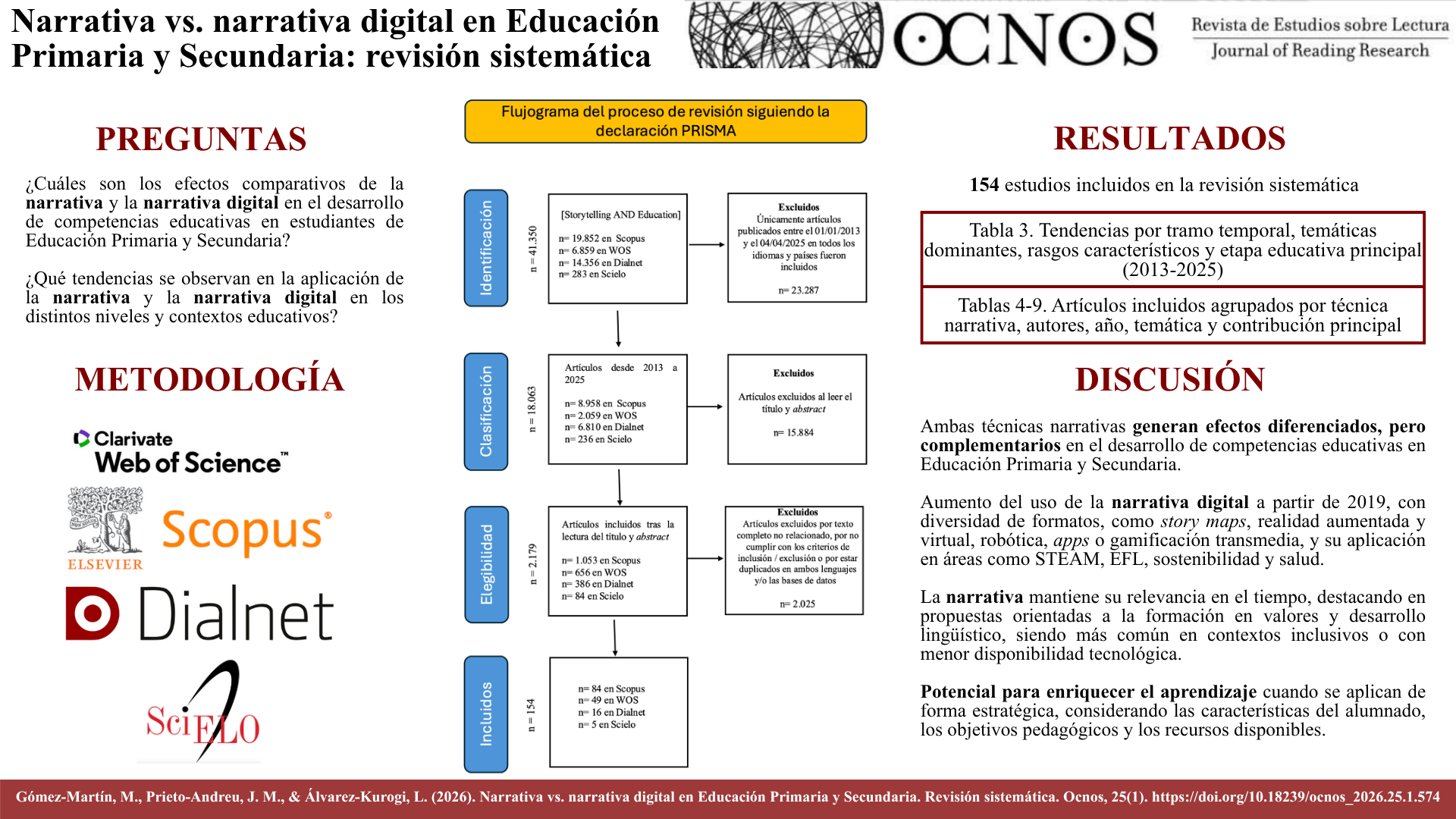
Initially, a total of 41,350 articles were identified, 19,852 from Scopus, 6,859 from WoS, 14,356 from Dialnet, and 283 from Scielo. Initially, a total of 41,350 articles were identified, 19,852 from Scopus, 6,859 from WoS, 14,356 from Dialnet, and 283 from Scielo. Consequently, 8,958 were selected in Scopus, 2,059 in WoS, 6,810 in Dialnet, and 236 in Scielo. To refine the results, specific filters were applied: in Scopus, the results were filtered within the “Social Sciences category; in WoS, articles were limited to the category “Web of Science Core Collection and KCI-Korean Journal Database”; in Dialnet, no filters were applied; and Scielo was analysed through WoS, applying the “Scielo Citation Index” filter.
Therefore, the classification phase began with a total of 18,063 articles, discarding 15,884 (Scopus 7,905, WoS 1,403, Dialnet 6,424, and Scielo 152) based on the reading of titles and abstracts. 2,179 articles were selected: 1,053 articles in Scopus; 656 in WOS; 386 in Dialnet; and 84 in Scielo. During the eligibility phase, 2,025 articles were excluded for not meeting the inclusion and exclusion criteria, for presenting a full text unrelated to the subject of the study, and due to duplication between languages and databases. Finally, a total of 154 articles were selected for the SR (84 in Scopus, 49 in WOS, 16 in Dialnet, and 5 in Scielo). A flow chart was also used to guide the article selection process (Figure 1).

The references for the articles included in the systematic review, with detailed information on their topics and main contributions, are available in the Zenodo repository at https://doi.org/10.5281/zenodo.17591201.
Results
Classification and distribution of selected items
The studies selected for this SR are organised according to storytelling technique and educational stage, with a predominance of research on STs in primary education, followed by STs in primary education and STs in secondary education. The studies selected for this SR are organised according to storytelling technique and educational stage, with a predominance of research on STs in primary education, followed by ST in primary education and ST in secondary education.
As for the educational stage, primary education accounts for the largest proportion with 97 articles (43 ST, 53 DST and 1 ST/DST), followed by 50 articles on secondary education (22 ST, 27 DST and 1 ST/DST) and 7 articles addressing both primary and secondary education (2 ST and 5 DST), representing 62.98% for primary education, 32.46% for secondary education and 4.54% for both stages combined.
Themes, trends and current affairs
The 154 studies identified show a clear evolution in the subject matter and use of ST and DST. Table 2 organises the findings by annual periods, from the oldest to the most recent:
Overall, the number of publications is growing steadily—especially since 2019—and the focus is shifting from literacy and motivation to the integration of emerging technologies (augmented and virtual reality, robotics, apps, and narrative video games) and higher-level skills (computational thinking, executive functions, metacognition, and social engagement).
Main contributions of ST and DST
Of the 154 articles included in the RS, 67 analyse ST and demonstrate its effectiveness in: promoting values and attitudes towards science; improving literacy in indigenous children; increasing interest in horticulture; stimulating narrative and graphic creativity; enhancing understanding and retention of concepts; developing thinking skills, metacognition and self-esteem; promoting interaction and imagination in children with multiple disabilities; demonstrating improvements in foreign language learning (EFL); acquiring mathematical content; reducing anxiety; and developing socio-emotional and storytelling writing skills.
On the other hand, 85 articles address DST, highlighting its positive impact on knowledge and vocabulary acquisition, oral expression, listening and reading comprehension, social and creative skills, English literacy, self-regulation, knowledge of healthy habits, science concepts, creative thinking and motivation in EFL contexts, in addition to findings on computational thinking, mathematical comprehension, historical and geographical literacy, creative writing, executive functions, inclusion of students with Special Educational Needs (SEN), motivation in immersive virtual reality environments, and narrative video games.
Finally, two articles explore both ST and DST: in Primary Education, a significant improvement in the perception of narrative self-efficacy is observed through multimodal storytelling workshops, which incorporate gestural theatre, drawing, oral and digital storytelling; and in Secondary Education, its application in STEM environments and in distance learning promotes greater attraction and motivation on the part of students. Tables 3 to 9 summarise the main contributions of ST and DST in primary and secondary education, highlighting the topics and techniques for each educational stage.
Source: Prepared by the authors
Source: Prepared by the authors
Source: Prepared by the authors
Source: Prepared by the authors
Source: Prepared by the authors
Source: Prepared by the authors
Source: Prepared by the authors
Discussion
The results of this SR show a greater presence of DST in both Primary and Secondary Education, although with different applications depending on the educational level. In primary education, DST is mainly linked to the development of skills such as reading, writing and oral communication, as well as motivation, creativity, digital literacy and language development, even in students with SEN. In Secondary Education, however, its application is linked to the development of critical thinking, motivation and active participation among students, as well as improvements in academic performance and comprehension of more complex content, such as economic, mathematical or biological concepts. Nevertheless, in both educational stages, these experiences are developed through the use of technological resources, such as video games, augmented and virtual reality, robotics, educational applications, and interactive and immersive narratives. This trend is in line with the findings of , who highlight the value of interactive approaches in the classroom, but this contrasts with the views of , which highlight the usefulness of traditional storytelling in contexts with limited technological resources, or with a focus on socio-emotional learning. In this regard, the results of this SR show that ST is also effective in linguistic development and the development of cognitive and social skills. Therefore, it is suggested that both techniques can be implemented in a complementary or independent manner, adapting to the conditions of the educational environment to maximise their impacts.
On the other hand, a constant trend in the use of ST over time has been identified, while DST shows a significant increase in its recent application, probably due to its link with advanced technologies, such as augmented reality and robotics (; ). This differentiated evolution reflects the innovative approach of DST compared to ST, which remains relevant by focusing on the development of linguistic and socio-emotional skills (). Consequently, although DST predominates in technological innovation, it is worth highlighting the aforementioned importance of ST in contexts with limited resources (; ), demonstrating how both techniques address different but complementary educational needs.
Finally, both techniques share the goal of developing cognitive, linguistic, and social skills, although the technological use of DST favours the development of computational thinking (), improving digital skills (), as well as being efficient in immersive environments, teaching complex concepts (; ) and languages () and increasing motivation (). ST already emphasises more human content, such as social-emotional skills in inclusive contexts (), storytelling (), cultural literacy (; ), multicultural understanding (), and inclusion (; ).
Together, complementary application of both techniques - adapted to the educational context - would maximise their impact and strike a balance between technological innovation and tradition.
Limitations
This SR included studies published in open and restricted access, in different languages and from various geographical contexts, favouring a broad and representative view of the use of traditional and digital storytelling in formal education. However, the analysis focused on primary and secondary education, excluding applied research in early childhood education and higher education, where relevant experiences may also be developed. Furthermore, studies with a qualitative approach, which could add a more contextualised understanding of educational processes, were not included, nor were doctoral theses, books, technical reports or conference papers taken into account, limiting the inclusion of innovative proposals not yet disseminated through formal academic channels.
Projection
Further research on the use and impact of technological resources and teacher training in the implementation of ST and DST would be desirable. This knowledge will contribute to optimising these narrative techniques in order to improve the educational process.
Conclusions
Based on the theoretical framework, results obtained, and corresponding discussion, this SR shows that ST and DST have differentiated but complementary impacts on the development of educational competencies in Primary and Secondary Education. In response to the first research question - what are the comparative effects of ST and DST on the development of educational skills in Primary and Secondary Education students? -, it has been found that DST is particularly effective in developing digital skills, computational thinking, oral expression, language learning and complex concepts, thanks to its integration with interactive technologies and immersive environments. ST has a greater impact on socio-emotional skills, narrative creativity, empathy, and cultural literacy.
Regarding the second question - what trends can be observed in the application of ST and DST at different educational levels and in different contexts? -, there has been an upward trend in the use of DST since 2019, with an increasing diversity of formats, such as story maps, augmented and virtual reality, robotics, apps, and transmedia gamification, and its application in areas such as STEAM, sustainability, and health. ST, meanwhile, remains constant over time, standing out in proposals aimed at values education and language development, and is more common in inclusive contexts or those with less technological availability. However, although the results of the RS show that both techniques are mainly implemented in Primary Education, DST is also beginning to take on greater prominence in Secondary Education, especially in interdisciplinary projects linked to complex and global issues.
Overall, this study fulfils its stated objective by identifying and comparing the application and effectiveness of ST and DST at different levels and in different international educational contexts. The findings highlight the complementary nature of both techniques and their potential to enrich learning when applied strategically, taking into account the characteristics of the students, the educational objectives and the available resources.
Authors’ contribution
Mario Gómez Martín: Project Management; Formal Analysis; Conceptualization; Data Curation; Writing - Original Draft; Writing - Revision and Editing; Research; Methodology; Resources; Software; Supervision; Validation; Visualization; Aacquisition of funds.
Joel-Manuel Prieto-Andreu: Conceptualization; Writing - Revision and Editing; Methodology; Resources; Supervision; Validation; Acquisition of funds.
Leandro Álvarez-Kurogi: Conceptualization; Writing - Revision and Editing; Methodology; Resources; Supervision; Validation; acquisition of funds.
References
1
Almufarreh, A., & Arshad, M. (2023). Promising emerging technologies for teaching and learning: Recent developments and future challenges. Sustainability, 15(8), 6917. https://doi.org/10.3390/su15086917
4
Bruner, J. (1991). The narrative construction of reality. Critical Inquiry, 18(1), 1-21. https://doi.org/10.1086/448619
6
Chubko, N., Morris, J. E., McKinnon, D. H., Slater, E. V., & Lummis, G. W. (2019). Engaging adolescent Kyrgyzstani EFL students in digital storytelling projects about astronomy. Issues in Educational Research, 29(4), 1107-1130. https://ro.ecu.edu.au/ecuworkspost2013/7170/
7
Clark, M. C., & Rossiter, M. (2008). Narrative learning in adulthood. New Directions for Adult and Continuing Education, 119, 61-70. https://doi.org/10.1002/ace.306
8
De-Jager, A., Fogarty, A., Tewson, A., Lenette, C., & Boydell, K. M. (2017). Digital storytelling in research: A systematic review. The Qualitative Report, 22(10), 2548-2582. https://doi.org/10.46743/2160-3715/2017.2970
9
Del-Moral-Pérez, M. E., Villalustre-Martínez, L., & Neira-Piñeiro, M. R. (2017). Competencias comunicativas y digitales impulsadas en escuelas rurales elaborando digital storytelling. Aula Abierta, 45(1), 15–24. https://doi.org/10.17811/rifie.45.1.2017.15-24
10
11
Faraniza, Z. (2021). Blended learning best practice to answers 21st century demands. Journal of Physics: Conference Series, 1940(1), 012122. https://doi.org/10.1088/1742-6596/1940/1/012122
13
14
15
16
Hurtado-Mazeyra, A., Alejandro-Oviedo, O. M., Núñez-Pacheco, R., & Cabero-Almenara, J. (2023). El Digital Storytelling en la modalidad 2D y con realidad aumentada para el desarrollo de la creatividad en la educación infantil. Revista de Educación a Distancia (RED), 23(73). https://doi.org/10.6018/red.536641
17
Isbell, R., Sobol, J., Lindauer, L., & Lowrance, A. (2004). The effects of storytelling and story reading on the oral language complexity and story comprehension of young children. Early Childhood Education Journal, 32(3), 157-163. https://doi.org/10.1023/b:ecej.0000048967.94189.a3
18
İspir, B., & Yıldız, A. (2023). An overview of digital storytelling studies in classroom education in Turkey. Eğitimde Nitel Araştırmalar Dergisi, 23(35). https://doi.org/10.14689/enad.35.1714
19
20
21
Law, Y. K., Lam, S. F., Law, W., & Tam, Z. W. (2017). Enhancing peer acceptance of children with learning difficulties: classroom goal orientation and effects of a storytelling programme with drama techniques. Educational Psychology, 37(5), 537-549. https://doi.org/10.1080/01443410.2016.1214685
22
23
Mendoza-Hidrovo, M. E., & Hermann-Acosta, A. (2023). Storytelling una herramienta digital en el ámbito educativo: revisión sistemática en el contexto suramericano. Polo del Conocimiento. https://polodelconocimiento.com/ojs/index.php/es/article/view/5317/13021
24
Miller, C. H. (2014). Digital storytelling: A creator's guide to interactive entertainment. CRC Press. https://doi.org/10.4324/9780203425923
25
Molan, S., Weber, D., & Kor, M. (2022). Shaping children’s knowledge and response to bushfire through use of an immersive virtual learning environment. Journal of Educational Computing Research, 60(6), 1399-1435. https://doi.org/10.1177/07356331211054569
26
Montanero-Fernández, M. (2019). Métodos pedagógicos emergentes para un nuevo siglo ¿Qué hay realmente de innovación? Teoría de la Educación. Revista Interuniversitaria, 31(1), 5-34. https://doi.org/10.14201/teri.19758
27
Nair, V., & Yunus, M. M. (2021). A systematic review of digital storytelling in improving speaking skills. Sustainability, 13(17), 9829. https://doi.org/10.3390/su13179829
28
Nair, V., & Yunus, M. M. (2022). Using digital storytelling to improve pupils' speaking skills in the age of COVID 19. Sustainability, 14(15), 9215. https://doi.org/10.3390/su14159215
29
30
Page, M. J., McKenzie, J. E., Bossuyt, P. M., Boutron, I., Hoffmann, T., Mulrow, C. D., Shamseer, L., Tetzlaff, J., Akl, E. A., Brennan, S., Chou, R., Glanville, J., Grimshaw, J., Hróbjartsson, A., Lalu, M. M., Li, T., Loder, E., Mayo-Wilson, E., McDonald, S., & Moher, D. (2021). The PRISMA 2020 statement: an updated guideline for reporting systematic reviews. The BMJ, n71. https://doi.org/10.1136/bmj.n71
31
Parsazadeh, N., Cheng, P. Y., Wu, T. T., & Huang, Y. M. (2021). Integrating computational thinking concept into digital storytelling to improve learners’ motivation and performance. Journal of Educational Computing Research, 59(3), 470-495. https://doi.org/10.1177/0735633120967315
32
Pérez-García, Á. P., & Sacaluga-Rodríguez, I. (2023). El storytelling como recurso didáctico-comunicativo para fomentar la lectura. Texto Livre: Linguagem e Tecnologia, 16. https://doi.org/10.1590/1983-3652.2023.40452
33
Rajendran, V., & Yunus, M. M. (2021). Interactive Learning via Digital Storytelling in Teaching and Learning. International Journal of Education and Literacy Studies, 9(3), 78. https://doi.org/10.7575/aiac.ijels.v.9n.3p.78
34
Ramalingam, K., & Jiar, Y. K. (2023). The impact of KaniMani storytelling mobile application (KM-SMA) on Tamil students’ speaking skills and motivation in learning Tamil. International Journal of Learning, Teaching and Educational Research, 22(1), 129-142. https://doi.org/10.26803/ijlter.22.1.8
35
Robin, B. R. (2008). Digital storytelling: A powerful technology tool for the 21st Century classroom. Theory Into Practice, 47(3), 220-228. https://doi.org/10.1080/00405840802153916
36
38
Sarasqueta, G. (2021). Técnicas de la comunicación política ante la era de la infoxicación y la interrupción: del storytelling al storydoing. Comunicación y Hombre, 17, 73-84. https://doi.org/10.32466/eufv-cyh.2021.17.648.73-84
39
Sarıca, H. Ç., & Usluel, Y. K. (2016). The effect of digital storytelling on visual memory and writing skills. Computers & Education, 94, 298-309. https://doi.org/10.1016/j.compedu.2015.11.016
40
Schroeder, M., Tourigny, E., Bird, S., Ottmann, J., Jeary, J., Mark, D., Kootenay, C., Graham, S., & McKeough, A. (2022). Supporting Indigenous children’s oral storytelling using a culturally referenced, developmentally based program. The Australian Journal of Indigenous Education, 51(2). https://doi.org/10.55146/ajie.v51i2.50
41
Smeda, N., Dakich, E., & Sharda, N. (2014). The effectiveness of digital storytelling in the classrooms: a comprehensive study. Smart Learning Environments, 1, 1-21. https://doi.org/10.1109/ICALT.2013.157
42
Villaustre-Martínez, L., & Del-Moral-Pérez, M. E. (2014). Digital storytelling: a new strategy for storytelling and skills acquisition by future teachers. Complutense Journal of Education, 25(1). https://doi.org/10.5209/rev_rced.2014.v25.n1.41237
43
Yangin-Ersanli, C. (2023). The effect of using augmented reality with storytelling on young learners' vocabulary learning and retention. Novitas-ROYAL (Research on Youth and Language), 17(1), 62-72. https://novitasroyal.org/download/the-effect-of-using-augmented-reality-with-storytelling-on-young-learners-vocabulary-learning-and-retention/
44
Zabelina, D. L., & Robinson, M. D. (2010). Creativity as flexible cognitive control. Psychology of Aesthetics, Creativity, and the Arts, 4(3), 136-143. https://doi.org/10.1037/a0017379