The direct and inferential mediation model (DIME) proposes that reading comprehension is the result of interactions between prior knowledge, word reading, vocabulary, comprehension strategies, and inference skill. In this study, its relevance was tested through structural equation modelling in a sample of 241 5th and 6th graders in primary education schools in Spain. The model showed an adequate relevance explaining 60.5% of the variance in reading comprehension of expository texts using general domain tests to measure the predictor components. Prior knowledge was the component with the greatest total effect on reading comprehension, followed by vocabulary, inference skill, and comprehension strategies. The total effect of word reading was not significant. The direct and indirect effects on reading comprehension of prior knowledge, vocabulary, and comprehension strategies were significant. The direct effects from prior knowledge to comprehension strategies and from vocabulary to comprehension strategies were not significant. The results found have important implications in the design of intervention programmes to improve reading comprehension.
Downloads
Download data is not yet available.
Article Details
How to Cite
Martínez-Cubelos, J., & Ripoll-Salceda, J.-C. (2026). Testing the direct and inferential mediation model of reading comprehension in Spanish students. Ocnos. Journal of reading research, 25(1). https://doi.org/10.18239/ocnos_2026.25.1.547
Martínez-Cubelos and Ripoll-Salceda: Testing the direct and inferential mediation model of reading comprehension in Spanish
students
Introduction
Reading comprehension is a highly complex cognitive activity that involves constructing
a coherent mental representation of the information contained in texts (). Its development is one of the most important tasks throughout schooling, as it
is essential for accessing knowledge across different curricular areas. However, in
educational practice it is not easy to design effective programmes to enhance it.
Considering scientific evidence is a necessary first step, but most teachers may see
this challenging for two reasons: on the one hand, they have not been trained to critically
analyse published studies, and on the other, the sheer amount of information to be
reviewed is overwhelming. One way to address this problem, at least partially, is
to take into account component-based models of reading comprehension. These models
synthesise research findings and describe the skills and knowledge that should be
targeted to improve reading comprehension, as well as those that are important to
assess when difficulties are found. A model that has had considerable effect due to
the simplicity of its formulation and its closeness to teaching practice is the simple
view of reading (SVR).
The SVR () proposes that reading comprehension results from the interaction between two components:
decoding and general language comprehension. The DIME model, although grounded in
the SVR, is more complex, since in addition to decoding —referred to as word reading—and
general language comprehension—represented by vocabulary— it incorporates other components:
prior knowledge, inference skill, and comprehension strategies (). In the educational field, having a model that integrates more variables and their
interrelationships is of great interest, as it could contribute to the development
of more precise intervention programmes.
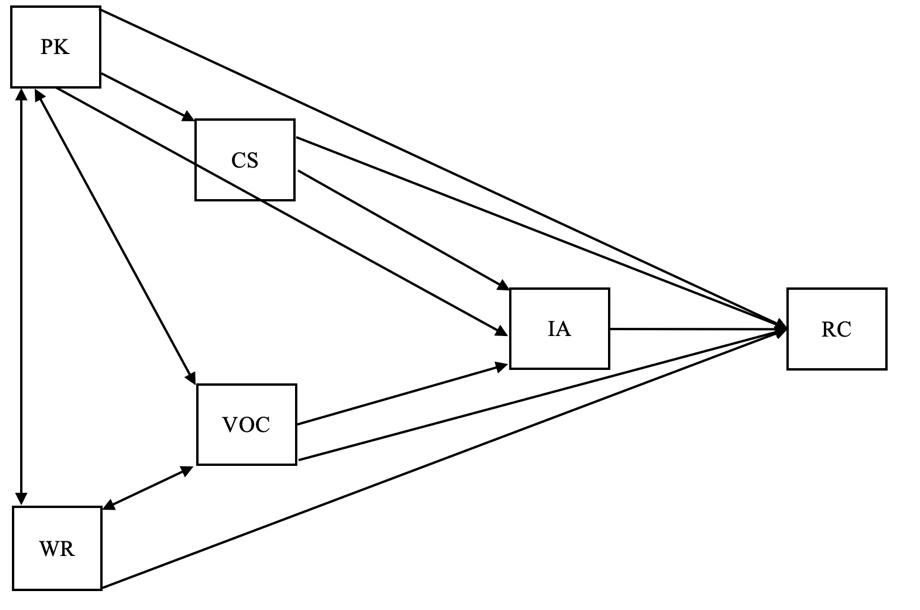
The DIME model () is defined as “direct” because all of its components have a direct effect on reading
comprehension, and as “inferential mediation” as most of them —with the exception
of word reading— also have a direct effect through inference skill. The model assumes
that prior knowledge has a direct effect on reading comprehension when dealing with
literal information, but also an indirect effect when the text requires the construction
of inferences. Vocabulary has a direct effect on reading comprehension, since not
knowing the meaning of a word hinders literal comprehension, but it also has an indirect
effect, as not knowing a synonym of a word prevents establishing an inferential relationship
between that word and its referent. Comprehension strategies exert both direct and
indirect effects on reading comprehension, since carrying out a summary, for instance,
can help construct inferences that lead to better understanding.
The first formulation of the DIME model was proposed by . In the procedure for its construction, a literature review was conducted that included
studies involving English-speaking 4th graders onwards. To establish unidirectional paths, or direct effects, they proposed
the criterion that at least one experimental or quasi-experimental study should demonstrate
that an intervention focused on one component of the model had an effect on another.
In cases where it was not possible to establish a unidirectional path based on this
criterion, studies were sought to support a bidirectional or correlational path. The
authors tested the fit of four variations of the model, justified by unidirectional
paths for which the evidence was weak or contradictory. Figure 1 shows the model that best fits the data from 177 English-speaking 9th graders.
Figure 1Best-fitting model in
The DIME model has been tested in Spanish following a procedure similar to that used
by . However, evidence has only been found for the unidirectional paths from comprehension
strategies, inference skill, and vocabulary to reading comprehension, as well as from
prior knowledge and comprehension strategies to inference skill ().
examined the best-fitting version proposed in Cromley and , comparing it with a modified version that included a new unidirectional path from
vocabulary to comprehension strategies. The modified version proved to be the best
fit for the data from 737 English-speaking university students. Similar results have
been found in three other studies: two in English and one in German , ; ).
In general, findings from previous research show that the DIME model is useful to
explain reading comprehension of both narrative and expository texts, despite the
significant differences between their characteristics. Expository texts are more difficult
to understand and are less well remembered, as they include specialised vocabulary
and subject matter (). Results also show that the most important predictor components are prior knowledge
and vocabulary. However, it should be noted that in the study by , the strongest predictor was word reading, probably because the participants showed
decoding difficulties.
Despite progress in the study of this model, its applicability to Spanish-speaking
students has not yet been analysed. Adopting a model whose evidence is based on another
language may be risky, as results may be conditioned by the characteristics of the
orthographic system. In irregular systems, such as the English system, word reading
shows a stronger relationship with reading comprehension, since readers require more
time than in transparent systems, such as the Spanish system, to achieve high levels
of reading accuracy (; ).
In this study, the fit of the DIME model was tested with 5th- and 6th Spanish graders. The a priori model considered was the one that showed the best fit
in . Participants were selected from these grades because, as shown in the validation
of other models such as the SVR, in the early years of primary education word reading
is the variable that contributes most to reading comprehension, whereas in higher
grades it is general language comprehension that makes the greatest contribution (; ; ). Since the DIME model is more complex than the SVR, testing it in higher grades
allows for a more specific understanding of which variables, and to what extent, contribute
to reading comprehension beyond general language comprehension.
To examine whether students’ general linguistic abilities are sufficient to understand
typical texts from the area of Social and Natural Sciences, a test of reading comprehension
using expository texts was employed. Furthermore, the predictor components were assessed
with general-domain measures, as they were not related to the content of the texts
used to evaluate reading comprehension. The applicability of the DIME model to explain
the comprehension of expository texts, as found in previous studies, may be conditioned
by the specificity of the measures employed. In , all predictor components were assessed with domain-specific measures, as they were
related to the content of the comprehension test text, and in prior knowledge was evaluated with a domain-specific test. In research not based
on the DIME model, it has been found that when domain-specific knowledge is considered,
the strength of the relationship with reading comprehension is greater than when domain-general
knowledge is assessed (; ). Moreover, the teaching of domain-specific vocabulary has a direct effect on reading
comprehension (), whereas it is irrelevant when the vocabulary is domain-general ().
The following objectives were established to provide evidence on these issues:
– To examine whether the DIME model can be applied to explain the reading comprehension
of expository texts in Spanish 5th- and 6th graders.
−To determine the effects of the predictor components of the DIME model on reading
comprehension in Spanish 5th- and 6th graders.
Method
Participants
The sample consisted of 122 girls and 119 boys from 5th (n = 135; M age = 10.40 years; SD = 0.52) and 6th grade of primary education (n = 106; M age = 11.43 years; SD = 0.54). The sample was drawn from four public schools in the autonomous community
of La Rioja (Spain) using a convenience sampling technique: two urban schools and
two rural cluster schools. Data from 11 participants were excluded because they did
not have the basic skills required to complete the written assessment tests without
adaptations.
Measurements
− Collective Reading Efficiency Test (TECLE, as per its Spanish acronym) (). The test consists of 64 items, each formed by a sentence missing its last word.
The participant must choose from four options the word that best completes the sentence.
The time limit to complete as many items as possible was 5 minutes. One point was
awarded for each correct item, with scores ranging from 0 to 64. To reduce the effect
of chance guessing, the final score was estimated as the number of correct responses
minus the number of errors divided by three (). In the manual of the Uruguayan version, reliability measured with the test-retest
method is reported as .88, and convergent validity, using a reading fluency test as
the criterion variable, as .80 (). In this study, reliability was .95 measured with Cronbach’s alpha (α), .96 with
McDonald’s Omega (ω), .97 with the Composite Reliability index (CR), and .41 with
the Average Variance Extracted (AVE). Although the AVE was below .50, reliability
can be assumed to be adequate, since it has been suggested that a CR value above .70
is sufficient. AVE is considered a very strict indicator and tends to reject models
with low factor loadings ().
− General Knowledge Test (). This test consists of 132 items in the form of short-answer open questions. Because
it was validated with university students and items are organised in increasing order
of difficulty, an abbreviated version with the first 41 items was used. One point
was awarded for each correct response, with scores ranging from 0 to 41. In a pilot
study with Spanish 6th graders, reliability measured with α was .82 (n = 56). Convergent validity, using grades in Natural Science and Social Science as
criterion variables, was .48 and .29, respectively (n = 27). In this study, reliability was assumed to be adequate: α = .86, ω = .86, CR
= .90, and AVE = .20.
− Vocabulary subtest of the Analytical Assessment Battery of Written Language (PEALE,
as per its Spanish acronym) (). This test includes 42 items, each consisting of a target word and three options.
The participant must select the word whose meaning is the most similar to the target
word. One point was awarded for each correct response, with scores ranging from 0
to 42. In order to reduce the effect of chance guessing, the final score was estimated
as the number of correct responses minus the number of errors divided by two (). This test has been used in different studies, with reliability reported between
.90 and .97 with α and between .90 and .99 with the split-half method (; ). In this study, reliability was assumed to be adequate: α = .75, ω = .86, CR = .87,
and AVE = .17.
− Reading Awareness Scale (ESCOLA, as per its Spanish acronym) (). This is a self-report test in multiple-choice format with three options designed
to assess comprehension strategies. It provides information about “how readers perceive
themselves” and “how they believe they would act” in given situations. In this research,
the abbreviated version 28B was administered, as the manual advises against using
the full version with participants aged 10 or younger. Scores ranged from 0 to 56.
The manual report’s reliability of .81 (α) and convergent validity of .72 using a
metacognition test as the criterion. In this study, reliability was considered poor:
α = .56, ω = .56, CR = .67, and AVE = .10.
− Oral Inference Test. Since no reference or widely used test exists to assess inference
skill in Spanish, this test was designed by the second author of this study. The full
version comprises 38 items, each with a short statement followed by an open short-answer
question. The first eight items require constructing inferences to establish reference-referent
relationships, the next 11 items to identify implicit cause-effect relationships,
the following 13 items to make predictions about events in the text, and the last
six items to answer questions whose responses are not explicitly stated. One point
was awarded for each correct answer, with scores ranging from 0 to 38. In a pilot
study with 71 Peruvian 5th- and 6th graders, reliability was of .74 (α). In this study, reliability was considered poor:
α = .62, ω = .63, CR = .70, and AVE = .10. Convergent validity was .46 using as the
criterion variable the inferential questions of the reading comprehension subtest
from the Reading Process Assessment Battery (PROLEC-SE, as per its Spanish acronym)
().
− PROLEC-SE (). This test includes two expository texts, each followed by five literal and five
inferential questions. One point was awarded for each correct response, with scores
ranging from 0 to 20. The manual report’s reliability of .85 (α) and convergent validity
of .23 using teacher ratings of students’ reading ability as the criterion variable.
In this study, reliability was assumed to be adequate: α = .76, ω = .77, CR = .80,
and AVE = .18.
Procedure
Data were collected between March and May 2019, with prior authorisation from the
Department of Education of La Rioja (Spain), the Research Ethics Committee of the
University of Navarra (Spain), and the students’ families. The assessment instruments
were administered in groups by the principal investigator of this study in two sessions
of approximately 60 minutes each.
Data analysis
Before testing the model fit, the database was inspected to identify and manage outliers.
In addition, it was verified that the data met the assumptions required for path analysis.
Univariate outliers were identified using the median absolute deviation, and multivariate
outliers with the minimum covariance determinant (). The assumption of univariate normality was checked by examining skewness and kurtosis
coefficients; multivariate normality through Mardia’s kurtosis coefficient; homoscedasticity
with the Breusch-Pagan and White statistical tests; absence of multicollinearity through
the variance inflation factor (VIF); and linearity through a scatterplot of residuals
and standardised predicted values of the dependent variable.
Once the database assumptions were verified, a path analysis was conducted to test
whether the DIME model can be applied to explain the reading comprehension of expository
texts in Spanish-speaking 5th- and 6th graders. A structural equation model with observed variables was tested. Statistical
analyses were conducted using SPSS Amos (version 23) software. The maximum likelihood
method was employed, as it is the most commonly used when data are continuous and
follow a multivariate normal distribution. To evaluate model fit, the chi-square/degrees
of freedom ratio (/df), the root mean square error of approximation (RMSEA), the standardised root mean
square residual (SRMR), the comparative fit index (CFI), and the Tucker-Lewis index
(TLI) were considered. The model was regarded as a plausible approximation to the
data when /df < 3, RMSEA ≤ .08, SRMR ≤ .08, CFI ≥ .90, and TLI ≥ .90 ().
In order to determine the effects of the predictor components on comprehension, the
values of bidirectional paths were calculated as correlations (r), and the values of unidirectional paths, or direct effects, as standardised regression
coefficients (β). This coefficient indicates the amount of change, in standard scores,
that occurs in the dependent variable for each unit change in the corresponding independent
variable, while holding the others constant (). Indirect effects on reading comprehension—those mediated by other components—as
well as total effects, defined as the sum of direct and indirect effects, were also
estimated as β. Since SPSS Amos does not calculate standard errors, confidence intervals,
or p-values linked to these parameters, statistical significance was determined using
the bootstrapping method, setting confidence intervals at 95% and the number of bootstrap
samples at 1499 ().
Results
Database inspection
In order to ensure that the potential presence of outliers was not due to errors in
the scoring of the assessment tests, the reliability of this procedure was evaluated
using data from inference skill and reading comprehension, as their scoring requires
interpretation of responses. Inter-rater agreement was estimated through the intraclass
correlation coefficient, yielding excellent values (.98 and .97). In addition, the
database was reviewed to identify errors in data entry, and descriptive statistics
were examined to detect out-of-range scores in the assessment test scales. Table 1 shows that, in all cases, the minimum and maximum scores obtained were within the
expected ranges.
Table 1Descriptive statistics
Min. score
Max. score
M
SD
Word reading
17
64
45.01
11.58
Prior knowledge
1
32
14.29
6.32
Vocabulary
9
39
29.15
5.93
Comprehension strategies
20
53
40.96
5.20
Inference skill
13
27
21.47
2.74
Reading comprehension
0
17
7.63
3.89
Nota M = mean; SD = standard deviation.
Fifteen univariate outliers were identified and recoded to the accepted minimum and
maximum scores, and six multivariate outliers were retained in the dataset, as it
was confirmed through a multi-group invariance analysis that they were not problematic
(). Skewness and kurtosis coefficients ranged from −0.83 to 0.23, Mardia’s kurtosis
coefficient was −2.5613, the p-values linked to the Breusch-Pagan and White tests
were .11 and .41, respectively, and the VIF values ranged from 1.068 to 1.945. Therefore,
the data met the assumptions of univariate normality, multivariate normality, homoscedasticity,
and absence of multicollinearity. The assumption of linearity was also satisfied,
as the residuals were randomly scattered around the horizontal line of the standardised
predicted values of the dependent variable.
Applicability of the DIME model to Spanish
The findings suggest that the DIME model can be applied to explain the reading comprehension
of expository texts in Spanish 5th- and 6th graders, as the fit indices met the commonly proposed cut-off criteria for model
acceptance: /df = 2.6, RMSEA = .08, SRMR = .03, CFI = .90, and TLI = .95. The model accounted for
60.5% of the variance in reading comprehension.
Effects on reading comprehension
The direct effects (β), linked to the unidirectional paths, on reading comprehension
were significant, except for that corresponding to word reading, with values ranging
from small (≥ .02 and < .15) to large (≥ .35). The indirect effects (β) were all significant,
with small values (≥ .02 and < .15). The total effects (β) were also all significant,
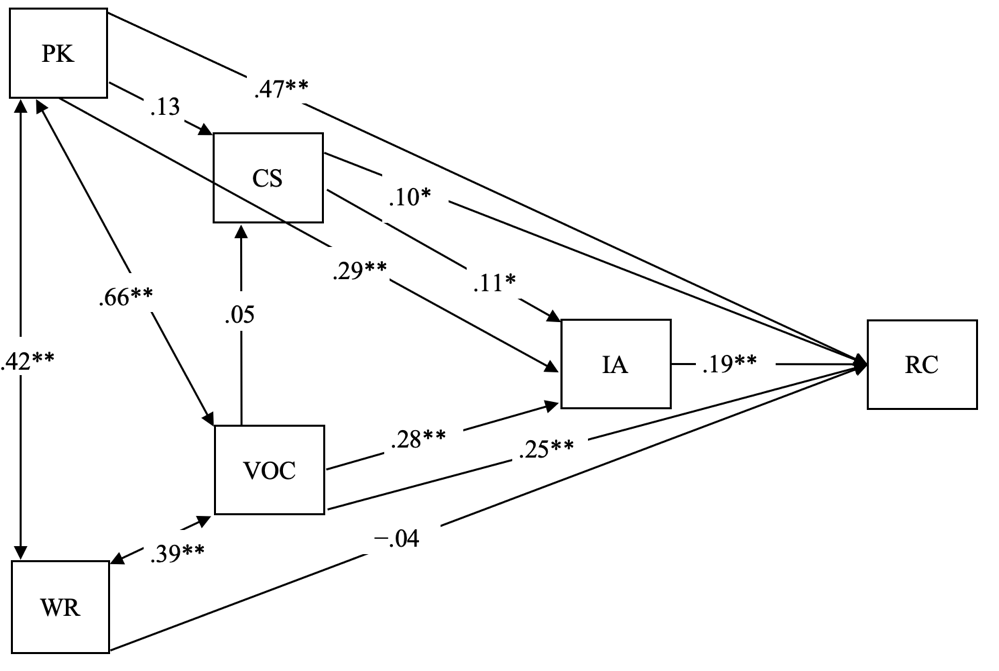
with values ranging from small (≥ .02 and < .15) to large (≥ .35) (). Table 2 provides a detailed account of the direct, indirect, and total effects. The path
diagram in figure 2 displays the values of the bidirectional paths (r) and the unidirectional paths (β).
Table 2Standardised effects on reading comprehension
The fit of the DIME model was adequate, showing that the general linguistic skills
of 5th- and 6th graders are sufficient to understand typical texts from the area of Social and Natural
Sciences. The model explained 60.5% of the variance in reading comprehension, a result
higher than that found by with path analysis (between 36% and 58%) and in in 3rd grade (57%). However, it was slightly lower than that reported by with the best-fitting version of their model (65.7%) and by in 4th grade (61%). In the modification by (92.8%) and in in 5th grade (100%), the explained variance was substantially higher. Comparisons with the
study by are not possible, since no information on the percentage explained by the model is
provided. These findings suggest that when domain-specific linguistic skills are considered,
the strength of the relationship with reading comprehension is greater than when general-domain
skills are assessed. In , the model explained 92.8% of the variance using only domain-specific measures, whereas
in the present study it accounted for 60.5% using general-domain measures.
On the other hand, the most important total effect on reading comprehension was linked
to prior knowledge. Furthermore, both its direct effect and its indirect effect, mediated
by inference skill, were significant. These findings suggest that prior knowledge
contributes directly to reading comprehension when the text does not require going
beyond explicit information, and indirectly when inference construction is needed.
A possible reason for the importance of having knowledge about the topic of the text
when inferences are not required is that it allows the reader to focus attention on
key ideas; in cases where inferences are necessary, it facilitates the integration
of information by establishing links between seemingly disconnected parts of the text.
It should be noted that in this study the direct effect of prior knowledge on comprehension
strategies was not significant.
The findings by were similar, since the most important total effect on reading comprehension was
also linked to prior knowledge. did not provide information on total effects; however, as in the present study, the
direct effect of prior knowledge on reading comprehension was the most relevant. The
results also partially align with those of . In that study, prior knowledge was the second most important predictor after vocabulary.
Nevertheless, in contrast to the non-significant result obtained in the present study,
in the three studies mentioned the direct effect of prior knowledge on comprehension
strategies was significant.
It is reasonable to assume that prior knowledge plays an important role in the implementation
of certain comprehension strategies. For example, detecting incoherent information
in a text requires some knowledge of the content addressed. A possible explanation
for the non-significant direct effect found in this study lies in the assessment instruments
used to measure comprehension strategies and prior knowledge, as they were not related.
This hypothesis is reinforced by the fact that the direct effects were significant
both in and , where related tasks were used. In both studies, readers had to apply comprehension
strategies to texts related to the knowledge test contents. However, this justification
does not hold when considering the findings of , as the direct effect was significant even with an unrelated measure.
In this study, vocabulary was the second strongest predictor of reading comprehension.
Both its direct effect and its indirect effect, mediated by inference skill, were
significant. These findings support the hypothesis that readers need to know the meaning
of words not only to understand literal information but also to give cohesion to the
text by constructing inferences in which semantic relationships are established between
references and referents. It should be noted that in this study the direct effect
of vocabulary on comprehension strategies was not significant.
These results are consistent with those found by , since the most important total effect on reading comprehension was also linked to
vocabulary. In , as in the present study, the most relevant direct effect on reading comprehension
was linked to vocabulary. The results partially match those reported by and , since in both cases vocabulary was the component with the greatest total effect.
As in this study, found that the direct effect of vocabulary on comprehension strategies was not significant
at any grade level, whereas in it was significant in only one grade. These results contrast with the significant
direct effects reported by and . To date, few studies, beyond those focusing on the DIME model, have sought to explain
why vocabulary is important for the use of certain comprehension strategies. However,
it can be assumed that knowing the meaning of the words in a text plays a decisive
role in producing a coherent summary of it. Similarly, knowing the meaning of the
words in a title is necessary in order to predict its content or activate prior knowledge.
A possible explanation for the non-significant direct effect of vocabulary on comprehension
strategies in the present study, as well as in and , may lie in the assessment instruments used, as they were unrelated. This interpretation
gains strength when considering that in the effect was significant using related instruments, since the vocabulary assessed
consisted of words that were part of the texts in which readers had to apply comprehension
strategies. However, this explanation does not hold in light of the findings of , as unrelated instruments were used and the direct effect was nonetheless significant.
In this study, the third most important total effect on reading comprehension was
linked to inference skill. It should be noted that this effect corresponds to the
direct effect, as this component does not have mediated effects. This result is consistent
with and , but not with , where, unexpectedly, the effect was not significant. This discrepancy could be explained
by the fact that this component was measured using a test of visual analogies.
Both in this study and in that by and , the fourth predictor with the greatest total effect on reading comprehension was
comprehension strategies. Moreover, both its direct effect and its indirect effect,
through inference skill, were significant. These findings support the idea that comprehension
strategies do not only facilitate literal understanding but also inferential comprehension.
It can be argued that producing summaries, graphic organisers or rereading a section
of the text when comprehension difficulties are detected allows readers to make inferences
that were overlooked during the first reading.
Word reading was the only predictor of reading comprehension with a non-significant
total effect. It should be noted that this effect corresponds to the direct effect,
as this component does not have mediated effects. This result replicates those found
by and, partially, by , since the effect was significant but the least important. However, these findings
are in contrast with those of , where word reading was the most important predictor in two of the three grades.
The probable reason is that the students in their study were in lower educational
levels than those considered in the other DIME model studies. There is ample evidence
that in the early years of primary school the effect of word reading on comprehension
is greater compared with other components such as inference skill, vocabulary, comprehension
strategies, or general language comprehension, whereas the opposite occurs in later
grades (; ; ; ). Another possible explanation for these findings is that participants in had low levels of accuracy and reading speed, which makes the relationship with reading
comprehension stronger than in more proficient readers.
Limitations of the study
The findings should be interpreted with caution due to potential methodological limitations.
The five predictor components may be capturing part of the variance of other variables
that have been identified as important in research, such as morphological awareness,
motivation, attention, working memory, or graph-phonological-semantic cognitive flexibility.
The reliability estimated for the Oral Inference Test and for ESCOLA was poor. Moreover,
the use of self-report measures has been questioned, as readers’ perceptions of what
they do not always match their actual behaviour (). The TECLE was used to assess word reading, since it can be administered in groups,
thus requiring less time for data collection. Nevertheless, it should be borne in
mind that this test includes a substantial component of reading comprehension, as
selecting the correct response requires understanding the sentence.
Recommendations for future research
In future studies on the DIME model in Spanish, it is recommended that students from
different educational levels beyond those considered in this study be included, as
this would allow for a more complete understanding of the model’s fit across ages.
Performance-based tasks or think-aloud protocols should be used to address the limitations
linked to self-report measures. It would also be advisable to employ different measures
of word reading, since in Spanish high levels of accuracy are reached relatively quickly,
but reading speed continues to improve throughout primary education. Further research
should also examine whether differences arise when using narrative versus expository
texts, as these show different characteristics. Finally, the use of structural regression
analysis with multiple indicators for each component would be valuable in order to
reduce measurement error.
Practical implications
Although word reading is known to be important for reading comprehension, the findings
of this study suggest that in the later years of primary education it should not be
considered a priority objective. In contrast to pedagogical approaches that focus
on teaching skills for locating or processing information, pupils’ repertoire of knowledge
shows a strong relationship with reading comprehension, suggesting that the development
of a broad general knowledge base may be an effective way to foster text comprehension.
Authors contribution
Juan Martínez-Cubelos: Project administration; Formal analysis; Conceptualisation; Data curation; Writing
- original draft; Writing - review & editing; Investigation; Methodology; Resources;
Software; Supervision; Validation; Visualisation.
Afflerbach, P. (1990). The influence of prior knowledge on expert readers' main idea
construction strategies. Reading Research Quarterly, 25(1), 31-46. https://doi.org/10.2307/747986
2
Ahmed, Y., Francis, D. J., York, M., Fletcher, J. M., Barnes, M., & Kulesz, P. (2016).
Validation of the direct and inferential mediation (DIME) model of reading comprehension
in grades 7 through 12. Contemporary Educational Psychology, 44-45, 68-82. https://doi.org/10.1016/j.cedpsych.2016.02.002
3
Ahmed, Y., Miciak, J., Taylor, P., & Francis, D. J. (2022). Structure altering effects
of a multicomponent reading intervention: an application of the direct and inferential
mediation (DIME) model of reading comprehension in upper elementary grades. Journal of Learning Disabilities, 55(1), 58-78. https://doi.org/10.1177/0022219421995904
4
Baker, D. L., Crespo-Alberto, P., Monzalve-Macaya, M., García, I., & Gutiérrez‑Ortega,
M. (2022). Relation Between the essential components of reading and reading comprehension
in monolingual Spanish-speaking children: a meta-analysis. Educational Psychology Review, 34, 2661-2696. https://doi.org/10.1007/s10648-022-09694-1
5
Bowen, N. K., & Guo, S. (2011). Preparing for an SEM analysis. En N. K. Bowen, & S.
Guo (Eds.), Structural equation modeling (pocket guides to social work research methods) (pp. 52-72). Oxford University Press. https://doi.org/10.1093/acprof:oso/9780195367621.003.0003
6
Cervetti, G. N., Fitzgerald, M. S., Hiebert, E. H., & Hebert, M. (2023). Meta-analysis
examining the impact of vocabulary instruction on vocabulary knowledge and skill.
Reading Psychology, 44(6), 672-709. https://doi.org/10.1080/02702711.2023.2179146
Cromley, J. G., & Azevedo, R. (2006). Self-report of reading comprehension strategies:
what are we measuring? Metacognition and Learning, 1, 229-247. https://doi.org/10.1007/s11409-006-9002-5
9
Cromley, J., & Azevedo, R. (2007). Testing and refining the direct and inferential
mediation model of reading comprehension. Journal of Educational Psychology, 99(2), 311-325. https://doi.org/10.1037/0022-0663.99.2.311
10
Cromley, J. G., Snyder-Hogan, L., & Luciw-Dubas, U. A. (2010). Reading comprehension
of scientific text: a domain-specific test of the direct and inferential mediation
model of reading comprehension. Journal of Educational Psychology, 102(3), 687-700. https://doi.org/10.1037/a0019452
11
Cuadro, A., & Costa, D. (2019). Evaluación del nivel lector. Manual técnico del test de eficacia lectora revisado
(TECLE-R). Prensa Médica Latinoamericana.
Domínguez-Gutiérrez, A. B., Carrillo-Gallego, M., González., V., & Alegría-Iscoa,
J. (2016). How do deaf children with and without cochlear implants manage to read
sentences: The key word strategy. Journal of Deaf Studies and Deaf Education, 21(3), 280-292. https://doi.org/10.1093/deafed/enw026
15
Duñabeitia, J. A., Griffin, K. L., Martín, J. L., Oliva, M., Sámano, M. L., & Ivaz,
L. (2016). The Spanish general knowledge norms. Frontiers in Psychology, 7(1888), 1-5. https://doi.org/10.3389/fpsyg.2016.01888
16
Florit, E., & Cain, K. (2011). The simple view of reading: is it valid for different
types of alphabetic orthographies? Educational Psychology Review, 23, 553-576. https://doi.org/10.1007/s10648-011-9175-6
17
Härtig, H., Bernholt, S., Fraser, N., Cromley, J. G., & Retelsdorf, J. (2022). Comparing
reading comprehension of narrative and expository texts based on the direct and inferential
mediation model. International Journal of Science and Mathematics Education, 20, 17-41. https://doi.org/10.1007/s10763-022-10302-5
18
Hernández-Sobrino, L., García-Navarro, M., González-Santamaría, V., & Domínguez-Gutiérrez,
A. B. (2023). ¿Es el vocabulario profundo una habilidad necesaria para la comprensión
lectora en los primeros cursos de Educación Primaria? Revista de Psicología y Educación, 18(1), 11-21. https://doi.org/10.23923/rpye2023.01.230
19
Hjetland, H. N., Brinchmann, E. I., Scherer, R., & Melby-Lervåg, M. (2017). Preschool
predictors of later reading comprehension ability: a systematic review. Campbell Systematic Reviews, 14. https://doi.org/10.4073/csr.2017.14
20
Hoover, W. A., & Gough, P. B. (1990). The simple view of reading. Reading and Writing: An Interdisciplinary Journal, 2(2), 127-160. http://doi.org/10.1007/BF00401799
21
Kim, Y-S. G. (2020). Hierarchical and dynamic relations of language and cognitive
skills to reading comprehension: testing the direct and indirect effects model of
reading (DIER). Journal of Educational Psychology, 112(4), 667-684. https://doi.org/10.1037/edu0000407
22
Kline, R. (2016). Principles and practice of structural equation modeling (4.ª ed.). Guilford Press.
23
Leys, C., Delacre, M., Mora, Y. L., Lakens, D., & Ley, C. (2019). How to classify,
detect, and manage univariate and multivariate outliers, with emphasis on pre-registration.
International Review of Social Psychology, 32(1), 1-10. https://doi.org/10.5334/irsp.289
24
Malhotra, N. K., & Dash, S. (2011). Marketing research an applied orientation. Pearson Publishing.
25
Mar, R. A., Li, J., Nguyen, A. T. P., & Ta, C. P. (2021). Memory and comprehension
of narrative versus expository texts: A meta-analysis. Psychonomic Bulletin & Review, 28(3), 732-749. https://doi.org/10.3758/s13423-020-01853-1
Martínez-Cubelos, J., & Ripoll-Salceda, J. C. (2022). Adaptación del modelo de comprensión
lectora directo y de la medicación inferencial para hispanohablantes: una revisión
sistemática. Revista de Psicodidáctica, 27(2), 186-193. https://doi.org/10.1016/j.psicod.2022.05.001
28
McNamara, D. S., & Magliano, J. (2009). Toward a comprehensive model of comprehension.
En B. Ross (Ed.), The psychology of learning and motivation (Vol. 51) (pp. 297-384). Elsevier. https://doi.org/10.1016/S0079-7421(09)51009-2
29
Miller, A. C., & Keenan, J. M. (2009). How word decoding skill impacts text memory:
the centrality deficit and how domain knowledge can compensate. Annals of Dyslexia,
59(2), 99-113. https://doi.org/10.1007/s11881-009-0025-x
30
Puente, A., Jiménez, V., & Alvarado, J. (2009). Escala de conciencia lectora (ESCOLA). Evaluación e intervención psicoeducativa de
procesos y variables metacognitivas durante la lectura. Editorial EOS.
31
Ramos, J., & Cuetos, F. (2005). Evaluación de los procesos lectores (PROLEC-SE). TEA Ediciones.
32
Ripoll-Salceda, J. C., Aguado-Alonso, G., & Castilla-Earls, A. P. (2014). The simple
view of reading in elementary school: a systematic review. Revista de Logopedia, Foniatría y Audiología, 34(1), 17-31. https://doi.org/10.1016/j.rlfa.2013.04.006
33
Wright, T. S., & Cervetti, G. N. (2017). A systematic review of the research on vocabulary
instruction that impacts text comprehension. Reading Research Quarterly, 52(2), 203-226. https://doi.org/10.1002/rrq.163