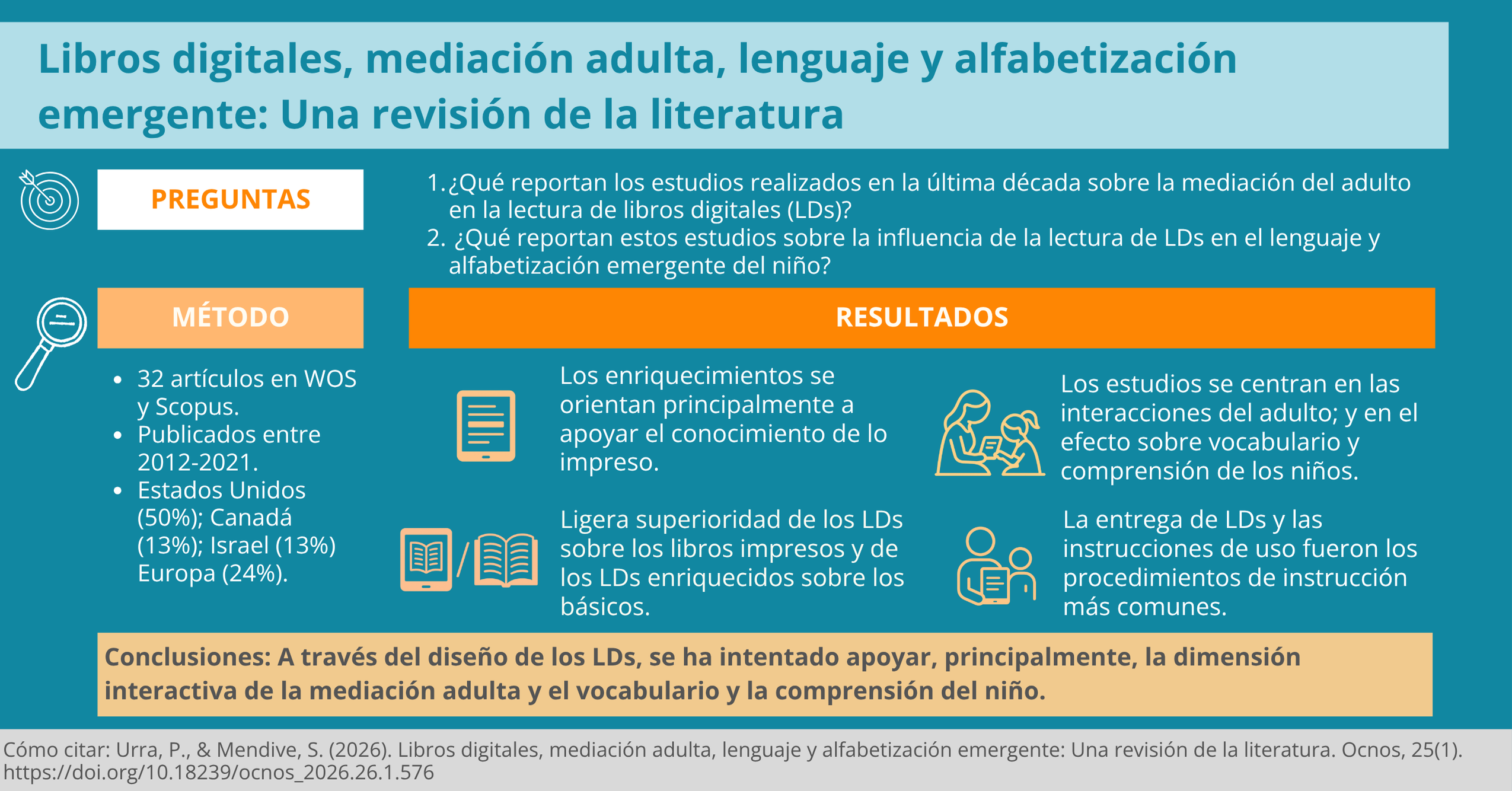
The influence of digital books on adult mediation and emergent literacy has joined the ongoing debate regarding the role of shared reading of print books. However, a systematic evaluation of the enhancements available in digital books, participants’ study conditions, and instructional methods in interventions is still lacking. This review analysed studies from the last decade on digital books, language skills, and adult mediation, considering these factors. A total of 32 articles from WOS and Scopus were reviewed. The findings indicated a widespread use of enhancements supporting print knowledge; research focused on interactions promoted by the adult reader and the assessment of children’s vocabulary and comprehension. Additionally, a slight superiority of digital books over print books and of enhanced digital books over basic ones was observed for children’s lexico-semantic skills and the interactive dimension of adult input. Book distribution and usage instructions were the most common instructional procedures. These findings reveal efforts to support adult mediation and children through digital books. The implications are relevant for families, educators, researchers, and software developers interested in promoting adult mediation and language skills through digital books.
Downloads
Download data is not yet available.
Article Details
How to Cite
Urra, P., & Mendive, S. (2026). Digital books, adult mediation, and language and emergent literacy. A literature review. Ocnos. Journal of reading research, 25(1). https://doi.org/10.18239/ocnos_2026.25.1.576
Urra and Mendive: Digital books, adult mediation, and language and emergent literacy. A literature review
Introduction
The issue of the influence of digital books on language and emerging literacy in early
childhood has added to the debate about the role of shared reading of printed books.
A growing industry offering digital books in early childhood language and literacy
has joined the debate about their varied characteristics and qualities (), and research warning about the risks of using digital media in this population
() has prompted studies on the effectiveness of these books for children.
With regard to shared reading of printed books, the debate about the effectiveness
of early exposure to books remains open. Meta-analyses show benefits for language
and emerging literacy in girls and boys (e.g., ), especially when interventions are compared with passive groups (i.e., no intervention;
). Because young children do not decode on their own during their early years, the
effect of early shared reading can be explained in large part by adult mediation.
This occurs when the adult intervenes between the stimulus (e.g., book) and the child
and modifies the order, frequency, intensity, and context of that stimulus to facilitate
access to meaning and the internalisation of psychological processes or cognitive
modifiability (). Indeed, it has been shown that during this activity, the child has the adult’s
full attention and participates in conversations of greater linguistic complexity
(), which facilitates the development of quality interactions. Similarly, several studies
have shown that dialogic reading () during shared reading—that is, repeated exposure of the child to the book accompanied
by the use of strategies that promote their participation—promotes language and emerging
literacy and, in particular, vocabulary ().
However, the quality of interactions facilitated by digital books and, therefore,
the results for language and emerging literacy could be less consistent if we consider
both findings related to lower language development in children exposed to screens
at an early age () as those showing greater adult focus on the device and regulation of the child’s
behaviour than on the content of digital books (). On the other hand, the joint involvement of adults and children during the use
of digital media has been shown to mitigate its negative effect on the early literacy
skills of children in kindergarten and first grade (). Therefore, in order to gain an up-to-date understanding of the influence of digital
books on language and emerging literacy, it is necessary to simultaneously systematise
their influence on the role of adult mediation.
On the other hand, research on the role of digital books in mediation, as well as
in language development and emerging literacy, has focused on comparing their effects
with those of printed books. However, it has recently been suggested that this analysis
should focus on the design characteristics of books in relation to their purpose rather
than on the possible superiority of one or the other ().
Furthermore, two important issues that should be addressed when evaluating the effectiveness
of digital books are the study conditions and instructional procedures used in the
interventions (). The former refer to the specific circumstances experienced by participants in an
intervention, which may influence the observed results (). Existing reviews (; ; ) have focused on systematising the effects of digital books compared to printed books,
under the assumption that digital books could produce different effects than printed
books. They have also explored the results generated in children from reading digital
books with adult support and without adult support using audio narration. However,
the rapid advancement of the digital book industry in recent years and the growing
interest of researchers suggests that new conditions may be emerging that are important
to systematise.
Furthermore, it is essential to examine what type of support is being provided to
users. The literature on shared reading of printed books shows that the type of instruction
provided to adults in interventions has benefits for children (). However, we do not know the type of instruction given to adults in the context
of shared reading of digital books or what is given to children in the independent
reading condition to understand how digital books might influence children’s language
outcomes and emerging literacy and to project improvements that increase fidelity
and user adoption in future interventions ().
The role of enhancements
Digital books —also known as e-books or book apps— are books accessible through screen-based
technologies () and are characterised by enhancements that “improve” the reading experience, making
it different from that of printed books. These are multimedia or interactive resources
that complement or expand the content of the text, or that support the reading experience.
These include background sounds, animations, hotspots (e.g., when touched, they activate
sounds or animations) and games that motivate the reader ().
These enhancements have been an important part of the debate on the influence of reading
digital books in early childhood. According to , enhancements that are consistent with the story support comprehension and retelling,
while those that are not related to children’s passive viewing and the production
of non-cohesive retellings. Fifteen years later, a meta-analysis () proposes a finer distinction: multimedia and interactive features. It concludes
that the former (e.g., animated images and sound effects) are beneficial for children’s
comprehension and vocabulary, while the latter (e.g., games and dictionaries) are
distracting because children must simultaneously listen to the narration of the story
while interacting with an element on the screen, which may not be directly related
to the content of the story. A subsequent review conducted by agrees that animations and games can be distracting elements that hinder learning,
as can sound effects. Nevertheless, points out that the distinction between multimedia and interactive items is problematic
because in some cases it can be blurred (e.g., an animation can be activated by touching
the hotspot), which tests the scope of the results of .
A subsequent meta-analysis () distinguishes between two types of enhancement: those that promote interest and
enjoyment in reading for aesthetic purposes; and those that focus on the narrative
plot for learning purposes. It concludes that enhancements are fundamental to understanding
the text, since studies in which the digital book differs from the printed book only
in terms of digitisation show lower scores for the digital version; on the other hand,
those that use enhancements for learning purposes are more beneficial than the printed
book. Additionally, it determines that dictionaries do not contribute to comprehension,
but they do have an effect on vocabulary acquisition.
The classifications indicated appear to be based on different criteria: design (e.g.,
auditory/visual); the degree of interactivity of the enhancements (multimedia/interactive);
and the objectives for which they were designed (aesthetic/learning). Therefore, the
enhancement of digital books should be systematised from a broader perspective, allowing
us to recognise what resources exist; what skills they could be impacting; and under
what study conditions and instructional procedures they have been observed, in order
to guide decision-making for the development of digital books aimed at early childhood.
Adult mediation
Another relevant dimension in the discussion has been the role of the adult mediator,
who supports the child during shared reading (). The review by concludes that adults tend to talk more about the device than the content during
shared reading of digital books and that the presence of an adult improves comprehension,
language development and print awareness. A meta-analysis by compared children’s word learning and comprehension with digital books versus printed
books with and without adult assistance. It determined that there were no differences
between digital and printed books in terms of children’s comprehension and vocabulary
when an adult was present; likewise, when digital books incorporated multimedia features
consistent with the narrative, they were more beneficial than printed books. Therefore,
it concludes that some of these features provide scaffolding similar to that provided
by an adult.
The meta-analysis by recognises that adult mediation during the reading of printed books was more effective
than the enhancements included in digital books for children’s independent reading.
As for this discussion, a meta-analysis by points out that the superiority of parental mediation during the reading of printed
books and the quality of the linguistic results obtained by children could be influenced
by parents’ preference for this type of book and their resistance to digital books.
In the studies mentioned, the mediating role of the adult seems to be based on the
assumption that it is replaceable in the child’s independent reading skill. However,
it is necessary to analyse whether the research conducted in recent years is operating
on this assumption. Therefore, it is necessary to systematise how their role in reading
digital books is being assessed and what support they are being offered in the interventions.
The type and quality of instruction provided to adults during the intervention may
impact their performance as mediators.
Consequently, although previous reviews have addressed the impact of digital books
on children’s comprehension and vocabulary, as well as the role of adult mediation
in these skills, there has been insufficient exploration of which dimensions of mediation
have been studied and what other language and emerging literacy skills these books
might contribute to. Similarly, other factors that could influence the results have
not been studied in detail, such as the enhancement included in digital books, the
study conditions in which the subjects participated, and the instructional procedures
of the interventions. Therefore, a scoping review () was conducted, guided by the following questions:
1.
What do studies conducted over the last decade report about adult mediation in digital
book reading, considering enhancement, study conditions, and instructional procedures?
2.
What do these studies report about the influence of reading digital books on language
and emerging literacy, considering enhancement, study conditions, and instructional
procedures?
Method
Item search and selection
Between September and December 2022, items were searched for in the Web of Science
(WOS) and Scopus databases that had been published between 2012 and December 2021.
A search range of ten years was established from the start of the search, considering
the years of greatest research development in the field according to WOS. Different
combinations of the following words were used: digital literacy, digital practices,
digital book, e-book, electronic book, young children, toddlers, preschoolers, preschool
education, kindergarten, language.
The results yielded 121 articles in WOS and 100 in Scopus. At this stage, 86 articles
from WOS and 7 from Scopus were withdrawn because, although they addressed issues
related to digital literacy, they did not develop interventions based on digital books
that would allow for the observation of effects on mediation or on children’s language
skills and emerging literacy.
More specific filters were then applied to analyse the 128 articles obtained in the
previous step, and the following records were excluded: duplicates (=1); theoretical
and literature reviews (=10); those involving children in grades higher than or equal
to first grade (=13); unrelated to language and emerging literacy (=22); from populations
with atypical linguistic-communicative profiles (=21); involving bilingual, multilingual
subjects and those oriented towards second language teaching (=10); focused on educator
performance and classroom interventions (=18); on literacy games that are not in book
format (=3); observational studies on home literacy environments that did not involve
interventions based on digital books (=4); that did not use books available in tablet,
smartphone, iPad or computer format (=1). It should be noted that research on atypical
children (e.g., autistic children) and bilingual children was not included in order
to exclude variability related to their linguistic or communicative performance. In
total, we got 25 items.
To expand the search, the snowball strategy was used. Papers published by the most
cited authors in the field were reviewed. Next, the bibliographic references of the
25 filtered articles were examined to find studies that may not have been identified
using the keywords. Seven articles were collected using this strategy. A total of
32 articles were analysed; 50% were conducted in the United States; 13% in Canada
and Israel respectively, and 24% in Europe (table 1).
Analysis of the articles
All analyses were performed by the first author and then reviewed and agreed upon
by the second author at all stages of the process. Thematic regularities were discovered
through categorical analysis to answer the questions. Fourteen articles answered question
1; 31 answered question 2; and 13 answered both questions 1 and 2 (table 1).
Table 1Articles analysed
Authors
Question 1
Question 2
Country
+
United States
+
Canada
+
Canada
+
United States
+
United States
+
+
United States
+
+
Israel
+
+
Israel
+
+
Israel
+
+
Israel
+
+
United Kingdom
+
+
United Kingdom
+
+
Norway
+
+
United States
+
+
United States
+
United States
+
United States
+
United States
+
Canada
+
+
Canada
+
Turkey
+
United States
+
The Netherlands
+
The Netherlands
+
United States
+
United States
+
+
United States
+
Hungary
+
Hungary
+
+
United States
+
United States
+
United States
− Enhancements. Enhancements in digital books were classified according to their medium
or function, resulting in: a) support for understanding the printed text (page navigation
resources, text highlighting); b) auditory (music); c) audio narration of the story
(voice telling the story); d) visual (static images); e) animation (dynamic images,
videos); f) direct support for adults (toolbar with reading recommendations for adults);
g) support for vocabulary knowledge (dictionary, vocabulary questions); h) hotspot
(touching activates sounds or animations); i) hotspot focused on phonological awareness
of the word (touching activates phonemes or syllables of the word); j) personalisation
(customised marks, such as the name of the child reading); k) focus on an element
of the story; l) undefined.
− Study conditions and instructional procedures. The study conditions in which the
subjects participated and the instructional procedures used in the interventions were
considered. The categories for the study conditions were as follows: a) Printed book/Digital
book; b) Basic digital book/Digital book enhanced with some multimedia resource subject
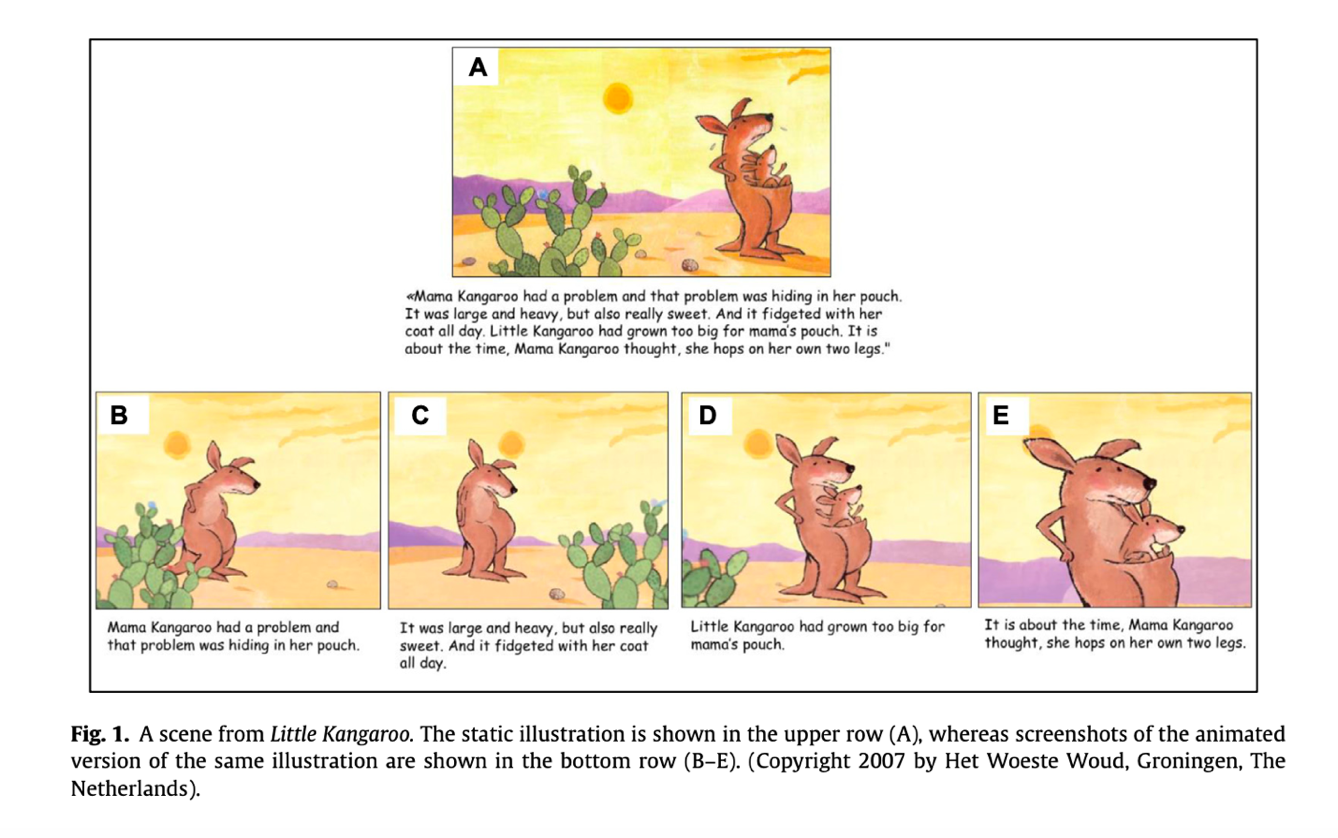
to experimental conditions (e.g., static image/animation, Figure 1); c) With adult support/Without adult support; d) Other condition (e.g., attention
to image/attention to text). In the instructional procedures, the following categories
were identified: a) only providing participants with the digital book; b) familiarising
participants with the digital book beforehand; c) instructing participants on how
to use the digital book; d) providing participants with reading recommendations; and
e) providing reading training.
− Adult mediation. The linguistic input quality model by was adapted to classify the results related to mediation. Studies that reported on:
a) adult interactions to promote child participation in back-and-forth exchanges were
categorised under the interactive dimension; b) adult behaviours to promote language
use at the phonological, morphosyntactic, and discursive levels were included in the
linguistic dimension; and c) meaning-oriented interactions were assigned to the conceptual
dimension.
− Children’s skills. The results of research related to children’s skills (; ) were categorised as follows: a) knowledge and alphabetical awareness (skills related
to knowledge of letters and alphabetical awareness); b) discourse production (the
ability to produce a text, consisting of units larger than a sentence, with a communicative
intention in a given context); c) discourse comprehension (the ability to retrieve
a text and construct a representation of its content); d) lexical-semantics (the ability
to understand or express the content of words); e) pragmatics (the ability to use
language during conversational interactions in a context-relevant manner); f) phonology
(the ability to recognise and use the sounds of language); g) print awareness (the
ability to manipulate the e-book); h) attention (focusing on books as relevant stimuli).
It should be noted that the studies reported more than one type of outcome (e.g.,
discourse comprehension and lexical-semantic ability).
Figure 1Difference between basic LD (Ldb)/enhanced LD (LDe) with some multimedia resources
subject to experimental conditions
Results
Adult mediation
To contextualise the results, the enhancements identified in the studies linked to
this review question are described (table 2). The most common enhancements in the digital books used in this study group are
those that support knowledge of the printed text (n=11) and the presence of audio
narration (n=12). In studies that employ highlighting, this accompanies the audio
narration, which could favour the link between phonological processing and the printed
code (e.g. ). Next, we count the studies that used digital books with animations (=10), audio
resources (=7) and hotspot (=6) to bring elements of the story to life; support understanding
of the narrative plot; communicate the emotional states of the characters; or access
phonological knowledge of the word. Finally, there are studies that used digital books
with dictionaries (=3), personalisation (=3) and focus (=1).
Table 2Enhancements used in adult mediation studies
Enhancement
Articles
Supports knowledge of the printed word
; ; ; ; ; ; ; ; ; ; .
Auditive
; ; ; ; ; ; ; .
Audio narration
; ; ; ; ; ; ; ; .
Visual
; ; ; ; .
Animation
; ; ; ; ; ; ; ; ; .
Direct support for adults
.
Supporting vocabulary knowledge
; ; .
Hotspot
; ; ; ; ; .
Personalisation
; ; .
Zoom
.
As for adult mediation (table 3), 12 studies reported results on the interactive dimension of adult input; 5 on the
conceptual dimension; and 2 on the linguistic dimension. The experimental studies
compiled subject the study subjects to different study conditions (table 4) to systematise the effects of digital books on adult mediation in each of these
dimensions. The most common are between digital and printed books (=8) and between
basic and enhanced digital books (=6).
Table 3Dimensions of adult mediation
Dimension
Articles
Interactive
; ; ; ; ; ; ; ; ; ; ; .
Conceptual
; ; ; ; .
Linguistics
; .
Interactive, conceptual
.
Interactive, conceptual, linguistic
; .
In terms of printed books versus digital books, five studies report that when using
digital books, adults tend to praise, encourage, and focus more on children during
reading than when using printed books (e.g., ; ). Similarly, five studies found favourable results for the interactive dimension
when using printed books over digital books, including more speech expansion and more
interactions (e.g., ; ; ). Although this pattern of results appears contradictory, it is important to note
that the variables used in the studies are diverse and that instructional procedures
could influence the results, as explained in the following paragraph.
Table 4Study conditions in adult mediation studies
Study conditions
Articles
LD versus LI
; ; ; ; ; ; ;
LDb versus LDe
; ; ; ; ;
CAP versus SAP
; ; ;
[i]Note. LD = digital book; LI = printed book; LDb = basic digital book; LDe = enhanced digital
book; CAP = reading with adult support; SAP = reading without adult support.
Analysis of the instructional procedures of the group that compared printed books
versus digital books (table 5) reveals that the two studies that used digital books with recommendations for adults
to ask questions or make comments to children during reading obtained favourable results
over printed books for adult mediation in interactions () and in helping children understand the text and learn the printed word (). In contrast, studies that reported favourable results for printed books only used
instructional procedures such as instructions for use and book delivery.
Table 5Instructional procedures in adult mediation studies
Implementation procedures
Articles
Book delivery
; ;
Prior familiarisation with the LD
;
Instructions on the use of LD
; ; ; ; ;
LC recommendations
; ;
Training
[i]Note. LD = digital book; LC = shared reading.
When studying the three dimensions of interactivity, language and concept, it has
been found that adults tend to talk more with their children about the story, the
structure of words and their meaning when using digital books than when using printed
books (e.g. ; ).
As for the comparison between basic and enhanced digital books, five of the six studies
in this group report favourable results for enhanced digital books, particularly in
terms of interactivity (; ; ) and conceptual understanding (; ). In the studies, the procedure of providing instructions for use predominates (=5),
with the exception of , which uses book delivery, but includes an enhancement consisting of a character
inserted into the digital book to encourage parents to talk to their children by providing
dialogic reading strategies during reading. Only one study reports results more favourable
to the basic digital book (). It is striking that even though in this study the basic digital book differed from
the enhanced digital book in terms of a group of enhancements (audio improvements,
animations, and hotspots) and not just one of them, the basic book performed better.
Additionally, studies by Korat et al. (; ); , and explore the role of adults in enhanced digital books. Their findings indicate that
enhancements aligned with the content of the story and those that favour the conceptual
dimension of mediation —such as a dictionary— can encourage adults to effectively
support children while reading digital books. In these studies, the condition of maximum
effectiveness for the child is LDe with adult support. It should be noted that only
and use procedures such as reading recommendations and training outside the book, which
is why the role of enhancement materials, particularly dictionaries, seems to be fundamental
in improving the quality of adult mediation and, along with it, children's language
skills.
Children’s skills
The enhancements (table 6) most commonly used in digital books in this study group are audio narration (=28)
and those that support knowledge of the printed text (=22). Secondly, there are animations
(=20), hotspots (=17) and audio resources (=13), such as background music or sounds
associated with objects or characters in the story. Then there is the use of static
images which, beyond illustrating the story, enrich specific aspects of it (=6). Finally,
research reports the use of more specific resources in e-books, such as elements that
support vocabulary knowledge (=4) and personalisation (=3).
Table 6Enhancements used in studies addressing children’s abilities
With regard to the influence of digital books on children’s skills (table 7), studies focused on examining their influence on children's lexical-semantic skills
(=15) and discourse comprehension (=11). Six studies were then identified that addressed
pragmatic skills; five addressed reading attention; and four addressed skills related
to knowledge of the alphabet. A smaller number addressed behaviours related to the
use of digital books (=3); phonological skills (=2); and discourse production (=3).
Nearly half of the studies (=15) assessed more than one skill.
Table 7Children’s skills reported in studies
Children’s skills
Articles
Literacy knowledge and awareness
; ; ; .
Discourse production
; ; .
Discourse comprehension
; ; ; ; ; ; ; ; ; ; .
Lexical semantic
; ; ; ; ; ; ; ; ; ; ; ; ; ; .
Pragmatic
; ; ; ; ; .
Phonological
; .
Use of the book
; ; .
Attention
; ; ; ; .
With regard to study conditions (table 8), 16 studies compared groups that read digital books versus printed books. In this
group, nine point to favourable results for digital: Four studies point to support
for lexical-semantic skills (; ; , ); 1 to comprehension (); 1 to pragmatic skills (); 1 to alphabetical knowledge and awareness (); and 2 to phonological awareness (; ). Analysis of the instructional procedures (table 9) in the studies favourable to digital books shows that five used independent reading
by the child with audio narration support and, within this group, three gave instructions
to the child; one used prior familiarisation of the child with the digital book; and
one did not give any instruction. In the remaining four studies in the group favouring
digital books, an adult close to the child or a volunteer did the reading, and in
three of these, the children received some kind of instruction; in contrast, in this
subgroup, the children did not receive any instruction.
Table 8Study conditions in studies addressing children’s skills
Comparison conditions
Articles
LD versus LI
; ; ; ; ; ; ; ; ; ; ; ; ; ;
LDb versus LDe
; ; ; ; ; ; ; ; ; ; ; .
CAP versus SAP
; ; ; ; ; .
Another condition
; ; ;
None
;
[i]Note. LD = digital book; LI = printed book; LDb = basic digital book; LDe = enhanced digital
book; CAP = reading with adult support; SAP = reading without adult support.
Among the research studies that compared digital books with printed books, with favourable
results for the latter (=7), are those that reported findings in favour of knowledge
and literacy skills (; ); pragmatic skills (; ); discourse comprehension (); print knowledge () and general linguistic ability (semantic, morphosyntactic and pragmatic; ). In this group, five studies used independent reading by the child with audio narration,
and two used a parent as the reader. In the group that uses audio narration, only
two give instructions to the child; in the group where parents participate, the child
receives no instruction.
Among the studies that employed more specific group study conditions were those that
compared children's performance after reading a basic digital book and an enhanced
digital book (n=12). Nine studies report favourable effects on enhanced digital book
conditions, with six of them pointing to positive results for semantic skills (; ; ; ; ; ); three for comprehension (; ; ); and 1 for phonological skills and knowledge of the alphabet (). Among the enhancements studied to improve lexical-semantic ability are dictionaries,
animations, and vocabulary questions; among those aimed at comprehension are audio
narration, animations, and visual and sound effects consistent with the story. The
interactive feature that reveals the phonological structure of the word was an enhancement
that promoted the children’s phonological awareness.
Regarding the instructional procedures used in studies that employed enhanced digital
books and found favourable effects on lexical-semantic skills, three used independent
reading by the child with audio narration and delivery of the device without any instruction;
one used instruction for both the mother and the child; and one used instruction for
the adult only and no instruction for the child. In contrast, all studies that found
favourable effects of enhanced digital books on comprehension used independent reading
by the child, and only one gave instructions.
Table 9Instructional procedures in studies addressing children’s skills
Of the six studies that used adult-supported versus unsupported conditions, five revealed
favourable results for the supported condition in lexical-semantic skills (; ; ; ), discourse comprehension (), and children’s phonological awareness (). An adult caregiver participated in all of these studies, whereas the only study
in which an adult researcher participated () determined that the child learned more words from the digital book without support
and with an audio narrator than from the experimenter reading aloud. In this latest
study, the child was familiarised with the digital book beforehand; in contrast, in
the remaining studies, three used instructions for use, one used reading recommendations,
and one used training.
Discussion and conclusions
This review aims at analysing evidence from the last ten years on digital books and
their relationship with adult mediation and language skills and emerging literacy,
considering the role of enhancements, participants’ study conditions and the instructional
procedures of the interventions. The analysis showed studies focused on the interactive
dimension of mediation, lexical-semantic skills, and discourse comprehension in children,
as well as widespread use of enhancements that support knowledge of the printed word
and audio narration. Finally, it showed slightly favourable results for digital books
over printed books, and for enhanced digital books over basic ones, particularly for
children’s lexical-semantic skills and the interactive dimension of adult input. It
also showed favourable results for the condition with adult support over without support
and limited use of reading recommendations. These findings show that the impact of
digital books on adult mediation or children’s skills is inseparable from enhancement.
Analysis of the enhancements indicated that the most commonly used are supports for
print comprehension and audio narration. However, their presence is not related to
a possible superiority of digital books over printed books in terms of children’s
skills; in fact, some of the studies in this review recognise favourable results for
audio-narration (e.g. ) and others, an absence of differences (e.g. ). point out that printed books may be superior to digital ones in terms of comprehension
and vocabulary when the only difference between them is the use of audio narration
and text highlighting. Therefore, this result suggests that other enhancements could
have a greater influence on users’ skills. Dictionaries, animations, vocabulary questions,
and hotspots for recognising the phonological structure of words (e.g., ) proved to be effective when comparing enhanced digital books with basic ones.
The comparison between enhanced digital books and basic digital books allows us to
highlight the specific role of enhancements and focus the discussion on design aspects
rather than on comparisons with printed books (). According to , the effectiveness of digital books depends on the quality of the enhancements, so
it is important to continue researching in this area. Although our results show progress
in this direction, studies remain less numerous than those comparing digital books
with printed ones, which may be explained by the persistent belief in the superiority
of printed books over digital ones. To move forward, it is essential to incorporate
users’ perceptions of digital books and their enhancements.
Although few studies compared the condition with adult support versus without support,
the results are clear: the digital book enhanced with adult support is the most effective
condition for learning. In accordance with , adult support is essential for promoting children's skills and providing them with
cognitive and emotional support while reading; in other words, doing what the device
cannot achieve on its own. Therefore, it is important to continue making progress
in areas that will improve the quality of mediation.
One outstanding issue is to optimise instructional procedures, offering adults more
tools to mediate in these new reading contexts. Digital books can be accessible and
economical alternatives to interventions with printed books. The use of a character
in the digital book to encourage interaction between parents and children has shown
promise in improving mediation (), reducing the time and resource costs associated with shared reading training. Therefore,
developing digital books with recommendations for adults would facilitate their adoption
in vulnerable populations.
While one of the main strengths of this study was to provide an overview of the factors
involved in the influence of digital books on mediation and emerging language and
literacy, one limitation is that the classifications of enhancements could be refined.
To this end, studies should carefully describe each multimedia resource incorporated
and its function.
The results suggest that future research should continue to explore enhancements aimed
at both children and adults. This research showed that it is possible to work on other
skills beyond children’s comprehension and vocabulary and other dimensions of mediation,
in addition to interactive mediation, through specific enhancement activities, which
can be tested under specific experimental conditions.
In conclusion, this study highlights the need for researchers and software developers
to seek out elements that are attractive, accessible, and well-suited to the skill
being taught. One pending task is to transition towards instructional procedures that
provide more support to adults on how to read with children. Technological support
could be a great ally to this end.
Funding
This work has received support from the Chilean National Research and Development
Agency (ANID), through the National Doctoral Scholarship, 2022-folio No. 21221000;
from the National Fund for Scientific and Technological Development (FONDECYT) programme,
Folio No. 1231550; and ANID/SCIA/CIN250046.
References
1
Aparici-Aznar, M., & Igualada, A. (2018). El desarrollo del lenguaje y la comunicación en la infancia. Editorial UOC.
2
Arslan-Ari, I., & Ari, F. (2021). The effect of visual cues in e-books on pre-K children’s
visual attention, word recognition, and comprehension: An eye tracking study. Journal of Research on Technology in Education, 54(5), 800-814. https://doi.org/10.1080/15391523.2021.1938763
3
Biesta, G. J. J. (2010). Why “What Works” still won’t work: From evidence-based education
to value-based education. Studies in Philosophy and Education, 29(5), 491-503. https://doi.org/10.1007/s11217-010-9191-x
4
Bus, A. G., Neuman, S. B., & Roskos, K. (2020). Screens, apps, and digital books for
young children: The promise of multimedia. AERA Open, 6(1), 1-6. https://doi.org/10.1177/2332858420901494
5
Courage, M. L., Frizzell, L. M., Walsh, C. S., & Smith, M. (2021). Toddlers using
tablets: They engage, play, and learn. Frontiers in Psychology, 12, Article 564479. https://doi.org/10.3389/fpsyg.2021.564479
6
Deasley, S., Evans, M. A., Nowak, S., & Willoughby, D. (2016). Sex differences in
emergent literacy and reading behaviour in junior kindergarten. Canadian Journal of School Psychology, 33(1), 26-43. https://doi.org/10.1177/0829573516645773
7
Dore, R. A., Hassinger-Das, B., Brezack, N., Valladares, T. L., Paller, A., Vu, L.,
Golinkoff, R. M., & Hirsh-Pasek, K. (2018). The parent advantage in fostering children’s
e-book comprehension. Early Childhood Research Quarterly, 44, 24-33. https://doi.org/10.1016/j.ecresq.2018.02.002
8
Dore, R. A., Logan, J., Lin, T.-J., Purtell, K. M., & Justice, L. (2020). Characteristics
of children’s media use and gains in language and literacy skills. Frontiers in Psychology, 11, Article 2224. https://doi.org/10.3389/fpsyg.2020.02224
9
Dowdall, N., Melendez-Torres, G. J., Murray, L., Gardner, F., Hartford, L., & Cooper,
P. J. (2020). Shared picture book reading interventions for child language development:
A systematic review and meta-analysis. Child Development, 91(2), 383-399. https://doi.org/10.1111/cdev.13225
10
Eggleston, C., Wang, X. C., & Choi, Y. (2021). Mother-toddler shared reading with
electronic versus print books: Mothers’ language use and perspectives. Early Education and Development, 33(7), 1152-1174. https://doi.org/10.1080/10409289.2021.1943638
11
Flack, Z. M., Field, A. P., & Horst, J. S. (2018). The effects of shared storybook
reading on word learning: A meta-analysis. Developmental Psychology, 54(7), 1334–1346. https://doi.org/10.1037/dev0000512
12
Furenes, M. I., Kucirkova, N., & Bus, A. G. (2021). A comparison of children’s reading
on paper versus screen: A meta-analysis. Review of Educational Research, 91(4), 483-517. https://doi.org/10.3102/0034654321998074
13
Grolig, L. (2020). Shared storybook reading and oral language development: A bioecological
perspective. Frontiers in Psychology, 11, Article 1818. https://doi.org/10.3389/fpsyg.2020.01818
14
Guernsey, L., & Levine, M. (2015). Tap, click, read: Growing readers in a world of screens (First). Jossey-Bass. A Wiley Brand.
15
Guevara, J. P., Erkoboni, D., Gerdes, M., Winston, S., Sands, D., Rogers, K., Haecker,
T., Jimenez, M. E., & Mendelsohn, A. L. (2021). Promoting early literacy using digital
devices: A pilot randomized controlled trial. Academic Pediatrics, 21(6), 1001-1008. https://doi.org/10.1016/j.acap.2021.05.013
16
Haring-Biel, C., Buzhardt, J., Brown, J. A., Romano, M. K., Lorio, C. M., Windsor,
K. S., Kaczmarek, L. A., Gwin, R., Sandall, S. S., & Goldstein, H. (2020). Language
interventions taught to caregivers in homes and classrooms: A review of intervention
and implementation fidelity. Early Childhood Research Quarterly, 50, 140-156. https://doi.org/10.1016/j.ecresq.2018.12.002
17
Hutton, J. S., Huang, G., Sahay, R. D., DeWitt, T., & Ittenbach, R. F. (2020). A novel,
composite measure of screen-based media use in young children (ScreenQ) and associations
with parenting practices and cognitive abilities. Pediatric Research, 87(7), 1211-1218. https://doi.org/10.1038/s41390-020-0765-1
18
Korat, O., & Falk, Y. (2019). Ten years after: Revisiting the question of e-book quality
as early language and literacy support. Journal of Early Childhood Literacy, 19(2), 206-223. https://doi.org/10.1177/1468798417712105
19
Korat, O., & Shneor, D. (2019). Can e-books support low SES parental mediation to
enrich children’s vocabulary? First Language, 39(3), 344-364. https://doi.org/10.1177/0142723718822443
20
Korat, O., & Segal-Drori, O. (2016). E-book and printed book reading in different
contexts as emergent literacy facilitator. Early Education and Development, 27(4), 532-550. https://doi.org/10.1080/10409289.2016.1095613
21
Korat, O., Levin, I., Atishkin, S., & Turgeman, M. (2014). E-book as facilitator of
vocabulary acquisition: Support of adults, dynamic dictionary and static dictionary.
Reading and Writing, 27(4), 613-629. https://doi.org/10.1007/s11145-013-9474-z
22
Korat, O., Shamir, A., & Heibal, S. (2013). Expanding the boundaries of shared book
reading: E-books and printed books in parent–child reading as support for children’s
language. First Language, 33(5), 504-523. https://doi.org/10.1177/0142723713503148
23
Kucirkova, N. (2017). An integrative framework for studying, designing and conceptualising
interactivity in children’s digital books. British Educational Research Journal, 43(6), 1168-1185. https://doi.org/10.1002/berj.3317
24
Kucirkova, N. (2019). Children’s reading with digital books: Past moving quickly to
the future. Child Development Perspectives, 13(4), 208-214. https://doi.org/10.1111/cdep.12339
25
Kucirkova, N., Gattis, M., Spargo, T. P., De-Vega, B. S., & Flewitt, R. (2021). An
empirical investigation of parent-child shared reading of digital personalized books.
International Journal of Educational Research, 105, 1-12. https://doi.org/10.1016/j.ijer.2020.101710
26
Kucirkova, N., Messer, D., Sheehy, K., & Flewitt, R. (2013). Sharing personalised
stories on iPads: a close look at one parent–child interaction. Literacy, 47(3), 115-122. https://doi.org/10.1111/lit.12003
27
Kucirkova, N., Sheehy, K., & Messer, D. (2015). A Vygotskian perspective on parent-child
talk during iPad story sharing. Journal of Research in Reading, 38(4), 428-441. https://doi.org/10.1111/1467-9817.12030
28
Labbo, L. D., & Kuhn, M. R. (2000). Weaving chains of affect and cognition: A young
child’s understanding of CD-ROM talking books. Journal of Literacy Research, 32(2), 187-210. https://doi.org/10.1080/10862960009548073
29
Madigan, S., McArthur, B. A., Anhorn, C., Eirich, R., & Christakis, D. A. (2020).
Associations between screen use and child language skills: A systematic review and
meta-analysis. JAMA Pediatrics, 174(7), 665–675. https://doi.org/10.1001/jamapediatrics.2020.0327
30
Munn, Z., Peters, M. D. J., Stern, C., Tufanaru, C., McArthur, A., & Aromataris, E.
(2018). Systematic review or scoping review? Guidance for authors when choosing between
a systematic or scoping review approach. BMC Medical Research Methodology, 18(1). https://doi.org/10.1186/s12874-018-0611-x
31
Munzer, T. G., Miller, A. L., Weeks, H. M., Kaciroti, N., & Radesky, J. (2019a). Differences
in parent-toddler interactions with electronic versus print books. Pediatrics, 143(4). https://doi.org/10.1542/peds.2018-2012
32
Munzer, T. G., Miller, A. L., Weeks, H. M., Kaciroti, N., & Radesky, J. (2019b). Parent-toddler
social reciprocity during reading from electronic tablets vs print books. JAMA Pediatrics, 173(11), 1076-1083. https://doi.org/10.1001/jamapediatrics.2019.3480
33
Neuman, S. B., Wong, K. M., & Kaefer, T. (2017). Content not form predicts oral language
comprehension: The influence of the medium on preschoolers’ story understanding. Reading and Writing, 30(8), 1753-1771. https://doi.org/10.1007/s11145-017-9750-4
34
Noble, C., Sala, G., Peter, M., Lingwood, J., Rowland, C. F., Gobet, F., & Pine, J.
(2019). The impact of shared book reading on children's language skills: A meta-analysis.
Educational Research Review, 28, 100290. https://doi.org/10.1016/j.edurev.2019.100290
35
O’Toole, K. J., & Kannass, K. N. (2018). Emergent literacy in print and electronic
contexts: The influence of book type, narration source, and attention. Journal of Experimental Child Psychology, 173, 100-115. https://doi.org/10.1016/j.jecp.2018.03.013
36
Parish‐Morris, J., Mahajan, N., Hirsh‐Pasek, K., Golinkoff, R. M., & Collins, M. F.
(2013). Once upon a time: Parent–child dialogue and storybook reading in the electronic
era. Mind, Brain, and Education, 7(3), 200–211. https://doi.org/10.1111/mbe.12028
37
Reich, S. M., Yau, J. C., & Warschauer, M. (2016). Tablet-based ebooks for young children:
What does the research say? Journal of Developmental and Behavioral Pediatrics, 37(7), 585–591. https://doi.org/10.1097/DBP.0000000000000335
38
Reich, S. M., Yau, J. C., Xu, Y., Muskat, T., Uvalle, J., & Cannata, D. (2019). Digital
or print? A comparison of preschoolers’ comprehension, vocabulary, and engagement
from a print book and an e-book. AERA Open, 5(3). https://doi.org/10.1177/2332858419878389
39
Richter, A., & Courage, M. L. (2017). Comparing electronic and paper storybooks for
preschoolers: Attention, engagement, and recall. Journal of Applied Developmental Psychology, 48, 92-102. https://doi.org/10.1016/j.appdev.2017.01.002
40
Rowe, M. L., & Snow, C. E. (2020). Analyzing input quality along three dimensions:
Interactive, linguistic, and conceptual. Journal of Child Language, 47(1), 5-21. https://doi.org/10.1017/S0305000919000655
41
Rvachew, S., Rees, K., Carolan, E., & Nadig, A. (2017). Improving emergent literacy
with school-based shared reading: Paper versus ebooks. International Journal of Child-Computer Interaction, 12, 24-29. https://doi.org/10.1016/j.ijcci.2017.01.002
42
Sarı, B., Başal, H. A., Takacs, Z. K., & Bus, A. G. (2019). A randomized controlled
trial to test efficacy of digital enhancements of storybooks in support of narrative
comprehension and word learning. Journal of Experimental Child Psychology, 179, 212-226. https://doi.org/10.1016/j.jecp.2018.11.006
43
Sénéchal, M., Lefevre, J.-A., Hudson, E., & Lawson, E. P. (1996). Knowledge of storybooks
as a predictor of young children’s vocabulary. Journal of Educational Psychology, 88(3). https://doi.org/10.1037/0022-0663.88.3.520
44
Skibbe, L. E., Thompson, J. L., & Plavnick, J. B. (2018). Preschoolers’ visual attention
during electronic storybook reading as related to different types of textual supports.
Early Childhood Education Journal, 46(4), 419-426. https://doi.org/10.1007/s10643-017-0876-4
45
Smeets, D. J. H., & Bus, A. G. (2012). Interactive electronic storybooks for kindergartners
to promote vocabulary growth. Journal of Experimental Child Psychology, 112(1), 36-55. https://doi.org/10.1016/j.jecp.2011.12.003
46
Smeets, D. J. H., & Bus, A. G. (2015). The interactive animated e-book as a word learning
device for kindergartners. Applied Psycholinguistics, 36(4), 899–920. https://doi.org/10.1017/S0142716413000556
47
Strouse, G. A., & Ganea, P. A. (2016). Are prompts provided by electronic books as
effective for teaching preschoolers a biological concept as those provided by adults?
Early Education and Development, 27(8), 1190-1204. https://doi.org/10.1080/10409289.2016.1210457
48
Strouse, G. A., & Ganea, P. A. (2017a). Toddlers’ word learning and transfer from
electronic and print books. Journal of Experimental Child Psychology, 156, 129-142. https://doi.org/10.1016/j.jecp.2016.12.001
49
Strouse, G. A., & Ganea, P. A. (2017b). Parent-toddler behavior and language differ
when reading electronic and print picture books. Frontiers in Psychology, 8, Article 677. https://doi.org/10.3389/fpsyg.2017.00677
50
Takacs, Z. K., & Bus, A. G. (2016). Benefits of motion in animated storybooks for
children’s visual attention and story comprehension. An eye-tracking study. Frontiers in Psychology, 7, Article 1591. https://doi.org/10.3389/fpsyg.2016.01591
51
Takacs, Z. K., & Bus, A. G. (2018). How pictures in picture storybooks support young
children’s story comprehension: An eye-tracking experiment. Journal of Experimental Child Psychology, 174, 1-12. https://doi.org/10.1016/j.jecp.2018.04.013
52
Takacs, Z. K., Swart, E. K., & Bus, A. G. (2014). Can the computer replace the adult
for storybook reading? A meta-analysis on the effects of multimedia stories as compared
to sharing print stories with an adult. Frontiers in Psychology, 5, Article 1366. https://doi.org/10.3389/fpsyg.2014.01366
53
Takacs, Z. K., Swart, E. K., & Bus, A. G. (2015). Benefits and pitfalls of multimedia
and interactive features in technology-enhanced storybooks: A meta-analysis. Review of Educational Research, 85(4), 698-739. https://doi.org/10.3102/0034654314566989
54
Troseth, G. L., Strouse, G. A., Flores, I., Stuckelman, Z. D., & Russo-Johnson, C.
(2020). An enhanced eBook facilitates parent-child talk during shared reading by families
of low socioeconomic status. Early Childhood Research Quarterly, 50, 45-58. https://doi.org/10.1016/j.ecresq.2019.02.009
55
Tzuriel, D. (2013). Mediated learning experience and cognitive modifiability. Journal of Cognitive Education and Psychology, 12(1), 59–80. https://doi.org/10.1891/1945-8959.12.1.59
56
Whitehurst, G. J., Falco, F. L., Lonigan, C. J., Fischel, J. E., DeBaryshe, B. D.,
Valdez-Menchaca, M. C., & Caulfield, M. (1988). Accelerating language development
through picture book reading. Developmental Psychology, 24(4), 552–559. https://doi.org/10.1037/0012-1649.24.4.552
Willoughby, D., Evans, M. A., & Nowak, S. (2015). Do ABC eBooks boost engagement and
learning in preschoolers? An experimental study comparing eBooks with paper ABC and
storybook controls. Computers and Education, 82, 107-117. https://doi.org/10.1016/j.compedu.2014.11.008
59
Xu, Y., Yau, J. C., & Reich, S. M. (2019). The added challenge of digital reading:
Exploring young children’s page turning behaviors. In Proceedings of the 18th ACM International Conference on Interaction Design and Children, 432-438. https://doi.org/10.1145/3311927.3323121