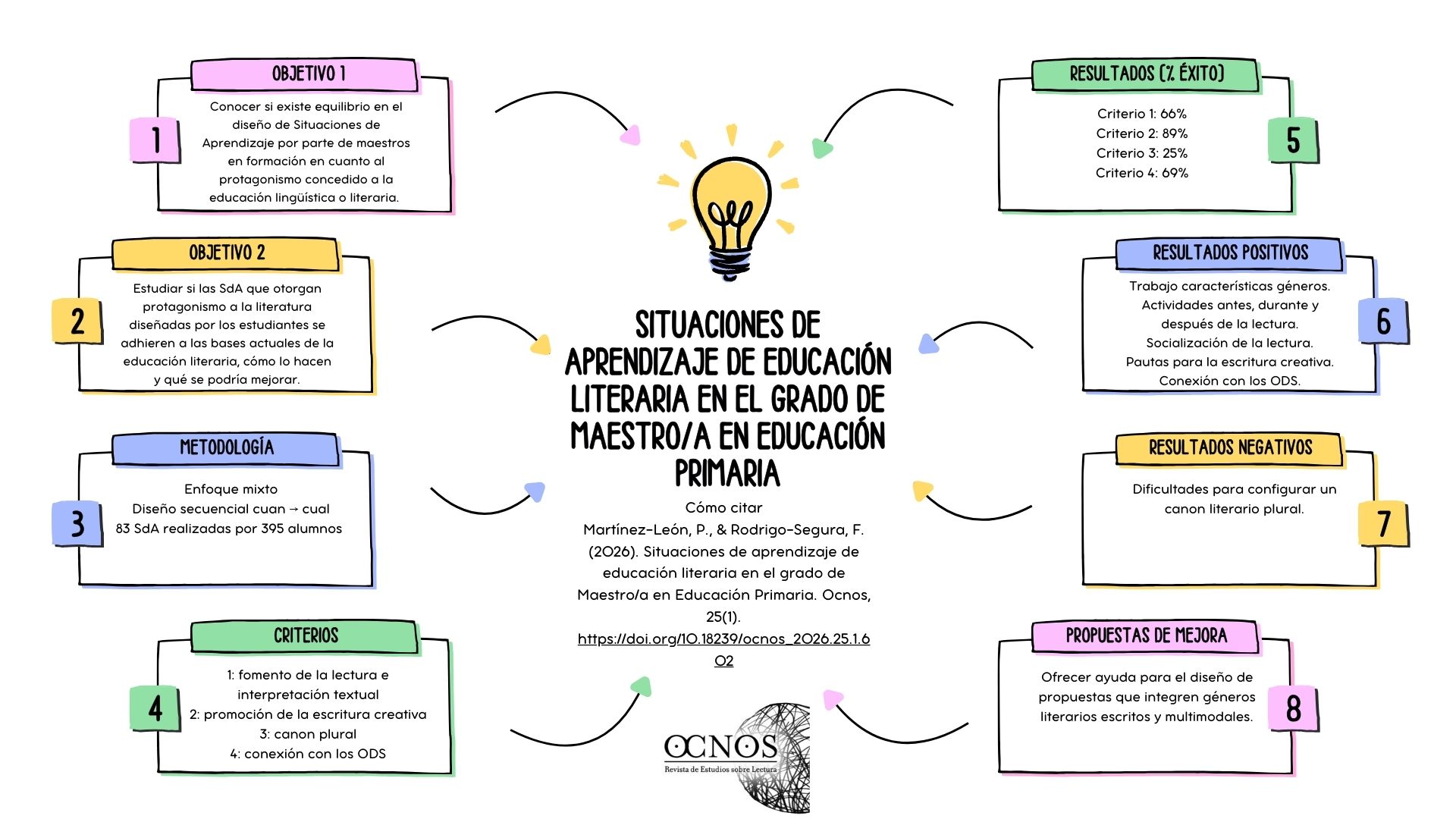
This study examines teaching experiences within the ‘Language and Literature Planning’ course in the fourth year of a primary education degree course at Universidad de València, Spain. The research involved a sample of 395 students across three consecutive academic years (2022/2023, 2023/2024, and 2024/2025), who were tasked with designing a learning situation as part of an annual curriculum plan for a primary school class (in accordance with guidelines set by the Educational Quality Improvement Act). The main study objective was to examine how these learning situations, while serving as an interdisciplinary teaching model, align with the principles of contemporary literary education. A mixed-method approach was employed that follows a sequential design from quantitative to qualitative analysis. In the first phase, learning situations focused on literary education were selected for further examination. In the second phase, a qualitative analysis was conducted using the following criteria: (1) encouragement of reading and textual interpretation; (2) encouragement of creative writing; (3) a plural canon; and (4) connection with the Sustainable Development Goals. The findings indicate that criterion three presented the greatest challenge for students.
Downloads
Download data is not yet available.
Article Details
How to Cite
Martínez-León, P., & Rodrigo-Segura, F. (2026). Literary education learning situations during Primary Teacher Training. Ocnos. Journal of reading research, 25(1). https://doi.org/10.18239/ocnos_2026.25.1.602
Martínez-León and Rodrigo-Segura: Literary education learning situations during Primary Teacher Training
Introduction
Learning situations within the framework of today’s literary education
This research stems from a concern to link the interdisciplinary teaching model required
by Ley Orgánica 3/2020, de 29 de diciembre, por la que se modifica la Ley Orgánica 2/2006,
de 3 de mayo, de Educación (, of 29th December, amending Organic Act 2/2006, of 3rd May, on Education) (LOMLOE, as per its Spanish acronym), with the current foundations
of literary education in order to assess the extent to which the teaching proposals
designed by students of the Teaching Degree comply not only with the requirements
of this teaching model, but also with the fundamentals of our specific teaching methodology.
To this end, a theoretical and methodological contextualisation was first conducted
around the paradigm of literary education. Secondly, the concept of “learning situation”
was defined, specifying its characteristics in relation to language and literature
teaching.
To begin this brief overview, the well-known principles established by for literary education should be noted: experimentation with literary communication
in situations that allow literature to be seen as a real communicative situation;
the use of texts appropriate to students’ tastes and reading skills; reader involvement
and response; shared interpretation with increasing complexity; and the interrelation
of literary reception, reflection and production activities.
Considerations regarding a school literary canon that has moved away from monolithic
positions towards openness and plurality in the broadest sense are added to these
principles: texts from diverse literary genres, interdisciplinary, combining different
languages and formats, intercultural, with authors from all cultures and genres, children’s
and young adult literature, classical and universal literature, and also literature
closer to the students’ time and context (). This exercise in opening up the canon involves “explicitly questioning the formation
of national canons in order to place literature within a framework of global reception,
of much more general networks and connections”, building bridges between literatures
from a transatlantic and non-Eurocentric perspective and making room for systematically
overlooked literary voices ().
Considering that the development of literary competence involves the comprehension,
production and enjoyment of literary texts by learners, and that the practices of
reading and writing are understood to be inseparable, we would like to highlight here
as relevant aspects the promotion of text production, commentary on texts, and the
diversity of strategies for encouraging reading, among the many possibilities for
literary education that form part of the necessary methodological eclecticism referred
to by .
Under these parameters, this research will explore the usefulness of developing literary
education through the design of learning situations. Teaching experience shows that
methodology is a key issue for the proper training of future teachers. Therefore,
on this occasion, we have invited students from the 4th year of the Primary Language and Literature Planning course of the Teaching Degree
to develop learning situations, in relation to which Real Decreto 157/2022, de 1 de marzo, por el que se establecen la ordenación y las
enseñanzas mínimas de la Educación Primaria (, of 1st March, establishing the organisation and minimum teaching requirements for Primary
Education), states the following:
They are an effective tool for integrating curricular elements from different areas
through meaningful and relevant tasks and activities to solve problems creatively
and cooperatively (...) In order for the acquisition of skills to be effective, learning
situations must be well contextualised (...) The aim is to offer students the opportunity
to connect their learning and apply it in contexts close to their everyday lives (...)
Their implementation must involve oral production and interaction and include the
use of authentic resources in different media and formats, both analogue and digital
(...) They must promote aspects related to common interest, sustainability and democratic
coexistence, which are essential for students to be prepared to respond effectively
to the challenges of the 21st century ().
It follows from the above that this model, whose use is required by current education
legislation, involves contextualising and problematising learning as a starting point,
as well as interdisciplinarity, the production of texts in different languages and
the connection with issues of democracy, equality and sustainability linked to current
problems.
Similarly, we understand - in agreement with a variety of authors - that literary
education in the 21st century cannot be separated from its contribution to the fulfilment of the 17 Sustainable
Development Goals adopted by the UN in its 2030 agenda, thus linking the development
of literary competence and the promotion of reading habits with the aims of inclusion,
reducing inequalities, sustainability, peace and justice, which bring students closer
to current issues of social relevance through literature (; ; ).
A few lines on the evolution of literary education
The evolution of literary education has come a long way, adapting to the socio-cultural
and educational changes of each era. Originally understood as the teaching of literature,
this concept was transformed to focus more on the active process of reading and reader
involvement (; ). Literary education thus refers to the educational practice that seeks to develop
reading and literary skills and encourage reading habits among students, giving priority
to the reader’s participation in understanding literary texts, interaction with other
recipients in a process of intersubjective interpretation, and the establishment of
relationships between different literary and artistic works (intertextuality).
Literary education today establishes closer links with inclusive education, which
develops critical thinking and ethics through reflection on social values; with aesthetic
education, which shapes artistic sensitivity; with intercultural education, which
enables readers to approach otherness with empathy and rigour; and with language education,
which improves communicative competence (; ; , ).
Furthermore, this conception of literary education can contribute to the acquisition
of global competence, as defined by and , by training readers who are open and receptive to linguistic and cultural diversity,
who are aware of the cultural complexity that characterises contemporary societies
and who possess the necessary skills to interpret it (). A combination of literary texts with global reach and multicultural character should
thus be proposed (), to be addressed through specific mediation strategies focused on reading, free
interpretation, and dialogism (; ; ). All of these issues are present in the learning situation model and contribute
to the development of a specific pedagogy for the implementation of this global competence,
which is capable of connecting students with the world and enabling them to develop
a truly meaningful () and competent () learning of literature.
From a methodological point of view, current literary education favours approaches
such as teaching sequences and projects, as well as creative workshops (; ; ). Their common denominator is active methodologies that place the student at the
centre of the process, promoting motivating and participatory tasks from a horizontal
and competency-based approach. In short, we could say that literary education involves
promoting the real and contextualised use of language, starting with problems of comprehension
and interpretation or challenges of literary creation, and involving verbal and non-verbal
mechanisms of communication in cooperative scenarios of textual reception and production.
Learning situations as a competence-based tool
It is well known that teaching models similar to learning situations have been used
for decades under different names such as projects, challenges or teaching sequences,
although their application has not become widespread in educational centres (). , de 29 de diciembre, por la que se modifica la Ley Orgánica 2/2006, de 3 de mayo, de
Educación (LOMLOE) formally incorporates this methodology with the aim of making it standard
practice in teaching.
Learning situations are based on solving problems connected with the interests of
the students, promoting learning from an interdisciplinary and integrative perspective
of the curriculum (, de 1 de marzo, por el que se establecen la ordenación y las enseñanzas mínimas de
la Educación Primaria). Its design takes into account the Sustainable Development Goals (SDGs) () aimed at addressing social, cultural and environmental issues through reading, discussion
and text production. In this way, students can gain a deeper understanding of issues
such as social justice, gender equality, cultural diversity and sustainability.
In the field of language and literature teaching, Annex III of Decreto 106/2022 de la Conselleria de Educación de la Generalitat Valenciana ( of the Department of Education of the Autonomous Community of Valencia) emphasises
that learning situations must contribute to the effective and contextualised use of
language and encourage student participation in meaningful discursive practices. They
also align with Universal Design for Learning (UDL) to ensure cognitive, physical,
and emotional accessibility, as well as integrating linguistic and cultural diversity
and facilitating transfer between languages.
In the field of Language and Literature Teaching, learning situations should also
meet certain essential characteristics: they must be connected to reality, combine
analogue and digital formats, include constant feedback, and consider mistakes as
a natural part of learning. They should also promote reading for both educational
and recreational purposes. On the other hand, they must address three contexts of
communication: the personal, which allows for the expression of feelings and experiences
in a respectful environment; the social, which encourages community participation,
conflict resolution and reflection on values; and the educational, where language
becomes a means of conveying knowledge and developing skills.
As for assessment, any expression of knowledge throughout the teaching/learning process
should be considered assessable and should go beyond the summative dimension to become
truly formative, with self-assessment and peer assessment playing a key role. The
instruments used must be competency-based, varied and inclusive (), allowing students to self-regulate their learning and access it at their own pace,
in their own time and in formats that suit them.
Method
In this work, we opted for the so-called third route, in a mixed investigation, choosing
a sequential design → in order to achieve greater interpretative richness and more
complete and detailed information on the research problem.
According to , mixed methods represent a set of systematic, empirical, and critical research processes
and involve the collection and analysis of quantitative and qualitative data, as well
as their integration and joint discussion, in order to make inferences based on all
the information gathered (meta-inferences) and achieve a greater understanding of
the phenomenon under study.
Referring also to the suitability of mixed methods, Creswell states the following:
The concept of mixing different methods probably originated in 1959, when Campbell
and Fiske used multiple methods to study validity of psychological traits. They encouraged
others to employ their “multimethod matrix” to examine multiple approaches to data
collection in study (…) Recognizing that all methods have limitations, researchers
felt that biases inherent in any single method could neutralize or cancel the biases
of other methods. Triangulating data sources –a means for seeking convergence across
qualitative and quantitative methods- were born ().
Based on this commitment to mixed methods, the author refers, in particular, to the
sequential procedures we have chosen to use in this work in the following lines:
Sequencial procedures, in which the researcher seeks to elaborate on or expand the
findings of one method with another method. This may involve beginning with a qualitative
method for explorary purposes and following up with a quantitative method with a large
simple so that the researcher can generalize results to a population. Alternatively,
the study may begin with a quantitative method in which theories or concepts are tested,
to be followed by a qualitative method involving detailed exploration with a few cases
or individuals ().
In our case, the research begins with a quantitative phase, as we count and select
from the total number of learning situation designed by the students (83 learning
situations created by 395 students divided into groups of 4-5 people) only those that
give predominance to literary education (47% of the sample) and then count how many
of these learning situations meet each of the established criteria. Next, in the qualitative
phase, we thoroughly analyse how the resulting learning situations adhere to these
criteria by providing illustrative examples. In this second phase, there was an inter-judge
validation carried out by the two researchers who signed the article.
Problem
The interdisciplinary teaching model required by the learning situations proposed
by the LOMLOE poses the challenge of accommodating the objectives of specific teaching
methods at the same time. For this reason, in this article we propose to analyse whether
the current foundations of literary education (specified, after conducting a bibliographic
review, in four requirements: promotion of reading and textual interpretation; promotion
of creative writing; plural canon; connection with the SDGs) are being met and, if
so, how they are being met in the learning situations designed by our students, in
order to help them optimise their design in subsequent courses.
Objectives
To determine whether there is balance or asymmetry in the design of learning situations
by trainee teachers in terms of the prominence given to linguistic or literary education
in the subject of Language and Literature Planning in Primary Education.
To study whether the learning situations that give prominence to literature designed
by students adhere to the current foundations of literary education (encouraging reading
and textual interpretation; promoting creative writing; plural canon; connection with
the Sustainable Development Goals) and, if so, how they do so and what could be improved.
Research questions
1. How many of the learning situations designed by students give prominence to literary
education?
2. How many learning situations meet each of the criteria set out in the foundations
of 21st-century literature teaching: (1) encouraging reading and textual interpretation;
(2) promoting creative writing; (3) plural canon; (4) connection with the Sustainable
Development Goals (SDGs)?
3. How do learning situations contribute to the promotion of reading and textual interpretation
through the activities proposed?
4. How do they contribute to the promotion of creative writing?
5. To what extent is the canon (integration of texts of different genres and formats)
configured by students in the design of their literary education learning situations
pluralistic?
6. How do learning situations contribute to the fulfilment of the Sustainable Development
Goals?
Questions 1 and 2 will be answered in the quantitative phase of the research, and
questions 3–6 in the qualitative phase. Therefore, in the quantitative phase, the
total number of learning situation designed by the students and the number of learning
situation in which literary education is given prominence will be counted, providing
a proportion and graphical representation. Likewise, the number of literary education
learning situations that meet each of the four established criteria will be counted,
and the proportion and graphic representation will be provided. The qualitative phase
will analyse how each of the four criteria is reflected in the proposals designed,
providing a selection of illustrative examples of the four categories of analysis
corresponding to these criteria, which have emerged from a content analysis process
() after reading the literature on the current foundations of literary education, from
which it has been possible to abstract the reiteration of this series of principles,
in the form of coincidences or regularities (; ; ; ; ). This qualitative analysis allows us to observe how the activities proposed by the
students in their work contribute to each requirement (i.e., encouraging reading,
facilitating textual interpretation, promoting creative writing, integrating diverse
literary genres and languages into the school curriculum, and fostering the development
of specific SDGs).
In line with what we have been discussing, according to Hernández-Sampieri and Mendoza-Torres,
we follow a sequential explanatory design → which:
Is characterised by an initial stage in which quantitative data is collected and analysed,
followed by another stage in which qualitative data is collected and evaluated. Mixed
methods occur when initial quantitative results inform the collection of qualitative
data. It should be noted that the second phase builds on the results of the first.
Finally, the findings from both stages are integrated into the interpretation and
preparation of the study report ().
Assumption
We assume that the study of the characteristics of learning situations and the curricular
changes introduced in , de 29 de diciembre, por la que se modifica la Ley Orgánica 2/2006, de 3 de mayo, de
Educación (LOMLOE), does not necessarily imply that students comply with the current principles
of literature teaching (promotion of reading and textual interpretation, promotion
of creative writing, plural canon, connection with the SDGs) in the design of their
interdisciplinary teaching proposals in the form of learning situations. If this assumption
is confirmed, it should be understood that, in addition to studying active methodologies,
interdisciplinarity, and the problematisation and contextualisation of teaching/learning
involved in the learning situation teaching model, we would also need to study or
review the purposes of literary education in the 21st century (which our students work on in their second year in the Literary Training
for Teachers course).
Sample
The sample consists of a total of 395 students belonging to eight groups from three
consecutive years (22/23, 23/24, 24/25), who were asked to design a learning situation
within the framework of an annual Language and Literature programme for a Primary
Education course, following the guidelines of the LOMLOE, in the subject Language
and Literature Planning in Primary Education in the 4th year of the Primary Education Teaching Degree at Universitat de València. A total
of 83 learning situations designed by the students were analysed (given that they
were divided into groups of 4-5 people for their preparation).
Results
Quantitative analysis
Next, we will answer questions 1 and 2 through quantitative analysis.
Table 1Proportion of literacy and language learning situations
Literary education
Language education
39/83 → 47%
44/83 → 53%
Table 1 shows the proportion of learning situations designed by students that prioritise
literary education (47%) or language education (53%), confirming that the proportion
is fairly balanced and that, therefore, there is no asymmetry. Students have not neglected
literary education in their learning situations. In any case, it should be noted that
this is an interdisciplinary teaching model by definition and that the interrelated
work of linguistic and literary content is recommended, although when selecting the
literary education proposals, attention has been paid to the examples that gave greater
prominence to specific competences (C8 Independent Reading and C9 Literary Education)
and basic knowledge (Subblocks 3.1 Reading Habit and 3.2. Literature) directly related
to the literature in the Primary Education curriculum.
Table 2Proportion of learning situations that meet each criterion
Table 2 shows the proportion of learning situations designed by students that meet each criterion.
The comparison shows that the criterion that has been most successful is criterion
2, corresponding to the promotion of creative writing (89%), followed by criterion
4, relating to the link between learning situations and the SDGs (69%), and criterion
1, relating to the promotion of reading and textual interpretation (66%). In contrast,
the criterion that, by far, the fewest learning situation comply with is criterion
3, referring to the configuration of a plural canon (25%). We believe that this may
be due to the fact that most proposals culminate in the production of a specific literary
genre, for which textual models are provided throughout the process. This means that,
in most cases, different genres and formats are not combined in the same learning
situation.
Qualitative analysis
We then move on to the qualitative analysis to answer questions 3, 4, 5, and 6 of
the research, but not before defining the analysis criteria in the table below, specifying
when a learning situation was considered to meet them. These criteria are derived
from a synthesis of the literature read on the current foundations of the literary
education paradigm, to which we hope the proposals designed by the students will adhere.
Table 3Criteria for qualitative analysis of literary education learning situations
1) Reading promotion/textual interpretation
The learning situation designed by the students encourages literary reading and promotes
textual interpretation through specific activities, i.e., it focuses on specific competencies
8 (reading habit) and 9 (literary competence).
2) Creative writing promotion
The learning situation designed by the learners encourages writing with literary intent
and provides guidelines or instructions for systematising creative writing.
3) Plural canon
The learning situation designed by the students integrates texts from different literary
genres and in different formats, combining diverse languages – words, images – (poetry,
theatre, narrative, comics, albums, etc.).
4) Link to SDGs
The learning situation designed by the learners links literary education to one of
the 17 SDGs of the 2030 Agenda (gender equality, reduction of inequalities, sustainable
communities, etc.), which is specifically integrated into the proposed activities.
The following tables give good examples of compliance in the learning situations for
each of the four criteria considered.
Analysis of criterion 1
Table 4Illustrative examples of learning situation that meet criterion 1 (promotion of reading
and textual interpretation)
Learning situation
Illustrative example
Discovering the treasures of the world of stories (3rd year of primary education)
Students generate expectations about the content of a selection of stories based on
the title and cover. Subsequently, opening and closing formulas, structure, and types
of characters and narrators are identified.
We learn poetry with Carmelina Sánchez Cutillas (4th year of primary education)
Students analyse a selection of poems by the author (theme, rhyme, literary devices,
etc.).
Christmas tales (4th year of primary education)
The students hold a discussion based on their reading of Hoffmann’s “The Nutcracker”,
illustrate their favourite episode and perform the work.
Love for literature (4th year of primary education)
The students become booktubers while making a video review of a book they have enjoyed.
They exchange opinions about literary reading.
Sustainable theatre (5th year of primary education)
After an explanation of the characteristics of the dramatic genre, students read and
discuss three short plays by Yanett Mora (El árbol del parque), Silvina Carrasco (Respeto por las diferencias) and María Gabriela Méndez (¿Y si el de color te enseña una lección?) on nature, diversity and racial discrimination.
Messengers of Truth (6th year of primary education)
Students identify elements characteristic of the poetic genre in an anti-racist rap
song and reflect on its role in denouncing injustice and its relationship to current
world events.
A very funny trip (6th year of primary education)
As part of a programme in which each learning situation focuses on a Spanish city
and a representative writer, the city of Barcelona is explored through the figure
of Francisco Ibáñez. A comic by the author is read and analysed, and the characteristics
and resources specific to the genre are explored. The students create comics that
are displayed in the school library.
Analysis of criterion 2
Table 5Illustrative examples of learning situation that meet criterion 2 (promotion of creative
writing)
Learning situation
Illustrative example
Discovering the treasures of the world of stories (3rd year of primary education)
Based on a selection of excerpts from stories, learners make up a continuation. They
rewrite them by changing the type of narrator at the same time. They determine the
setting, characters, conflict, and resolution. The teacher provides guidance.
Start over (4th year of primary education)
Learners create a comic strip putting themselves in the shoes of refugees or migrants.
The teacher guides the process of completion.
Christmas tales (4th year of primary education)
Learners are asked to collaboratively create an interactive digital story with a Christmas
theme, after assigning roles (secretary, character creator, context creator).
The literary character factory (4th year of primary education)
The students make up a new character for Laura Gallego’s novel Todas las hadas del reino, after reading it and working on the descriptive text in class.
Let’s take a poetic journey through nature (5th year of primary education)
The students create video poems based on a selection of poetic texts about nature
by contemporary Valencian poets and guidelines provided by the teacher.
Sustainable theatre (5th year of primary education)
Learners write a short collaborative dramatic text on irresponsible consumption based
on guidelines and textual models.
And, despite everything, Palestine (6th year of primary education)
Students create a picture book about the war between Palestine and Israel, after reading
examples of albums accompanied by the teacher and receiving guidelines.
Messengers of Truth (6th year of primary education)
Students sing rap against bullying based on guidelines regarding the type of rhyme
and the use of literary devices.
Don’t tell me stories (6th year of primary education)
Students make descriptions of the characters and setting of a story based on model
texts and different rubrics.
Analysis of criterion 3
Table 6Illustrative examples of learning situation that meet criterion 3 (plural canon)
Learning situation
Illustrative example
The shadow of humility (3rd year of primary education)
We work on narrative typology (describing situations) and descriptive typology (character
creation). The final product will be a comic book.
Let’s read the world! (5th year of primary education)
The final project for the learning situation is to design the classroom library. The
children decide how to categorise the books in coloured drawers, by genre and theme.
They draw up the operating rules and hold a competition for writing poems and illustrated
micro-stories to decorate the library.
Other stories, other cultures (5th year of primary education)
Based on the reading of an anthology of intercultural stories (Quincemundos, published by Graó), they are rewritten in comic form and performed theatrically.
Giving voice to feelings (5th year of primary education)
A musical composition is created based on the students’ poems, following the characteristics
and structure of the song. Artificial Intelligence is used to add music to compositions.
Camera, action! (6th year of primary education)
Students hold a short film competition on the SDGs. After watching various animation
shorts, students are asked to create stories that exemplify each SDG. Based on the
narrative, the script is developed and the video is recorded.
Between verse and prose (6th year of primary education)
A treasure hunt is organised in the classroom with tests to work on different types
of discourse. The students write poems (haikus and calligrams), micro-stories and
comics.
Analysis of criterion 4
Table 7Illustrative examples of learning situations that meet criterion 4 (link to the SDGs)
Learning situation
Illustrative example
Paths of peace: opening our hearts for Ukraine (3rd year of primary education)
Students must create poems for peace denouncing the war situation in Ukraine. They
work on SDG 16 (peace, justice and strong institutions).
Stories under the sea (4th year of primary education)
Students create a story based on SDG 14 (life below water), which raises readers’
awareness of the importance of preserving wildlife in seas and oceans.
Carme Miquel, the Valencian voice of education and nature (4th year of primary education)
Each learning situation in the programme focuses on a female character, in this case
the teacher and writer Carme Miquel. Based on the author’s stories, new stories are
written and illustrated, then published and given to schools affected by the flood.
SDG 5 (gender equality) and 13 (climate action).
Heroes of the Earth (4th year of primary education)
The students create a comic strip about an environmental issue, after researching
it (SDGs 13, 14 and 15, climate action, life below water and life on land).
Let’s take a poetic journey through nature (5th year of primary education)
Students create video poems based on poetic texts associated with SDG 15 (life on
land) to raise awareness about the importance of caring for biodiversity.
And, despite everything, Palestine (6th year of primary education)
SDG 16 (peace, justice and strong institutions) is addressed. Students must research
the conflict between Israel and Palestine in order to create a picture book on the
subject.
Camera, action! (6th year of primary education)
Students create digital stories and record videos about the 17 SDGs.
Discussion and conclusions
First and foremost, the purpose of this research was to determine whether there was
asymmetry in the design of learning situations by trainee teachers in terms of the
prominence given to linguistic or literary education. In this regard, it has been
found that the proportion of learning situations for literary education (47%) and
linguistic education (53%) is fairly balanced. This is in recognition, as mentioned
above, of the interdisciplinary nature of learning situations and the necessary interrelation
between linguistic and literary knowledge.
Secondly, we wanted to study whether the learning situations that prioritised literary
education designed by students adhered to the current foundations of literary education
(encouraging reading and textual interpretation; promoting creative writing; plural
canon; connection with the Sustainable Development Goals) and, if so, how they did
so and what could be improved.
In relation to this second objective, a high success rate has been achieved in terms
of compliance with criterion 2 (89%), referring to the promotion of creative writing,
and a fairly favourable success rate in terms of compliance with criteria 4 (69%),
relating to the link between learning situations and SDGs, and 1 (66%), related to
the promotion of reading and textual interpretation. The greatest challenge, without
a doubt, is meeting criterion 3 (25%), which has to do with establishing a plural
literary canon () or, in other words, working with texts from different literary genres and formats
in the proposals designed by the students. We attribute the possible lack of attention
to this criterion on the part of learners to the focus of their learning situation
on a single discursive genre, which becomes the final product and for which examples
of textual models are provided during the process.
In any case, this difficulty in establishing a plural literary canon on the part of
trainee teachers can be remedied by making reading (both shared and individual) a
core practice in teacher training at university level, through the provision of rewarding
encounters with texts from different literary genres, as recommended by . In our case, we found a valuable opportunity to do so in the second-year literary
studies course.
From the contrast between the results obtained from the quantitative analysis and
the illustrative samples of compliance with each of the criteria in the learning situations
in the qualitative analysis, the following stand out favourably: the reference to
the characteristics of each literary genre in activities that promote textual interpretation;
the consideration of activities for different stages of reading (before, during and
after), and the promotion of socialisation and the intersubjective construction of
meaning. This evidence seems to indicate that the literary conversation, book club
and literary discussion models offered throughout the degree programme have had a
profound impact on the educational training of our students (; ; ).
It is also worth highlighting the proportion of guidelines provided by teachers for
the production of literary texts and the consideration of the processual nature of
writing; or the ostensible social commitment of the proposals designed, which integrate
the SDGs in an original and meaningful way. All of these criteria are aligned with
the development of specific competencies 8 (independent reading) and 9 (literary education)
of the Primary Education Language and Literature curriculum. We attribute these achievements
by the students to their internalisation of the fundamentals of literary workshops
as a result of working throughout the degree with leading authors such as and . The connection between our students’ SDGs and the SDGs seems to be consistent in
some ways with the data obtained in the study by , which allow us to affirm that for a sample of students studying for a Master’s degree
in Primary and Early Childhood Education, reflection on the SDGs is a central aspect
of their training as future teachers, highlighting education as one of the best ways
to achieve changes in attitudes and habits.
Among the main challenges and proposals for improvement to be introduced with a view
to continuing this experience in future academic years, we would highlight, first
and foremost, the need to provide learners with assistance in developing proposals
that meaningfully integrate different written and multimodal literary genres, as well
as reading in various formats. Although we have been able to provide some representative
examples, most students focus, as noted, on a single genre per situation. A second
proposal for improvement is to strengthen the relationship between the learning situation
and the school’s reading project aimed at reinforcing the link and significance of
the activities proposed in each course with the reading promotion proposals in the
different areas (classrooms, library, families, etc.) of the school. In this regard,
we consider it particularly important to follow the principles for encouraging reading
proposed by , as well as the valuable guidelines provided by on the selection of reading material by the mediator.
In any case, in order to increase the success rate also in terms of compliance with
criteria 1 (66%), referring to the promotion of reading and textual interpretation,
and 4 (69%), referring to the connection with the SDGs, it would be advisable to work
in a combined manner on the characteristics of learning situations (as an interdisciplinary
teaching model, based on the use of active methodologies and starting from the problematisation
and contextualisation of teaching/learning), together with the current foundations
of the literary education paradigm (reiterated throughout the article) in the subjects
of Literary Training for 2nd Year Teachers and Language and Literature Planning for 4th Year Teachers.
In conclusion, it should be emphasised that this article has sought to analyse the
suitability and usefulness of learning situation as teaching tools that combine the
benefits of interdisciplinarity with advances in research in language and literature
teaching, in order to promote high-quality, skills-based, inclusive and intercultural
literary education inclusive and intercultural literary education (; ; ), through the design of proposals aimed at the primary stage by trainee teachers.
Funding
This study was conducted as part of the research project “Reading, literary and language
education and inclusion: an investigation through multimodal children’s and young
adult literature on diversity and sustainability,” funded by the Spanish Ministry
of Science and Innovation, ref. PID2022-139640NB-I00.
Authors’ contributions
Patricia Martínez-León: Project management; Formal analysis; Conceptualisation (introduction, problem, objectives,
research questions and hypotheses); Data curation; Writing – original draft; Writing
– review and editing; Research; Methodology (design, quantitative and qualitative
analysis); Resources; Software; Supervision; Validation; Visualisation; Fundraising.
Aguilar-Ródenas, C. (2013). La tertulia literaria dialógica de LIJ en la formación
inicial de maestros y maestras. Revista Interuniversitaria de Formación del Profesorado, 77(27, 2), 93-102.
2
Álvarez-Álvarez, C., & Pascual-Díez, J. (2013). Estudio de caso sobre la formación
de lectores críticos mediante textos literarios en la Educación Primaria. Ocnos, 10, 27-53. https://doi.org/10.18239/ocnos_2013.10.02
3
Ballester, J. (2015). La formación lectora y literaria. Graó.
Bermúdez-Martínez, M. (2019). Literatura infantil y juvenil multicultural. A través
de las culturas: coordenadas para una educación literaria en la sociedad contemporánea.
En J. M. De Amo, & P. Núñez (Eds.), Lectura y educación literaria. Nuevos modos de leer en la era digital (pp. 207-217). Octaedro.
6
Bermúdez-Martínez, M., & Iñesta-Mena, E. M. (2023). Competencia global y educación
literaria: fundamentos teóricos y aportes críticos. Ocnos, 22(2). https://doi.org/10.18239/ocnos_2023.22.2.341
7
Boix-Mansilla, V. & Chua, F. (2017). Signature pedagogies in global competence education:
Understanding quality teaching practice. En S. Choo, D. Sawch, A. Villanueva, & R.
Vinz (Eds.), Educating for the 21st Century. Perspectives, Policies and practices from around the
world. Springer. https://doi.org/10.1007/978-981-10-1673-8_25
8
Brown, S. C. & Kysilka, M. L. (2003). What every teacher should know about multicultural and global education. Pearson.
9
Camps, A. (2024). Escriure i aprendre a escriure. Articles, 100, 39-45.
10
Cassany, D. (2011). Prácticas lectoras democratizadoras. Textos, 58, 29-40.
11
Cerrillo, P. C. & Yubero, S. (2003). Qué leer y en qué momento. En P. C. Cerrillo,
& S. Yubero (Coords.), La formación de mediadores para la promoción de la lectura (pp. 237-244). Universidad de Castilla la Mancha.
12
Chambers, A. (2007). Dime. Los niños, la lectura y la conversación. Fondo de Cultura Económica.
13
Colomer, T. (1995). L’adquisició de la competència literària. Articles, 1, 37-50.
14
Colomer, T. (2024). Trenta anys d’educació literària. Articles, 100, 55-62.
15
Creswell, J. W. (2003). Research design. Qualitative, quantitative and mixed methods approaches. Sage Publications.
Delmiro-Coto, B. (2002). La escritura creativa en las aulas. En torno a los talleres literarios. Graó.
18
Dueñas, J. D., Tabernero, R. M., Calvo, V., & Consejo, E. (2014). La lectura literaria
ante nuevos retos: canon y mediación en la trayectoria lectora de futuros profesores.
Ocnos, 11, 21-43. https://doi.org/10.18239/ocnos_2014.11.02
19
Durán, C., Jover, G., Linares, R., & Manresa, M. (2023). La educación literaria en el marco de la LOMLOE. Guía de Orientaciones Didácticas. Ministerio de Educación, Formación Profesional y Deportes.
20
Fernández Cobo, F. (2022). Globalización, educación y mercado editorial. Reflexiones
en torno a una nueva cartografía del campo literario infantil y juvenil. En R. F.
Llorens-García, M. Ruiz-Bañuls, & J. Rovira-Collado (Eds.), Educación literaria y América Latina. Retos en la formación lectora (pp. 149-167). Visor.
21
Gibbs, G. (2012). El análisis de datos cualitativos en investigación cualitativa. Morata.
22
Hernández-Delgado, L., & López-Valero, A. (2025). Itinerarios para la formación de
la ciudadanía de acuerdo con la agenda 2030. Literatura infantil y ODS. Tejuelo, 41, 115-146. https://doi.org/10.17398/1988-8430.41.115
23
Hernández-Sampieri, R., & Mendoza-Torres, C. P. (2023). Metodología de la investigación. Las rutas cuantitativa, cualitativa y mixta. McGraw Hill.
24
Ibarra, N., & Ballester, J. (2020). Educación literaria y diversidad(es): en torno
a identidades plurales en la formación del lector y la ciudadanía. En N. Ibarra (Coord.),
Identidad, diversidad y construcción de la ciudadanía a través de la investigación
en educación literaria (pp. 11-22). Octaedro.
25
Lage, J. J. (2022). Animación a la lectura. Diez principios básicos. Laberinto.
26
Ley Orgánica 3/2020, de 29 de diciembre, por la que se modifica la Ley Orgánica 2/2006,
de 3 de mayo, de Educación (LOMLOE). Boletín Oficial del Estado, núm. 340, de 30/12/2020. https://www.boe.es/eli/es/lo/2020/12/29/3/con
27
López-Valero, A., Encabo-Fernández, E., Jerez-Martínez, I., & Hernández-Delgado, L.
(2021). Literatura infantil y lectura dialógica. La formación de educadores desde la investigación. Octaedro.
28
Luis-Rico, M. I., De-la-Torre Cruz, T., Escolar-Llamazares, M. C., Ruiz-Palomo, E.,
Garbayo-Maeztu, O., & Jiménez-Palmero, D. (2020). Competencia global changemaker y autonomía de centro. Un desafío político. Contextos educativos, 26, 137-153. https://doi.org/10.18172/con.4449
29
Margallo-González, A. M. (2012). La educación literaria en los proyectos de trabajo.
Revista Iberoamericana de Educación, 59(1), 139-156. https://doi.org/10.35362/rie590460
30
Martínez-León, P. (2023). El tratamiento de la salud mental desde una educación literaria
inclusiva. Digilec: revista internacional de lenguas y culturas, 10, 149-161. https://doi.org/10.17979/digilec.2023.10.0.9778
31
Martínez-León, P. (2024). Educación poética e intercultural en la formación de maestros
de Educación Primaria. Álabe: Revista de Investigación sobre Lectura y Escritura, 30, 65-82. https://doi.org/10.25115/alabe30.9402
32
Pérez-Esteve, P. (2023). El currículum de llengua i literatura. Articles, 97, 8-16.
33
Real Decreto 157/2022, de 1 de marzo, por el que se establecen la ordenación y las
enseñanzas mínimas de la Educación Primaria. Boletín Oficial del Estado, núm. 52, de 02/03/2022. https://www.boe.es/eli/es/rd/2022/03/01/157/con
34
Reyzábal, M. V., & Tenorio, P. (1992). El aprendizaje significativo de la literatura. La Muralla, 4ª ed. 2004.
35
Rodrigo, F., & Ballester, J. (2019). La formación lectora y literaria de los futuros
maestros mediante la metodología de trabajo por proyectos para el desarrollo de un
aprendizaje integrado basado en competencias. Ensayos: Revista de la Facultad de Educación de Albacete, 34 (2), 35-52.
36
Rodrigo-Segura, F., Méndez-Cabrera, J., & Hernáiz-Agreda, N. (2024). Abordar los ODS
y el pensamiento reflexivo en la formación de docentes: un estudio sobre situaciones
de aprendizaje para la planificación transdisciplinaria de la lengua y la literatura.
Educar, 60(2), 517-533. https://doi.org/10.5565/rev/educar.1951
37
Ruiz-Bañuls, M., Ballester-Pardo, I., & Martínez-Carratalá, F. A. (2024). Educación
literaria, herramientas digitales y ODS: análisis de percepciones entre el alumnado
universitario en formación. Prisma Social, 45, 97-116.
38
Sánchez-Enciso, J., & Rincón, F. (1985). Los talleres literarios: una alternativa didáctica al historicismo. Montesinos.
39
Sanmartín, N. (2020). Avaluar és aprendre. Departament d’Educació Generalitat de Catalunya.
40
Sanz-Leal, M., Orozco-Gómez, M. L., & Toma, R. B. (2022). Construcción conceptual
de la competencia global en educación. Teoría de la Educación. Revista Interuniversitaria, 34(1), 83-103. https://doi.org/10.14201/teri.25394
41
UNESCO (2017). Educación para los Objetivos de Desarrollo Sostenible. Objetivos de aprendizaje. Organización de las Naciones Unidas para la Ciencia y la Cultura.