This study analyses book lending patterns within the network of public libraries in the city of Madrid during 2024, with the aim of identifying the most read authors and works, as well as examining trends by gender, nationality and time of publication. Based on the analysis of over 1.7 million physical loans made by both adult and child users, the findings reveal a strong concentration of loans around a small number of authors and titles, largely those with the greatest media visibility and commercial popularity. The results also show a clear preference for the thriller genre among adult readers and a prominent presence of Japanese manga among the most borrowed titles for both adults and children. A significant overrepresentation of male authors is observed among the most borrowed, reflecting the existing gender gap in literary creation, along with a strong presence of authors from Spain and from the English-speaking world. The study concludes with a consideration of the value of analysing library lending data as a complementary source for the analysis of reading habits, offering a concrete and quantifiable snapshot of real public reading consumption.
Downloads
Download data is not yet available.
Article Details
How to Cite
Borrego, Ángel. (2025). What are we reading? Reading patterns among users of Madrid’s public libraries. Ocnos. Journal of reading research, 25(1). https://doi.org/10.18239/ocnos_2026.25.1.632
Borrego: What are we reading? Reading patterns among users of Madrid’s public libraries
Introduction
Academic studies on reading habits in Spain reflect a growing interest in understanding
what, why and how much people read. One of the most important data sources in this
area is the Barómetro de hábitos de lectura y compra de libros. According to the most recent edition (), 65.5% of Spaniards read books for leisure in their free time and 51.2% are frequent
readers, meaning they read daily or weekly. However, there are notable gender differences:
71.7% of women read books for leisure compared to 59% of men. Around 75.3% of young
people aged 14 to 24 read in their free time, and reading is also prevalent among
children: 78% of parents read books to their children under six, and 82.5% of children
between six and nine read in their free time. According to this report, 28.8% of the
Spanish population visited a regular library or mobile library in the past year, with
the vast majority (91.9%) being public libraries.
The survey Encuesta de hábitos y prácticas culturales en España 2024-2025 () provides similar findings: 60.2% of the population reads for leisure (65.3% of women
and 54.9% of men), and 29.2% either visited a library or accessed one online.
Interestingly, in literary creation there is a gender gap in the opposite direction:
according to the Estadística de la edición española de libros con ISBN (), of the 62,760 books registered with a single author and an ISBN, 60.3% were written
by men and 39.7% by women.
In November 2024, the polling company 40dB conducted a survey titled Radiografía de la lectura en el siglo XXI for the newspaper El País and the broadcasting network Cadena Ser, based on interviews with 2,000 people (). The results were consistent with those cited above: 55% of the population reads
regularly (daily or weekly) and women are more likely to be regular readers (60% vs.
50% of men). The survey also asked respondents to name authors they considered especially
important and books that had changed their lives, that they had recently given as
gifts, or that they kept on their nightstands. The results revealed the eclectic nature
of readers’ preferences: 72% of participants mentioned a significant book in their
lives that was not cited by anyone else, although bestsellers were strongly represented.
While there was no consensus on the most important author of the 21st century, Arturo
Pérez-Reverte was mentioned by 20% of respondents. In relation to book format, 46.6%
of respondents said they borrowed printed books from libraries, and 26.5% borrowed
electronic books.
In recent years, social media has become another source of insight into readers’ preferences.
Numerous studies in different countries have explored user reviews on Goodreads, a
social platform dedicated to books and reading owned by Amazon. In Spain, analyse Goodreads reviews to study the reception of 19 Spanish children’s and young
adult books between 2016 and 2019. In Mexico, Reyes-Abundes and examine readers’ experiences of Fernanda Melchor’s work through user reviews on the
platform.
Lluch (; ) has collected data to develop a non-academic literary canon, considering prize-winning
fiction for children and young adults () and for adults (), as well as books reviewed in the press, recommended by book influencers, or frequently
borrowed from libraries and selected for reading clubs (), among others.
The methodologies of most of the studies on reading habits discussed above involve
surveys, a method that has the limitation of depending on voluntary participation.
On the other hand, bestseller lists published occasionally by the press or specialised
magazines typically include only a small number of titles and, due to the commercial
sensitivity of the data, rarely report exact sales figures.
In this context, library book lending data remains an underexplored source for the
analysis of reading habits, probably because such data is not usually made publicly
available. However, these records can provide evidence of what users actually read,
offering a complementary perspective for the analysis of reading behaviour. Although
the data cited above indicates that the use of public libraries is limited to around
30–40% of the population, this is a significant enough segment to merit attention
—especially considering it probably includes a substantial group of habitual readers.
Moreover, while library collections may place some constraints on user choices, they
are generally broad and curated by professional librarians who work hard to maintain
a balance between the publishing market and readers’ interests.
This study explores the potential of public library loan data as a source of information
on the reading preferences of both adult and child users, based on the loan records
of the municipal library network of Madrid, available via the Madrid City Council’s
Open Data Portal (). Madrid has been chosen as a case study primarily due to the availability of data.
The research conducted for this study has not identified any other public library
network in Spain that publishes loan information in such detail. Moreover, the volume
of data provided by the Madrid public library network is sufficiently large to ensure
the robustness and representativeness of the analysis.
The objectives of this study are:
- to identify the most borrowed authors and titles in Madrid’s municipal public libraries
in 2024;
- to break down the data on the most borrowed authors by gender, nationality, and
publication period;
- to determine the genre of the most borrowed titles;
- to assess the extent of overlap between the most borrowed authors and those identified
in survey-based studies or recommended by other actors in the reading ecosystem, such
as literary awards;
- to analyse the potential of library lending data as a complementary source for the
analysis of reading habits.
Methodology
Data
This study is based on an analysis of book lending data from public libraries in the
city of Madrid during 2024. These data are available in monthly files via the Open
Data Portal of the Madrid City Council (). The data files include information about the item borrowed (author, title and ISBN),
the document format (book, DVD, map, etc.) and the age group of the user (14 years
and over, or under 14).
In 2024, public libraries in Madrid recorded a total of 3,025,112 loans. Of these,
87.5% (2,647,176 loans) were books, which are the focus of this study. Table 1 presents a summary of the data analysed. The total number of authors and titles borrowed
by adult (14 years and up) and child (under 14) users is lower than the sum of individual
values because some authors and works were borrowed by both user groups. Additionally,
although all book loan records included a title, 13,429 books lacked author information.
In the case of works by multiple authors, the record identifies the primary author
according to cataloguing rules. Furthermore, despite efforts to eliminate minor variations
of the same title (such as converting all titles to lowercase), some works may have
been counted more than once due to slight differences in the characters used in the
title.
Table 1Age groups of borrowers in 2024 at Madrid public libraries
User
Authors
Titles
Loans
Adult (14+)
63,931
164,731
1.770,833
Child (under 14)
18,601
53,601
876,339
Not available
NA
NA
4
Total
66,133
174,799
2.647,176
Since it was not feasible to gather data on the gender and nationality of all authors
in the dataset, this information was retrieved —primarily from Wikipedia— only for
those authors who had more than 500 loans to adult users during 2024. After excluding
pseudonyms (such as Geronimo Stilton or Carmen Mola) and cases where the information
could not be found, the gender and nationality of 515 authors were identified. These
authors accounted for 619,961 loans, representing more than one third (35%) of total
adult user loans. In cases of authors who developed their literary careers in a country
other than their country of birth, nationality was assigned based on the country where
they pursued their career. For example, although Theodor Kallifatides was born in
Greece, he has spent most of his life in Sweden and writes in Swedish, so he is identified
as Swedish in the data.
The loan files do not include the year of publication of the works —a piece of information
that does not always reflect the original publication date. For this reason, the author’s
year of birth, as listed in the cataloguing record (e.g., Almudena Grandes (1960–2021)),
was used for the temporal analysis.
To determine the literary genre of the works borrowed, the catalogue of the Madrid
Public Library Network (https://gestiona3.madrid.org/biblio_publicas/) was consulted. Since it was not feasible to collect this information on all titles,
a sample of the 186 works that had over 350 loans to adult users during 2024 was used.
These titles accounted for 97,673 loans, representing 6% of adult book loans. Although
the Madrid City Council’s Open Data Portal offers a downloadable copy of the library
catalogue, the file contains over 70 million records, making it difficult to process
on a personal computer.
Data and code availability
As mentioned above, the monthly files with data for 2024 on loans from public libraries
in the city of Madrid are available via the Madrid City Council’s Open Data Portal
(). The code used for the analysis, which enables replication of the study and a more
detailed exploration of the results, is available on RPubs: https://rpubs.com/angelborrego/prestamo_bibliotecas_madrid.
Results
Loans to adult users
In 2024, adult users of the Madrid public library network made a total of 1,770,833
loans of 164,731 different titles published by 63,931 authors. Table 2 presents the 15 authors whose works registered more than 4,000 loans in the year,
indicating the number of different titles (not copies) borrowed and the total number
of loans. Table 3 lists the 15 most borrowed titles. The full lists of authors and titles can be obtained
using the code described in the Methodology section.
Table 2Authors with works most borrowed by adult users in Madrid public libraries in 2024
Author
Titles
Loans
Gómez-Jurado, Juan (1977-)
34
7,201
Santiago, Roberto (1968-)
80
6,926
Pérez-Reverte, Arturo (1951-)
79
6,232
Stilton, Geronimo
346
5,976
Mañas Romero, Pedro (1981-)
83
5,938
Pilkey, Dav (1966-)
73
5,425
Mola, Carmen
8
5,378
Maxwell, Megan (1965-)
59
5,286
Ibáñez, F. (1936-2023)
366
4,984
Silva, Lorenzo (1966-)
67
4.979
Kinney, Jeff (1971-)
60
4,933
Läckberg, Camilla (1974-)
34
4,690
King, Stephen (1947-)
144
4,600
Zweig, Stefan (1881-1942)
105
4,426
Allende, Isabel (1942-)
36
4,194
The results reveal a strong preference for the thriller genre, as one third of the
most borrowed authors specialize in series in this category. There is also a notable
presence of authors whose work is primarily aimed at children, despite being among
the most borrowed by adult users. Japanese manga also clearly stands out among the
most borrowed titles.
Table 3Books most borrowed by adult users in Madrid public libraries in 2024
Title
Author
Loans
My Hero Academia
Horikoshi, Kohei (1986-)
1,796
Naruto
Kishimoto, Masashi (1974-)
1,787
Tokyo Revengers
Wakui, Ken
987
El infierno
Mola, Carmen
973
La Bestia
Mola, Carmen
966
Berserk
Miura, Kentaro (1966-2021)
939
Todo vuelve
Gómez-Jurado, Juan (1977-)
920
Reina roja
Gómez-Jurado, Juan (1977-)
900
La novia gitana
Mola, Carmen
896
El cuco de cristal
Castillo, Javier (1987-)
887
Super patata
Laperla (1975-)
873
La Nena
Mola, Carmen
870
El problema final
Pérez-Reverte, Arturo (1951-)
868
Un amor
Mesa, Sara (1976-)
852
Nada
Laforet, Carmen (1921-2004)
839
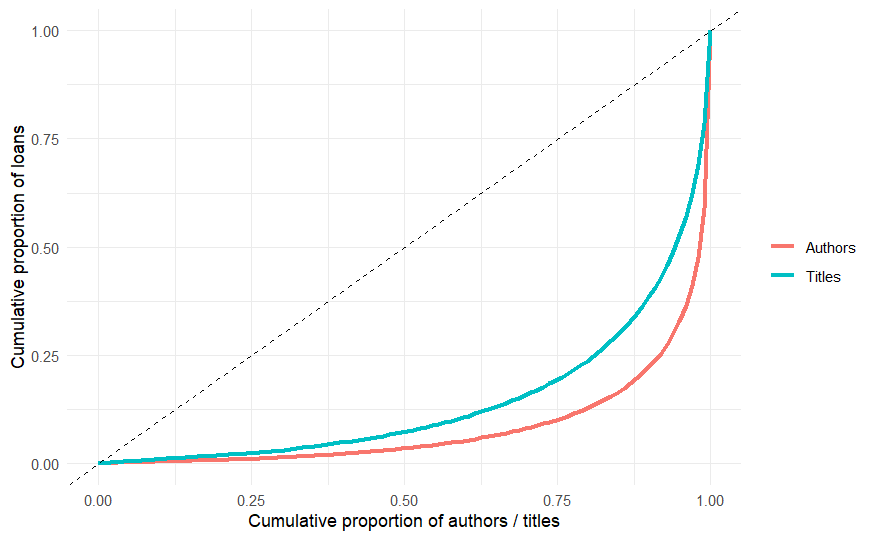
A select number of authors and titles dominate the loan data. Specifically, 11.7%
of the most borrowed authors account for 80% of the total loans made to adult users,
while 24.2% of the most borrowed titles represent 80% of the total borrowed. This
pattern suggests a high concentration of reader interest in a relatively small group
of authors and books.
Figure 1 visualizes this concentration of loans with two Lorenz curves: one for authors and
one for titles. The dashed diagonal line represents what a perfectly equitable distribution
would look like, where each author or title contributes proportionally to the total
number of loans. The further the curve deviates from this diagonal, the greater the
concentration of loans among a limited number of authors or books. The Gini index,
derived from the area between the Lorenz curve and the line of equality, quantifies
this inequality on a scale from 0 (perfect equality) to 1 (maximum inequality). In
this case, the Gini index is 0.84 for authors and 0.72 for titles, indicating a strong
concentration of loans among a small number of authors and, to a lesser extent, titles.
Figure 1Cumulative distribution of loans by authors and titles in Madrid public libraries
in 2024
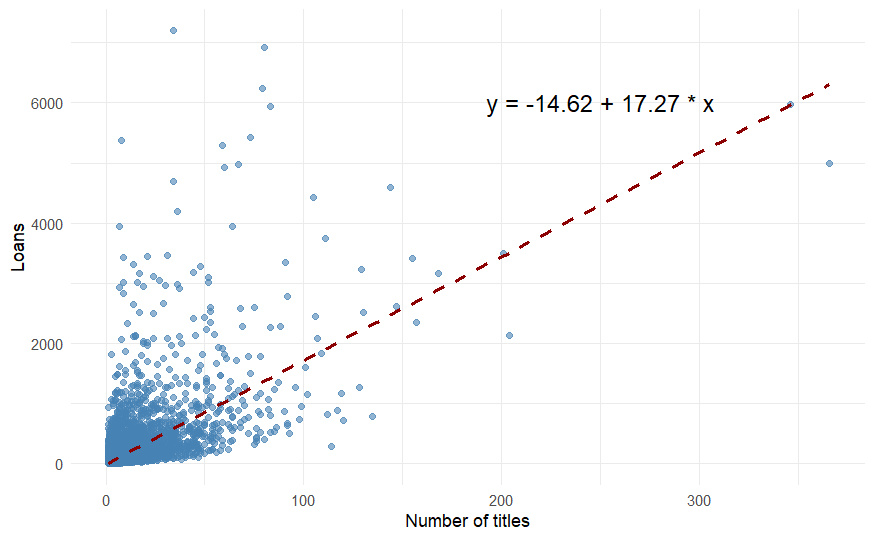
There is a clear relationship between the number of works available by an author and
that author’s total number of loans: authors with longer careers and a larger number
of books in the library catalogue tend to register more loans. The points on the chart
in Figure 2 represent different authors, whose positions are determined by the number of titles
they have in the library catalogue and the total number of loans for their works.
The trend line shows the best-fitting linear regression that describes the relationship
between the two variables.
This regression suggests that a higher number of titles is generally associated with
a greater number of loans. The Pearson correlation coefficient is 0.65, indicating
a moderately strong linear relationship between the two variables. The regression
model has an R2 of 0.43, meaning that approximately 43% of the variability in the number of loans
can be explained by the number of titles available by the author. The model is statistically
significant (p < 0.001). However, the standard deviation of the residuals is 112.7,
meaning that the model’s prediction for an author’s number of loans differs on average
by ±112.7 loans from the actual value. This suggests that there is still considerable
unexplained variability in the model, probably due to other factors such as the author’s
popularity, the subject matter of their works, or their presence on conventional and
social media.
Figure 2Relationship between number of titles and loans per author
Tables 4 and 5 present a breakdown of the number of loans by gender and nationality of the 515 authors
whose works are borrowed the most by adult users in Madrid’s public libraries. The
findings for gender (Table 4) reveal that nearly two thirds of the most borrowed authors are men (61%), who account
for a very similar percentage of the loans (62%), while women represent 39% of the
authors and 38% of the loans. This male overrepresentation reflects the gender gap
observed in literary creation ().
Table 4Gender of the 515 authors with works most borrowed by adult users in Madrid public
libraries in 2024
Gender
Authors
% authors
Loans
% loans
Male
316
61%
383,579
62%
Female
199
39%
236,382
38%
The data on nationality (Table 5) shows that works by Spanish authors account for 44% of the loans, probably due both
to a strong presence of national literature in Madrid’s public libraries and to a
preference for Spanish authors among users. In second place are works by English-speaking
authors (American and British), which together represent 29% of loans. Representing
a much smaller proportion of the total are French authors (6%) and Japanese authors
(3%), the latter mainly due to loans of manga titles. The remaining 18% of loans are
of works by authors from 31 other countries.
Table 5Nationality of the 515 authors with works most borrowed by adult users in Madrid public
libraries in 2024
Country
Authors
% authors
Loans
% loans
Spain
203
39%
271,568
44%
United States
92
18%
104,662
17%
United Kingdom
63
12%
73,755
12%
France
36
7%
35,664
6%
Japan
20
4%
21,035
3%
31 countries
101
20%
113,277
18%
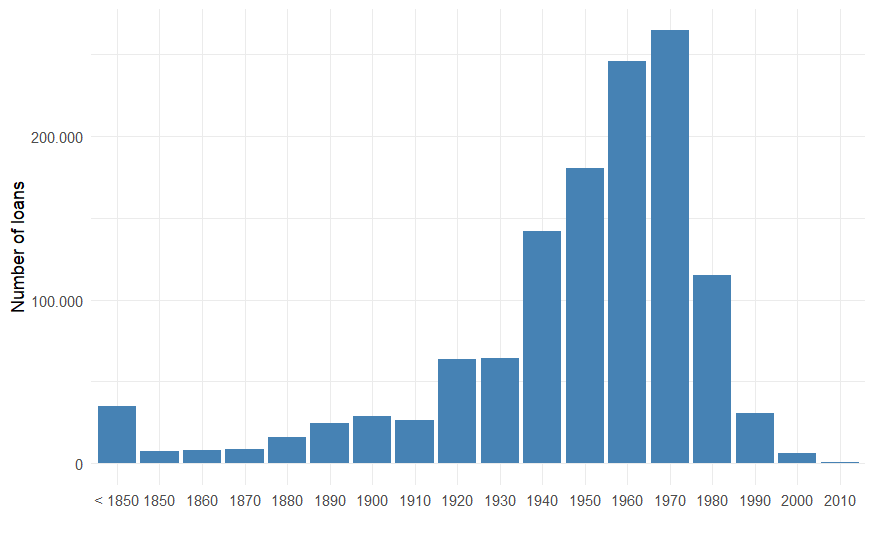
For the temporal analysis, the authors’ year of birth was used. This information was
available on 25,690 authors who account for 1,266,355 loans, representing 40% of the
authors in the dataset and 72% of the total loans.
Figure 3Loans to adult users in Madrid public libraries in 2024 by authors’ decade of birth
Figure 3 shows that the most popular authors are those born in the 1960s and 1970s, who together
account for 40% of the loans. In fact, seven of the 15 authors identified in Table 2 as the ones whose works were borrowed the most were born in these two decades. Among
authors born before the 20th century, besides Stefan Zweig, who appears in 14th place in Table 2, two authors stand out for registering more than 3,000 loans each in 2024: Benito
Pérez Galdós (1843–1920) and Agatha Christie (1890–1976). No other authors born before
the 1920s exceed this threshold, while three authors born in the 1920s do so: Andrea
Camilleri (1925–2019), René Goscinny (1926–1977) and Gabriel García Márquez (1927–2014).
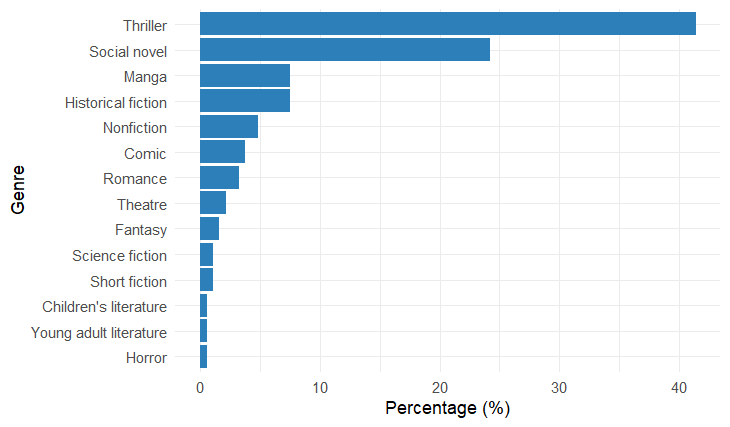
The genre analysis of the 186 books that exceeded 350 loans in 2024 again reveals
a clear preference for thrillers among adult users of the Madrid municipal library
network (Figure 4). This category, which covers novels classified in the catalogue as “crime”, “suspense”,
“noir” or “detective”, includes 77 of the 186 most borrowed titles. All together,
these titles account for 42% of the loans. In second place are social novels (24%
of titles and 23% of loans), manga (8% of titles and 11% of loans), and historical
novels (8% of titles and 7% of loans). Only nine of the 186 most borrowed titles were
non-fiction, among which El infinito en un junco by Irene Vallejo stands out for its number of loans.
Figure 4Genre of the 186 titles most borrowed by adult users in Madrid public libraries in
2024
Loans to child users
An analysis of loans to child users (under 14) reveals a high concentration around
a small group of authors and titles. Table 6 lists the 15 authors who registered the most loans to children. Almost all of them
form part of very popular and extensive series. Table 7 shows the titles borrowed the most, with Japanese manga once again occupying a prominent
place. Other illustrated humour series are also popular, reflecting the predominant
tastes of child readers.
Table 6Authors with works most borrowed by child users in Madrid public libraries in 2024
Author
Titles
Loans
Santiago, Roberto (1968-)
80
18,943
Stilton, Geronimo
375
18,643
Mañas Romero, Pedro (1981-)
86
15,537
Kinney, Jeff (1971-)
61
15,513
Pilkey, Dav (1966-)
76
14,023
Ibáñez, F. (1936-2023)
399
12,473
Stilton, Tea
160
12,015
Muncaster, Harriet (1988-)
50
9,926
Oro, Begoña
91
8,387
Blyton, Enid (1897-1968)
171
7,166
Goscinny, René (1926-1977)
203
6,516
Pichon, Liz (1963-)
37
5,773
Palmiola, Isaac (1979-)
41
5,567
Telgemeier, Raina (1977-)
15
5,562
Riordan, Rick (1964-)
55
4,879
Despite the large size of the children’s catalogue, the concentration of loans around
a few authors and titles is very high. Just 7.8% of the authors account for 80% of
children’s loans, while only 18.9% of the titles are responsible for 80% of the total.
According to the Gini index, this inequality has a value of 0.88 for authors and 0.76
for titles—levels even higher than those observed in loans to adults.
Table 7Titles most borrowed by child users in Madrid public libraries in 2024
Author
Title
Loans
Kishimoto, Masashi (1974-)
Naruto
2,956
Horikoshi, Kohei (1986-)
My Hero Academia
2,449
Laperla (1975-)
Super patata
2,274
Fujio, Fujiko F. (1933-1996)
Doraemon
2,006
Blabey, Aaron (1974-)
Animalotes
1,456
Davis, Jim (1945-)
Garfield
1,433
Aoyama, Gosho (1963-)
Detective Conan
1,079
Kinney, Jeff (1971-)
Un pringao total
1,074
Kinney, Jeff (1971-)
La ley de Rodrick
1,001
Kinney, Jeff (1971-)
¡Esto es el colmo!
981
Kanata, Konami (1958-)
El dulce hogar de Chi = Chi's sweet home
878
Kinney, Jeff (1971-)
Días de perros
863
Kinney, Jeff (1971-)
La cruda realidad
863
Kinney, Jeff (1971-)
¡Atrapados en la nieve!
780
Ibáñez, F. (1936-2023)
Mortadelo y Filemón
765
Overall, these results reflect the strong influence of a few well-established sagas
and franchises in children’s literature, which suggests a highly polarised landscape
of reading preferences dominated by characters, series and formats with a strong graphic
and serialised component.
Discussion
The analysis of book loans during 2024 in the Madrid public library network reveals
a strong concentration of reading consumption around a small group of bestsellers.
The high Gini indices for both adult loans (0.84 for authors and 0.72 for titles)
and children’s loans (0.88 and 0.76, respectively) reflect that a very small proportion
of the library catalogue accounts for most of the loans, raising questions about the
effective diversity of the content chosen by readers.
Among adult readers, there is a clear preference for thrillers (including crime, noir,
detective and suspense novels), which represent 42% of all loans. Authors such as
Juan Gómez-Jurado and Carmen Mola dominate the rankings, while Japanese manga stands
out among the most borrowed titles. This preference for popular genres among both
adult and child users may be related to their more accessible narratives and more
aggressive marketing strategies by their publishers. Many of the most borrowed works
form part of series of books with similar themes, plots, narrative structure, character
development and discursive style (). The results of this study also seem to confirm the theory that the two age groups
(adult and child readers) are converging (). It is noteworthy that among the most borrowed authors for adults are writers whose
work is usually aimed at children, such as Geronimo Stilton, Dav Pilkey or Pedro Mañas,
although this may be partly due to the shared use of family library cards.
The data reveal an overrepresentation of males among authors with the most borrowed
titles (61%), consistent with findings related to the persistent gender gap in literary
creation. According to data from the Spanish Ministry of Culture (), 60.3% of books with an ISBN registered under a single author were written by men.
Similarly, the nationality of authors reveals a strong presence of Spanish literature
(44% of loans) and works by English-speaking authors (29%), probably reflecting both
the structure of the collections and readers’ preferences.
Authors born in the 1960s and 1970s are responsible for a significant proportion of
the titles borrowed, which may be because authors of this age are actively publishing
and have a strong media presence. However, there is also considerable demand for classic
authors such as Stefan Zweig, Benito Pérez Galdós and Agatha Christie, who continue
to be regularly read many decades after their publication.
In loans to children, the concentration pattern is even more pronounced than it is
among adults, with 80% of loans attributable to just 7.8% of authors and 18.9% of
titles. Established figures such as Roberto Santiago, Jeff Kinney and Dav Pilkey dominate
the statistics, and there is also a notable presence of Japanese manga. Sagas, graphic
humour, and recurring characters appear to play a key role in fostering loyalty among
child readers.
Another significant finding is the limited overlap between the authors with most borrowed
works identified in this study and those who usually receive attention from other
agents in the literature ecosystem, such as literary prize juries. Gómez-Díaz and
identified 16 Spanish authors with the most literary awards between 2000 and 2020.
Of these, only half are among the 500 authors who registered the most loans in Madrid’s
public libraries in 2024: Lorenzo Silva (in 10th place), Almudena Grandes (21st), Fernando Aramburu (53rd), Javier Cercas (79th), Javier Marías (123rd), Ignacio Martínez Pisón (150th), Rafael Chirbes (156th) and Álvaro Pombo (226th). This group is comprised largely of authors with a strong media presence. In contrast,
other authors with multiple awards but less media visibility rank much lower in the
research results: Antonio Soler (749th), Cristina Fernández Cubas (990th), Javier Negrete (1,122nd), Francisco López Serrano (10,717th), José Antonio Ramírez Lozano (15,466th), Marcelo Luján (21,389th), Miguel Sánchez Robles (23,987th) and Blanca Riestra (33,062nd).
The 2023 edition of the Barómetro de hábitos de lectura y compra de libros () included a ranking of the ten most read authors according to survey responses. Only
one of these authors appears among the top ten most borrowed in Madrid’s public libraries:
Arturo Pérez-Reverte, who was also cited as a key author in the 40dB Radiografía de la lectura en el siglo XXI (). Five other authors mentioned in the Barómetro rank within the top 100 authors who registered the most loans in Madrid libraries
in 2024: Ken Follett (35th), Julia Navarro (45th), Gabriel García Márquez (52nd), J. K. Rowling (55th) and Carlos Ruiz Zafón (75th). The remaining four authors are further down in the loan statistics: J. R. R. Tolkien
(173rd), Ildefonso Falcones (225th), Antoine de Saint-Exupéry (394th) and Dan Brown (446th).
It is worth noting some of the limitations of this study. First, it focuses exclusively
on physical book loans, as digital loans, managed via platforms such as eBiblio, are
not included in the analysed dataset, which means the study excludes a significant
portion of reading consumption. Second, the database lacks detailed sociodemographic
information about users (age, gender, education level, etc.), preventing direct correlation
between reader profiles and borrowing patterns. Only a broad distinction between adult
and child users is possible, which hinders the interpretation of the data from the
perspective of sociology or audience studies.
Conclusion
This analysis of loans in Madrid’s public library network during 2024 reveals a marked
concentration of authors and titles in the borrowing patterns of both adults and children.
The findings confirm the prominence of popular genres such as thriller and manga,
as well as reader loyalty to certain sagas and authors.
The predominance of authors born in the 1960s and 1970s, along with the dominant presence
of Spanish, American and British literature, underscores the role of libraries as
mirrors of contemporary cultural dynamics. Other findings include the continued reading
of classics and a significant circulation of translated literature. Moreover, the
study identifies persistent inequalities, such as the overrepresentation of males
among authors who register the most loans, which is consistent with publication data.
Despite its limitations (such as the exclusion of digital loans and lack of detailed
sociodemographic data on users), this analysis confirms the great value of loan data
as a complementary source for the analysis of reading habits, enabling observation
of real cultural consumption practices in a public, free and accessible environment.
This study aims to encourage other libraries or networks to begin publishing this
type of information. In a context of increasing calls for administrative transparency,
there are good reasons for making these data publicly available, and the experience
of the Madrid public library network demonstrates that it can be done without compromising
user confidentiality.
While the field of reading studies tends to rely on surveys and published market data,
library loan systems offer a valuable alternative perspective, providing empirical
information about what is being read in shared reading spaces. Improving access to
this information for its analysis and dissemination could significantly enrich our
understanding of reader habits and reading promotion policies.
Gómez-Díaz, R., & García-Rodríguez, A. (2024). Los premios como configuradores de
un canon literario infantil y juvenil. Ocnos, 23(1). https://doi.org/10.18239/ocnos_2024.23.1.452
7
Gómez-Díaz, R., & García-Rodríguez, A. (2025). Los premios de ficción narrativa de
adultos en castellano. En G. Lluch (Dir.), Los libros que leemos. ¿Quién, dónde y cómo se decide? (pp. 67-95). Tirant Humanidades.
Reyes-Abundes, M., & Cebral-Loureda, M. (2024). Experiencia de lectura de la obra
de Fernanda Melchor: análisis de las reseñas en Goodreads. Ocnos, 23(1). https://doi.org/10.18239/ocnos_2024.23.1.363
13
Sánchez-García, P., Hernández-Ortega, J., & Rovira-Collado, J. (2021). Leyendo al
lector social: evolución de la literatura infantil y juvenil española en Goodreads.
Ocnos, 20(1), 7-22. https://doi.org/10.18239/ocnos_2021.20.1.2446