This article aims to analyze how Spanish children's and young adult literature publishers use TikTok as a reading recommendation tool in the digital environment. Specifically, it seeks to identify how many publishers are present on this network, characterize their publications—both in content and form—and evaluate their impact through interaction metrics. To do so, a content analysis methodology was applied, examining the accounts of children's and young adult publishers and the five most recent publications of each. The results reveal a still-minor and under-established presence on TikTok. Posts tend to be informative, focused on showcasing books or making simple recommendations. The impact is limited in terms of followers and interactions, although notable cases are identified where the use of influencers and more visual strategies generate greater reach. The study concludes that, although its development is still incipient, TikTok represents a channel with great potential for promoting reading among young audiences.
Downloads
Download data is not yet available.
Article Details
How to Cite
Gómez-Escalonilla, G. (2026). From the page to the screen: TikTok in children’s and young adult literature. Ocnos. Journal of reading research, 25(2). https://doi.org/10.18239/ocnos_2026.25.2.645
Gómez-Escalonilla: From the page to the screen: TikTok in children’s and young adult literature
INTRODUCTION
The publishing sector, which has traditionally been characterised by its methods of
book production and distribution, has undergone significant changes in recent decades
due to the rise of digitalisation and new technologies (). The first significant change was the online sale of printed books, a development
spearheaded by Amazon, alongside other changes in the distribution and marketing of
books. Digital books are also published, although the industry still relies primarily
on printed books: EUR 2.858 billion in revenue from printed books compared with EUR
165.5 million from digital books (). Whilst the essence of the sector has not changed, certain areas have, such as book
promotion and reading recommendations. One of the first changes is the websites set
up by publishers, where they not only talk about their books but can also sell them.
These changes have exacerbated and diversified with the emergence of social media,
where users have introduced new ways of communicating and promoting books, opening
up new avenues of connection between readers. Against this backdrop, publishers specialising
in children’s and young adult literature in Spain have begun to adapt their digital
strategies with the aim of connecting with an audience that is increasingly active
in digital environments. This research aims at examining the presence of children’s
literature publishers on social media, specifically on TikTok, in order to gain a
better understanding of this phenomenon. How many publishers have a presence on TikTok,
since when, what their posts are like, which books they mention, what format they
use, and how many followers they have—these are some of the questions this study aims
to answer.
The research presented here draws on numerous references that analyse various aspects
of the phenomenon: the effects of digitisation and new technologies on the world of
books (), with references from outside Spain (; or ), and within Spain (; ); the impact of social media on the publishing sector (; ; ). Furthermore, there is also a wealth of literature on the TikTok and BookTok phenomenon,
particularly in the English-speaking world (; ; ). All these references have paved the way for research more closely related to the
present study, which analyses children´s literature on social media. Therefore, the
study by analyses this sector on Instagram; analyse the influencers who review children’s literature on Instagram and YouTube.
also investigate the presence of children's and young adult publishers on social
media, focusing on Twitter, Instagram and Facebook. No research has been identified
in the Spanish-speaking world that focuses on children’s literature publishers on
TikTok; consequently, this study may be seen as paving the way for a new line of research
into this social media platform.
THEORETICAL FRAMEWORK
Changes in the publishing industry
Children’s and young adult literature is understood as a whole that encompasses the
period from when children are told stories until they are considered adults (). These books play a key role in cognitive, emotional and social development, as
well as encouraging a love of reading. Furthermore, it creates a stable economic environment.
The fact is that the publishing sector in Spain is the country’s leading cultural
industry: in 2024, it reached EUR 3,037.51 million, returning to turnover levels seen
before the 2008 crisis (). Since the pandemic, the publishing market has continued to grow, including the
children’s literature sector, which in 2024 generated turnover of EUR 551.48 million,
accounting for 18.2% of the total, an increase of almost 2% on the previous year.
In terms of corporate structure, the sector is characterised by a high degree of concentration,
dominated by large media groups, particularly Planeta and Penguin Random House, a
structure that also affects children´s literature: Destino Infantil y Juvenil (Planeta)
and Alfaguara Infantil y Juvenil (PRH). There is also the Loqueleo imprint, which
is part of the Santillana group. Other Spanish groups whose growth has been driven
by education include: Anaya, SM, Edelvives and Edebé, as well as independent publishers—some
with a significant presence, such as Kalandraka, Ekare and Norma Editorial, and others
on a smaller scale, such as Takatuka, A Buen Paso, Thule, Diego Pun and Editorial
Juventud.
Children’s literature publishers still maintain a high standard of publishing, characterised
by superb production values and a wide variety of themes (). This positive trend is reflected in the figures, both for consumption and production.
Overproduction in publishing
According to the Report on Reading Habits and Book Purchasing in Spain (), the reading rate among children is very high: 82.5% of children aged 6 to 9 read
books other than textbooks. The figures for young people aged 14 to 24 are also high:
at 75.3%, this figure has been rising in recent years and is 10 percentage points
above the national average (the reading rate in Spain stands at 65.5%).
As reading becomes more popular, so does the range of books available for young children.
In 2024, of the 59,758 titles published in print, 10,246 were children´s and young
adult books. The average print run for a children’s book (5,524 copies per title)
far exceeds the average print run for a book aimed at adults (3,517 copies). Based
on these figures, book production totals over 56 million copies published. It has
increased by more than 9% compared with last year’s figures.
Both in the publishing sector as a whole and in children’s literature, the market
is characterised by an overproduction of books. The reason why so much is produced
has to do with the dynamics of publishing: to achieve the “catalogue effect”, to focus
on new releases, to increase the chances of success… (). This trend towards an increasing supply of books requires maximising strategies
that raise the profile of a title and increase opportunities to promote reading through
conventional methods: advertising campaigns, press relations, book launches, book
fairs, shelf placement in bookshops, chains and high-street retailers, or engagement
with various stakeholders, such as booksellers, librarians, teachers and other “cultural
influencers” (). However, in recent years, other online strategies have been introduced: pop-up
websites, content marketing, online advertising, SEO optimisation on e-commerce platforms
(), collaborations with literary influencers, and a social media presence – the latter
being the focus of this study.
The digital impact
Digitalisation is having an impact on many aspects of the publishing industry, one
of which is the editing process. According to the book’s Domestic Trade section (), turnover for this format in children´s books stood at EUR 9.781 billion, although
this figure accounts for only 5.5% of total turnover. Although e-books have not managed
to replace paper books, other digital formats have certainly gained prominence in
the children’s and young adult sector. According to the Report on Reading Habits and
Book Purchasing (), there has been a significant increase in the reading of websites, blogs and social
media among teenagers: 25% of 10- to 14-year-olds already read social media, a figure
that rises to 68.5% among 15- to 18-year-olds.
From the perspective of how people spend their free time, websites, blogs and social
media may be activities that take time away from reading books, but these digital
platforms can also help to encourage reading if they are used as a means of recommending
books. In fact, although friends, colleagues or family remain the main source of recommendations
when buying or reading a book (51.4%), the internet now accounts for 32.3% and social
media for 23%.
Given this significance, publishers targeting this audience regard their online presence
as a key factor; indeed, most authors would prefer to have their work reviewed on
a blog or forum with thousands of visitors rather than in a cultural supplement reserved
for the cultural elite ().
TikTok and new forms of influencer marketing
Social media doesn’t just serve to raise the profile of books and promote them; it
also enables a new connection with audiences. Researchers who have investigated the
impact of digitalisation on reading among young people are already referring to the
“social reading” () made possible by children´s literature 2.0. One of the most widely researched areas
is how communities use these networks in relation to books. It inspires such a proactive
response from the public that children´s literature 2.0 definitively breaks down the
barriers between author and reader. It is children and young people who actively seek
out information on the texts that interest them ().
This ability for users to search for, create and share content can be profitable if
it attracts visitors and brands sponsor such activity. They are influencers, and they
have a greater impact on younger audiences because they are relatable, use accessible
language and look similar to them: they are peers who communicate, offer advice and
make recommendations, and their followers believe and trust their messages.
From 2012 onwards, booktubers, booktagrammers and booktokers began to proliferate,
racking up millions of views. Unlike recommendation algorithms, which suggest content
based on users’ online preferences and behaviour, influencers personalise recommendations
by acting as trusted opinion leaders (); they discover books, discuss plots, play games or compete around the works, thereby
creating a community of followers whose enthusiasm can influence a book’s commercial
success.
Publishers, taken aback by this phenomenon, are beginning to take notice of them and
forge relationships with them: by sending them their books or featuring them on their
own social media profiles, which they began to create as the 21st century progressed,
diversifying their online presence and adapting it to the characteristics of each
platform (). The latest to emerge is TikTok, the platform on which this study focuses.
TikTok was launched in 2016 by ByteDance, a Chinese technology company, under the
name Douyin, but in 2017 it rebranded as TikTok as part of its expansion outside China.
In 2018, following the acquisition and integration of Musical.ly, the platform saw
significant growth among young audiences thanks to its short-form video format, its
tailored algorithm and the ease with which users could create and share creative content.
The impact on the world of books began in 2020 through the community known as BookTok:
readers and content creators who started recommending books via videos, creating trends
that have had a direct impact on the publishing market and book sales. There is no
exact figure for how many users are on BookTok, as it is a very large and constantly
growing online community. However, the hashtag #booktok has racked up over 38 billion
views and 55 million mentions on TikTok, highlighting its massive reach. Although
there are other social media platforms that host communities of book influencers,
TikTok’s current popularity and its highly visual and viral nature justify the decision
to focus this research on this particular platform.
METHODOLOGY
Generally, this study aims at analysing the presence and characteristics of children’s
and young adult literature publishers on TikTok. More specific objectives include:
To find out how many publishing houses have a profile on TikTok.
To understand aspects of visual identity, the age and performance of children’s literature
accounts.
To understand your engagement metrics.
To analyse the posts of children’s literature publishers: their narratives and the
books mentioned therein.
To familiarise oneself with the formats and formal requirements of these posts.
As in other studies analysing social media (; ; ; ), this study employs content analysis. This research technique, based on the “objective,
systematic and quantitative analysis of the manifest content of communication” (), involves defining the corpus under study. In this case, the study population comprises
the 103 publishers listed by the Spanish Federation of Publishers’ Associations in
its directory of children’s literature publishers by subject area. Each name followed
by “publisher” was searched for using TikTok’s search engine, with institutional profiles
identified by their profile description and the use of a logo as their profile picture.
The search revealed that only 25 of the 103 publishers had a TikTok account at the
time the search was carried out, in May 2025.
A two-part content analysis was carried out on these 25 profiles: the first focused
on the profiles themselves; the second analysis examined the five most recent posts
on each profile, filtered by “recent” and excluding pinned posts. As Triqueta Editora
has no content and Conecto has only two posts, a total of 117 posts were ultimately
analysed.
This corpus, comprising 25 profiles and 117 posts, has been analysed using variables
that enable a comprehensive characterisation of both the profiles and the videos,
combining aspects of identity, audiovisual composition and performance. Firstly, the
profile information includes the type of image used (specifying what is shown: a personal
photograph, a logo, an illustration or a cartoon). The year the profile was created
is also recorded, based on the date of the first post. The total number of posts on
their profile is also displayed. The tracking metrics provided by the platform itself
are recorded; in this case: followers and “likes”.
As regards the content of the posts, most of the coding used for the variables is
dichotomous, based on whether the variable is present or absent. The system checks
whether an influencer or author appears, as well as their gender. It also identifies
visual and narrative elements: the setting in which it is filmed, the type of shot
(long shot, medium shot, close-up, etc.), the type of voiceover used (voice-over or
on-camera), and the use of visual or sound effects, as well as the presence of music
and subtitles. The variables relating to the books examine how many appear in the
posts, their literary genre, the degree to which their covers are visually recognisable,
and whether they appear upside down – a common feature in front-facing camera recordings.
The format is also classified using the most widely accepted classification system,
along with its tone and the hook – that is, the reason behind the message. These features
are complemented by engagement metrics (views, likes, favourites, shares and comments),
which enable us to measure the impact and level of audience engagement.
Table 1Variables in the analysis sheets
Profile: (Corpus: (25 publishers)
Posts: (Corpus: 117)
- Profile picture, logo, photograph, cartoon or other. If the profile picture is a
photograph, gender could be interests
- Year of commencement
- No. of posts
- Followers
- Like
- Duration
- Influencer (Yes / No)
- Author (Yes / No)
- Gender: Male / Female / Other)
- Background: Interior with bookcase / Other interior / Exterior with bookcase / Other
exterior / Other
- Type of plan: Miscellaneous / Close-up / Medium / General / NA
- Voice: Voice-over / On-screen narration
- Visual effects (Yes / No)
- Sound effects (Yes / No)
- Music (Yes / No)
- Subtitles (Yes / No)
- Books: One / More than one / No books
- Book genre: (Novel / Horror / Science Fiction / Thriller / Romance / Fantasy / Children’s
and Young Adult / Poetry / Classics / Essay / Self-help / Other / Non-fiction)
- Visual identification of the book(s) (Yes / No)
- Reversed cover layout (Yes / No)
- Post type: Review / Unboxing / Books haul / Book tag / Bookshelf / Wrap-up / Top
books / Visual storytelling / Graphic design / Other
- Tone: Positive / Negative / Neutral
- Hook: (Yes / No)
- Views
- Likes
- Favourites
- Shares
- Comments
These variables relating to the 25 publishers and 117 posts were entered into an Excel
spreadsheet, and frequency tables have been created to perform quantitative analyses
of the data obtained and, on this basis, to draw inferences and interpretations, all
carried out in accordance with the relevant ethical considerations.
ANALYSIS OF THE RESULTS
The presence of children’s book publishers on TikTok
Of the total of 103 publishers monitored, only 25 (24.2%) have a TikTok profile, confirming
that the sector has a limited presence on this platform. The absence of the two major
publishers in the duopoly—Alfaguara Infantil y Juvenil (PRH) and Destino Infantil
(Planeta)—is not due to a lack of interest in social media, but rather to the fact
that both operate through general corporate accounts (Penguinlibros and Planetadelibros),
following a pattern already seen in other digital environments.
Among the major publishers, Anaya Infantil y Juvenil and Edelvives do have a presence,
whilst SM does not have an active account, despite being frequently mentioned by other
users (around 150 times), which indicates recognition and interest from the reading
community.
The group of active profiles reflects a wide range of publishers is made up as follows:
– Imprints designed for children: Andana, Conecto, Cuento de Luz, Litera Libros, Zahorí,
Triqueta, Crononauta.
– Imprints aimed more at teenagers or young adults: Juventud, Nova Casa, Obscura and
Ra-ma, with a strong focus on comics and manga.
– Imprints with educational themes: Bruño, Sentir and Editorial GEU.
– Mixed imprints or imprints with an additional adult catalogue: Norma, Bromera and
Plutón.
– Publishers specialising in specific formats: Exlibric (autopublicación), Libros
del Zorro Rojo and Tramuntana (picture books).
This diversity suggests that content on TikTok does not follow a single editorial
model, but rather a range of approaches that are still in their experimental stages.
Profile characteristics: identity and activity
As regards visual identity, all publishers use their logo as their profile picture.
This approach, consistent with institutional practice, makes it easier to identify
content in an environment where mentions, remixes and third-party posts about the
books are rife.
As regards the age of the accounts, there are no profiles dating from before 2020,
which suggests they have only recently joined the TikTok ecosystem. Most of the openings
are scheduled between 2020 and 2022, with a significant increase in 2021. The most
recent edition is published by Editorial Sentir (2025).
Activity on these accounts is limited:
– 18 publishers have fewer than 100 posts.
– 6 have between 100 to 500.
– None of them has reached 500 posts, although Cuento de Luz is the most consistent
(468 videos).
Overall, the activity suggests exploratory or one-off strategies, rather than a sustained
or professionalised presence.
Scope and engagement metrics
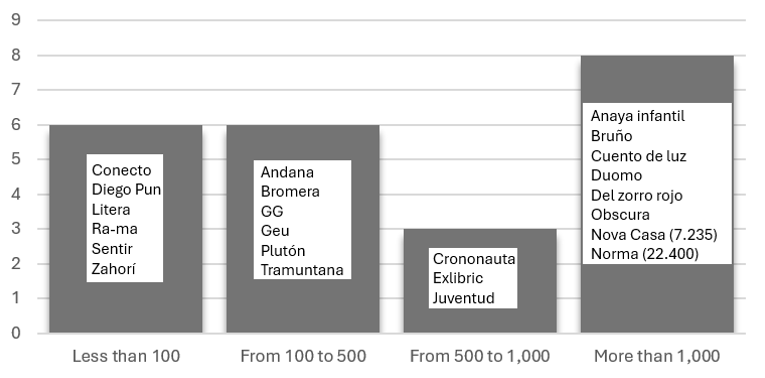
Profile scope, based on the number of followers, varies considerably:
– A small group with just over 100 followers (Conecto, Ra-ma, Sentir, Diego Pun, Zahorí).
– Most have between 100 and 1,000 followers.
– An intermediate group ranges from 1,000 to 2,000.
– Two cases stand out: Nova Publishing House: 7,235 followers (young adult romance)
and Norma Editorial (@normaedmanga): 22,400 followers.
The data suggests that certain genres—particularly manga—align more closely with the
consumption patterns characteristic of TikTok’s algorithm ().
Figure 1Number of followers on the children´s books accounts Source: Prepared by the authors.
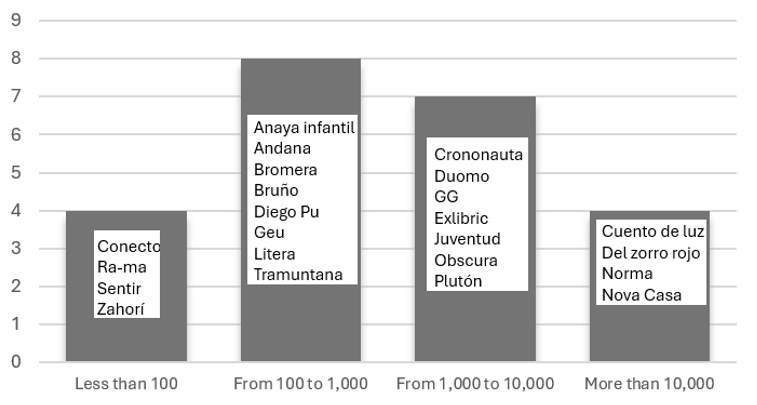
The distribution of “likes” confirms the previous pattern, although there are some
exceptions that show occasional spikes in visibility. Particularly noteworthy are:
Cuento de Luz (12,700), Libros del Zorro Rojo (37,900), Nova Casa (66,300) and, in
particular, Norma Editorial (214,700).
Figure 2Number of “likes” from children´s and young adults publishers Source: Prepared by the authors.
With regard to video views and engagement, the average number of views per video (853)
varies considerably, ranging from fewer than 100 to more than 6,000.
Engagement is low: average number of “Likes”: 23; “Favourites”: 3,5; “Comments”: 1.8.
There are very few “Shared” cases: just three.
Although some publishers exceed these figures (Nova Casa, Edelvives, Juventud, GEU),
the interaction tends to be superficial, and the content is largely expository and
does little to encourage active participation.
Qualitative analysis: narratives and communication strategies
Book-centred stories
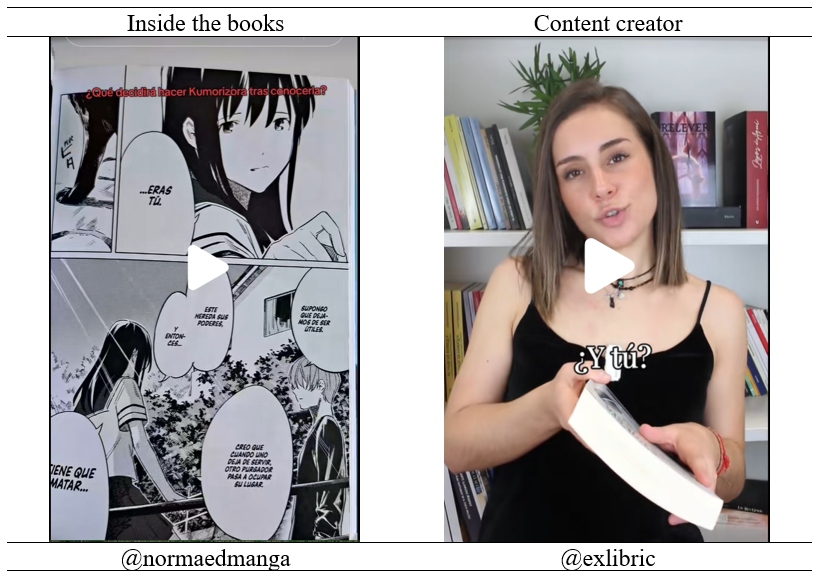
The main focus is on the physical presentation of the book (cover, interior pages,
illustrations). TikTok acts as a “showcase”, in keeping with its highly visual environment.
This strategy, which is consistent with the nature of the publishing product, makes
books—especially short stories—the narrative focus of the videos. The exhibition focuses
primarily on the interiors, illustrations and visual details of the items, drawing
on the aesthetic appeal of the objects themselves to attract visitors. This trend
reflects an intention to convey the content through the book’s own design, format
and visual presentation, rather than relying on external narratives or fictional stories
created around the title. As a fast-paced, visual platform, TikTok serves as an effective
showcase for this type of content, as shown in Figure 3, although in many cases there is little interaction beyond the direct presentation
of the book.
People-centred stories
In 49 posts, the focus of the video is on the people.
61% feature female protagonists, reflecting common trends among readers and in recommended
content.
Almost half (23 out of 49) are external influencers, whose use appears to be an effective
strategy for “translating” editorial content into the TikTok style and capitalising
on established communities. Examples of how they are used include content creators:
@sandracuestall (Zahorí Books) or @laauuvzqz (Nova Casa Editorial).
Authors and illustrators are credited in 19 cases: a strategy with great potential,
though one that remains underdeveloped, particularly given that authors are an exclusive
asset of the publisher and bring unique symbolic and emotional value. Their involvement
not only helps to bring the book to life and give the public an insight into the creative
process, but can also forge stronger bonds with readers by putting a face and a voice
to the content.
Figure 3Examples of key stories
Other stories
Some publishers are experimenting with other stories aiming at to showcasing the day-to-day
workings of the publishing industry. One of these features involves staff from the
publishing house, who appear in some videos explaining their work, sharing insights
into the editorial process, or simply showing the environment in which they work.
Another interesting story revolves around publishers’ participation in book fairs
and other literary events. This narrative approach makes the most of the behind-the-scenes
aspect, which is highly valued on social media, and allows the publisher to share
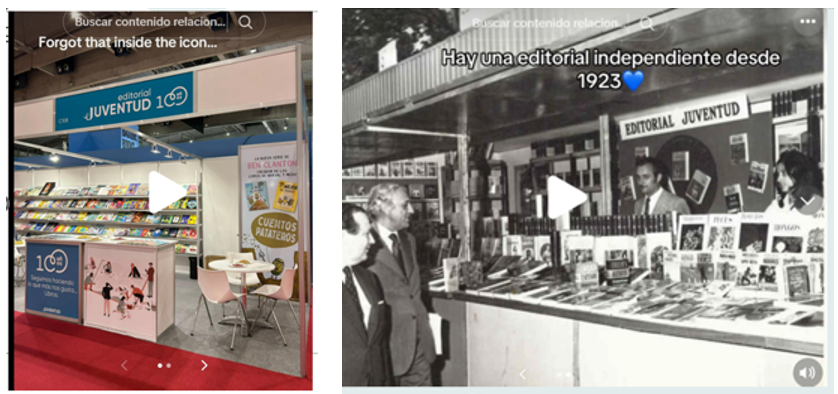
not only its books but also its involvement in the process. Another interesting example
is that of the publishing house Juventud, which has a video showing its stand at a
trade fair in 1923 and today, as can be seen in Figure 4.
Figure 4Published by Editorial Juventud Source: TikTok
Content and tone of posts
– There are references to the books in 96 posts: 49 refer to more than one book, 47
refer to just one.
– In 21 videos (18%), no title is mentioned, with coverage of events (presentations,
trade fairs, etc.) being the most common.
– In 13 cases, the title cannot be identified, which limits its promotional value.
– A total of 109 books are listed: 58 children´s literature books, and the rest are
novels, fantasy, romance and poetry.
– The most common format is Bookhaul (55 instances), followed by reviews/recommendations
(17).
– The tone is largely positive (70%) compared with other neutral posts, as there are
no posts that highlight negative aspects.
– 36 posts make use of thematic “hooks” (Book Day, Father’s Day, etc.), in line with
standard cultural marketing practices.
Visual, auditory and formal aspects
The analysis reveals patterns consistent with TikTok’s general style:
– A predominance of indoor spaces (70 cases), particularly shelving units (44).
– Predominant use of medium shots and close-ups (30), creating a sense of intimacy
and authenticity.
– Music has been included in 90 videos, in line with the algorithm’s prioritisation
of popular audio tracks, such as songs by Taylor Swift or Quevedo.
– Few visual and audio effects (22 and 8 instances respectively).
– Widespread use of on-screen text (92 videos), which improves accessibility and retention.
Overall, the resources are there, but they remain largely untapped in terms of creativity.
DISCUSSION
In 2010, , when asking publishing house communications directors about their recommendation
and promotion strategy, noted that its main purpose is to create a distinct communication
strategy for each book. Given that the children’s literature sector publishes 10,246
new titles a year, the only way for each title to be promoted individually would be
through social media. This is a possibility, although it is not yet a reality, in
light of the data provided, because the presence of children’s and young adult publishers
on TikTok is clearly still in its infancy and at an exploratory stage, in contrast
to the trends observed in previous studies on the publishing sector’s adoption of
social media platforms—a pattern also seen in other contexts (). Thus, in their study, concluded that the three publishers they examined—Balduque, Alba and Anagrama—all
used social media for promotional purposes, although Facebook was the most widely
used, in line with research in Argentina, where publishers’ use of social media is
led by Facebook (87%) and Instagram (80%) compared to the minority use of YouTube
(10%) (). Spanish studies also agree that Facebook is the most widely used platform (; ). The low proportion of active publishing houses on TikTok identified in this study
(24.2%) and the low level of activity on most profiles suggest that TikTok has not
yet been systematically incorporated into publishing houses’ communication strategies,
unlike other social media platforms.
This situation stands in stark contrast to TikTok’s growing influence on young people’s
reading habits—as evidenced by phenomena such as BookTok and reports on reading habits—and
highlights a disconnect between the platform’s potential and how it is being utilised
by institutions. The fact that some large publishers, such as Alfaguara Infantil y
Juvenil (PRH), Destino Infantil (Planeta) and SM, do not have their own profiles but
are mentioned by users suggests that discussions about their books are taking place,
though not always with their direct involvement.
The quantitative data confirms that TikTok’s algorithm does not favour only the major
agents, but rather the content that is best suited to the platform’s language. Significantly,
small and medium-sized publishers achieve levels comparable to—or even higher than—those
of large publishers in terms of relative engagement. This phenomenon had already been
suggested in research on cultural micro-communities on TikTok (), confirming that visibility is not strictly proportional to the size of a creator’s
library or the number of followers they have, but rather to their ability to produce
creative, reusable content or content that is in line with current trends.
The distribution of narratives reinforces this interpretation. The prevalence of the
showcase format (displaying covers, interior pages and new releases) reflects an almost
direct transfer of strategies typical of other social media platforms, such as Instagram
or Facebook, to TikTok (). This “linear” translation explains the low engagement: TikTok’s most effective
formats—viral audio clips, duets, fast-paced storytelling, transitions, miming, and
participation in challenges—appear only marginally in the corpus. This scarcity limits
the circulation of content and restricts its integration into the algorithmic dynamics
characteristic of “remix” culture ().
One notable interpretation is that publishers appear to prioritise safe, controlled
communication over participatory communication; a conclusion reinforced by the minimal
use of visual effects, limited experimentation with TikTok’s native formats, and the
scarce presence of editorial staff, which is likely due to brand management considerations
or a lack of specialist resources. Unlike BookTokers, whose content is characterised
by emotional expressiveness and a sense of intimacy, publisher profiles adopt a more
formal tone, which can limit their ability to build a community.
Furthermore, the presence of external influencers in almost half of the videos featuring
a person suggests that some publishers recognise the strategic value of these intermediaries.
However, this strategy appears to be ad hoc rather than systematic. The lack of authors
and illustrators in videos, despite the potential they offer to humanise the brand,
also points to an untapped area. have found that the professional accounts of publishers, bookshops, libraries and
writers use hashtags related to World Book Day or Sant Jordi’s Day on Twitter, and
that these accounts become sources of content which other users then disseminate and
share. In this regard, the high level of use of “hooks” identified in this study bodes
well for these children’s literature publishers to take the lead and generate viral
content on this social media platform.
Finally, the low level of engagement observed raises an important question: Are publishers
reaching out to the people who actually use TikTok to discover new books? Viewing
and engagement data suggest that the audience exposed to the videos may not fully
align with BookTok’s most active user segments. This hypothetical mismatch between
the target audience and the actual audience opens up a line of future research and
suggests that, without greater adaptation to TikTok’s cultural ecosystem, publishers’
influence will remain limited.
CONCLUSIONS
This study shows that the presence of children’s and young adult literature publishers
on TikTok remains limited and sporadic, despite the central role the platform currently
plays in the circulation of reading recommendations among young people. The limited
activity, the lack of narrative experimentation and the prevalence of expository strategies
suggest that the sector is in a period of transition, exploring the platform but without
fully integrating it into its communication dynamics.
The results confirm that visibility does not depend on the size of the publisher,
but on how well the content is adapted to TikTok’s language. Small and medium-sized
publishing houses can achieve significant levels of engagement, which opens up opportunities
to democratise cultural curation, provided they adopt more creative and participatory
strategies.
In terms of content, the qualitative analysis reveals an approach that is still largely
“borrowed” from other platforms: there is an abundance of videos focusing on covers,
new releases and catalogues, whilst narratives that make use of elements characteristic
of TikTok culture—humour, trends, viral audio clips, transitions, emotional storytelling,
creator involvement and collaborations with creators—remain in the minority. Strengthening
these practices could boost the content’s algorithmic relevance and its ability to
foster a sense of community.
Overall engagement is modest, suggesting that current strategies are unlikely to achieve
the level of engagement typical of BookTok. To improve this aspect, it would be advisable
to: systematise the use of influencers and specialist content creators; develop narrative
formats specific to the platform; increase the presence of authors, editors or mediators;
diversify genres and topics beyond simply showcasing new releases; and incorporate
more meaningful metrics (such as the likes-to-followers ratio and comments per view)
into the evaluation of results.
As for the study’s limitations, the short time period analysed and the variability
of publishing activity on TikTok make it impossible to identify conclusive long-term
trends. The absence of certain corporate groups also affects the sector’s overall
representativeness. Future research could expand the corpus, involve users, or analyse
networks of interaction between publishers and reader communities.
Despite these limitations, the results paint a clear picture: TikTok presents a real
opportunity for promoting children’s and young adult literature, but publishers are
still making only limited use of it. Adopting strategies that are more in line with
the platform’s inherent creative, algorithmic and community-based approach could enhance
its editorial impact and foster new forms of reader engagement.
Funding
This study is part of the project called “Cultural Scape. Cartografía de los modelos
de mediación literaria en línea. Desafíos para el sistema mediático y oportunidades
para la alfabetización cultural”. This project was conducted and funded by Universidad
Rey Juan Carlos in 2025. IP: Gloria Gómez-Escalonilla.
References
1
Abidin, C. (2021). Mapping Internet celebrity on TikTok: Exploring attention economies
and visibility labours. Cultural Science Journal, 12(1), 77-103. https://doi.org/10.5334/csci.140
2
Alcalá-Pérez, M. A. (2024). La comunicación en los creadores de contenido otakus españoles:
Lolweapon y Wade Otaku. Miguel Hernández Communication Journal, 15, 267-294. https://doi.org/10.21134/mhcj.v15i.427
3
Asplund, S. B., Egeland, B. L., & Olin‐Scheller, C. (2024). Sharing is caring: Young
people’s narratives about BookTok and volitional reading. Language and Education, 38(4), 635-651. https://doi.org/10.1080/09500782.2024.2324947
4
Berelson, B. (1952). Content analysis in communication research. Free Press.
5
Chartier, R., & Scolari, C. A. (2019). Cultura escrita y textos en red. Gedisa Editorial.
De-Amo-Sánchez, J. M., Baldrich-Rodríguez, K., & Domínguez-Oller, J. C. (2023). Estrategias
virtuales de promoción lectora en libros de no ficción: Un estudio netnográfico. Revista Colombiana de Educación, (89), 252-274. https://doi.org/10.17227/rce.num89-13867
8
Dezuanni, M., & Schoonens, A. (2024). #BookTok’s peer pedagogies: Invitations to learn
about books and reading on TikTok. Social Media + Society, 10(4). https://doi.org/10.1177/20563051241309499
Francés, M. A. (2021). Dialogic creation of the popular canon and social capital on
Twitter. Bulletin of Hispanic Studies, 98(10), 983-1001. https://doi.org/10.3828/bhs.2021.57
11
Gómez-Escalonilla, G. (2002). La edición de libros: Un sector potente a la defensiva
digital. En E. Bustamante (Ed.), Comunicación y cultura en la era digital: Industrias, mercados y diversidad en España (pp. 67-96). Gedisa.
12
Gómez-López, A., & Hellín-Ortuño, P. A. (2019). Estrategias de comunicación de las
editoriales literarias de España. Investigación Bibliotecológica: Archivonomía, Bibliotecología e Información, 33(80), 57-71. https://doi.org/10.22201/iibi.24488321xe.2019.80.57982
13
Jarast, N. (2020). La comunicación editorial de LIJ en tiempos de redes sociales.
Cuadernos del Centro de Estudios de Diseño y Comunicación, (124). https://doi.org/10.18682/cdc.vi124.4429
14
Jiménez-Pérez, E., & Fabregat-Barrios, S. (Coords.). (2019). La literatura infantil y juvenil: Investigaciones. Octaedro.
15
Lluch-Crespo, G., & Sanz-Tejeda, A. (2024). Contenidos, formas, usos e impactos de
los bookstagrammers y booktokers: Una revisión. Profesional de la información, 33(4). https://doi.org/10.3145/epi.2024.0402
16
López-Verdejo, M., Hoster-Cabo, B., & Sánchez-Canales, V. (2024). Divulgación de la
literatura infantil a través de cuentas de influencers en Instagram: Factores que
influyen en el nivel de engagement. Elos: Revista de Literatura Infantil e Xuvenil, 11, 1-21. https://doi.org/10.15304/elos.11.9338
17
Magadán-Díaz, M., & Rivas-García, J. (2019). Digitalización y modelos de negocio en
la industria editorial española. Journal of Technology Management & Innovation, 14(1), 63–72. https://doi.org/10.4067/S0718-27242019000100063
18
Magadán-Díaz, M., & Rivas-García, J. (2020). Las editoriales españolas en las redes
sociales: Presencia, actividad y compromiso. Revista de Comunicación, 19(1), 149-170. https://doi.org/10.26441/RC19.1-2020-A9
19
Marcos-Recio, J. C., Sánchez-Vigil, J. M., & Olivera-Zaldua, M. (2010). Evolución
de los departamentos de comunicación en las editoriales. El profesional de la información, 19(1), 52-56. https://doi.org/10.3145/epi.2010.ene.07
20
Martin, B., & Tian, X. (2016). Books, bytes and business: The promise of digital publishing. Routledge.
21
Mihal, I., & Saferstein, E. (2024). Libros y mediatización en redes sociales: Estrategias
de comunicación editorial durante la pandemia en la Argentina. TSN. Revista de Estudios Internacionales, (16), 187-201. https://doi.org/10.24310/transatlantic-studies-network.16.2024.20208
22
Observatorio de la Lectura y el Libro. (2017). Los libros infantiles y juveniles en España. Ministerio de Educación, Cultura y Deporte.
23
Pretel-Jiménez, M., Del-Olmo, J. L., & Ruíz-Viñals, C. (2024). El engagement de los
influencers literarios con sus seguidores en Instagram: Contenido y estrategia de
los Bookstagrammers. Revista Mediterránea de Comunicación, 15(1), 305-321. https://www.doi.org/10.14198/MEDCOM.24251
24
Rovira-Collado, J. (2013). LIJ 2.0. Estudiando la literatura infantil y juvenil en
la web social. Lenguaje y Textos, (37), 161-170.
25
Rovira-Collado, J. (2015). Redes sociales de lectura: Del libro de caras a la LIJ
2.0. Investigaciones sobre Lectura, (3), 106-122.
26
Rovira-Collado, J., & Ivanova, M. D. (2019). Educación literaria y LIJ 2.0 ante la
internet de la imagen: Bookstagramers, booktubers y otras redes de lectura. E-SEDLL, (1).
27
Szpilbarg, D. (2024). Un análisis del impacto del covid-19 en el mundo editorial en
Argentina: Redes sociales, digitalización y activismo digital. TSN. Revista de Estudios Internacionales, (16), 177-186.
Toledo, E. G., García, A. G., & Rodríguez, J. M. (2021). Digitalización en las editoriales
académicas. Trama & Texturas, (44), 33-44.
30
Trívez, J. (2024). La LIJ y sus lectores, locomotora de la lectura en España. En Anuario Iberoamericano sobre el Libro Infantil y Juvenil 2023. Fundación SM.
31
Velasco-Urbano, L., & Trillo-Domínguez, M. (2019). La evolución de la crítica literaria
en los nuevos medios: Del papel al booktube. Mediatika, (17), 169-191.
32
Vila-Carneiro, Z., & Martín-Macho, A. (2022). Bibliotecas, editoriales y LIJ en la
red: Análisis bajo el prisma del fomento lector. Didáctica: Lengua y Literatura, 34, 183-193. https://doi.org/10.5209/dida.84157