Reading is a determining factor in the educational field. Research reflects a concern about the growing demotivation and disconnection from school reading. Reasons such as compulsory reading or affinity with students’ interests become causes of distancing from an education that must cater to multiple reader profiles. In this context, non-fiction picture books can be a curricular option based on curiosity and interpretive thinking. The objective of this research is to identify reader profiles of 6th grade students based on their reception of these picture books study the analysis of variables with a sample of 160 students from six schools in the province of Cádiz. A quantitative, non-experimental, cross-sectional methodology was chosen, with a validated questionnaire and various analyses (clustering, multiple correspondences, decision trees, and chi-square tests). Three profiles were identified with regard to affinity towards non-fiction picture books, with the main finding being that reading interest is a predictor of profile. Significant differences were also identified according to gender, format, and motivation. The conclusion is that students’ interest, motivation, and positive attitude are determining factors in developing profiles that are compatible with non-fiction picture books.
Downloads
Download data is not yet available.
Article Details
How to Cite
Gutiérrez-Molero, S., Heredia-Ponce , H., & Romero-Oliva, M.-F. (2026). Non-fiction reader profiles. A study with Elementary School students. Ocnos. Journal of reading research, 25(2). https://doi.org/10.18239/ocnos_2026.25.2.646
Gutiérrez-Molero, Heredia-Ponce, and Romero-Oliva: Non-fiction reader profiles. A study with Elementary School students
INTRODUCTION
Reading is an increasingly addressed topic in the field of educational research, as
it plays a crucial role in students’ social, cognitive, and academic functioning (), making it an essential tool for proper participation in all spheres of society.
It is considered a key, cross-cutting skill that must be developed in 21st-century students ().
In this regard, one of the main objectives of basic education is to read various types
of texts comprehensively in order to write and express oneself correctly, thus making
it a fundamental skill for communicating and learning in all areas of knowledge (). Numerous studies show a correlation between this linguistic skill and academic
success in both linguistic and non-linguistic subjects, as reading facilitates access
to knowledge (; ).
In the field of institutional assessments, the PISA report (2022) establishes, in
its pilot study, a link between academic performance and levels of creative thinking,
as this has an impact on academic success (). This data is supported by educational research, which considers it an effective
tool that enhances the development of thinking and knowledge, contributing to the
formation of independent, autonomous, and responsible individuals ().
Motivation and interest in reading
Despite the importance of reading in students’ personal, social and academic development,
it is clear that encouraging reading habits is one of the main challenges facing teachers,
since students do not perceive reading as a recreational activity for enjoying their
free time, but rather associate it with obligation and academic tasks, which generates
disinterest and a lack of reading habits (). Furthermore, research shows a decline in reading enjoyment and habits among students
().
This negative perception can be due to a series of factors such as external pressures
and imposition as elements of rejection in students, since compulsory education means
that there are students who are able to read but are unwilling to do so because they
are not free to decide (). Similarly, highlight that for most students, reading involves a great deal of sacrifice, and
they perceive it as a tedious and compulsory activity.
Compulsory reading of classics is thus one of the most debated topics: despite being
cultural heritage and transcending any era, the Spanish education system continues
to promote the reading of classic works, encountering difficulties such as cultural
distance or the language used, not to mention the aforementioned compulsory nature
(). Similarly, state that young readers are distanced from reading the classics because they consider
them to be far removed from their own interests, proposing shared reading based on
their reading experiences, life experiences, reading intertext and knowledge of the
world, moving away from imposed reading and favouring vernacular reading. Thus, compulsory
reading of classical works is presented as a determining factor in the lack of interest
in reading ().
Research by demonstrated that if students are allowed to choose their own reading material, they
show greater intrinsic motivation, which in turn leads to better performance on reading
tests and greater self-efficacy. highlight that lack of motivation is determined by the difficulty in understanding
teachers’ explanations and comprehending the information conveyed in school textbooks.
However, focuses on the absence of time and space dedicated to reading and even on the lack
of motivation among teachers themselves.
As for teacher motivation, states that, in order to motivate students, it is essential for teachers to have
adequate literacy training, as this is the only way they can successfully mediate
and contribute to the development of students’ reading education. In this context,
research shows that active teachers do not read frequently and do not consider reading
to be a leisurely and enjoyable activity ().
Finally, an individual’s social environment is another decisive factor in reading
habits (). Therefore, argue that, in order to motivate students, this must come from the link between the
student’s commitment to reading, involving the conscious and voluntary use of cognitive
strategies, prior knowledge and social collaboration during reading, making it important
to understand reader profiles in order to design strategies.
Reader profiles in the student environment
According to , our society is constantly changing, which has an impact on attitudes, conceptions
and practices related to the enjoyment of reading. This is because young people in
the 21st century have grown up in a context marked by technological devices, which has led
to a transformation in reading materials and methods (). New scenarios are emerging that integrate multimodality and offer the possibility
of choosing between digital or analogue media according to reader preferences (; ), as well as vernacular readings versus academic ones ().
With regard to analogue or digital reader profiles, showed that analogue readers correspond to classic literary readers, while digital
readers are linked to informative reading. Likewise, the number of digital readers
increases with level of education and age, reaching 96.3% among young people aged
14 to 24. Other authors, such as , refer to hybrid or poly-literate readers to describe today’s readers who can read
both print and digital formats.
On this issue, argue that it is necessary to accept the existence of these different types of profiles
in order to understand reading, and according to , it is essential to know whether young people read, what they like to read, why they
read, what topics interest them, and how they share their reading, in order to facilitate
the design of reading proposals that connect children’s and young adult works with
literary texts of interest to students related to school, thus generating curiosity
among students.
With regard to the classifications of reader profiles, classifies three profiles based on their disposition towards reading: low, medium
and high, depending on how much they like to read, how much they read, how important
they consider reading to be, and to what extent they would like to participate in
reading activities. On the other hand, classify reader profiles as non-readers, occasional readers, average readers, and
regular readers.
As for the accidental reader, they are characterised by their dual approach to literary
and academic texts, being a heteronomous reader () who requires a mediator to access the works. Furthermore, they are independent readers
who enjoy reading works that interest them and sharing their insights, which is why
they value reading so highly. The concept of accidental readers stems from the fact
that they read randomly, since they access reading by chance, meaning that they read
optionally and intentionally, linking vernacular and compulsory reading (; ).
Another reader profile highlighted by scientific literature is the false reader. According
to , these readers have been created because the habit of reading is an attitude, and
the intention to approach social desirability causes them to have a distorted image.
The latest profile is established by highlight the strategic reader, characterised by the ability to set reading goals
and employ the necessary strategies to identify reliable sources of information that
enable interpretation through critical thinking.
Table 1 presents the reader profiles highlighted in the scientific literature.
Table 1Reader profiles identified in scientific literature
Authors
Identified profiles
Key features
- Analogue reader
- Digital reader
Analogue reader: classic literature.
Digital reader: informative readings.
- Hybrid or multi-literate readers
Current readers: they combine print and digital reading.
- Low reader
- Average reader
- High reader
Classification based on criteria such as how much they enjoy reading, how much they
read, how important they consider reading to be, etc.
&
- Non-reader
- Average reader
- Regular reader
- Occasional reader
Occasional reader: heteronymous and autonomous, with a dual perspective when reading
literary and academic texts. They access reading randomly.
- Fake reader
Readers with a distorted image when attempting to approach social desirability.
- Strategic reader
Readers with the ability to set goals for their reading and employ the necessary strategies
to identify reliable sources of information.
Source: Prepared by the authors
Non-fiction picture books that encourage curiosity about reading
In terms of text type, young people show less interest in fiction, losing interest
in secondary school. However, there is a preference for informative books and non-fiction
texts, making this type of book a valuable resource for promoting reading (). Non-fiction picture books are a collection of works with an innovative approach
to scientific dissemination aimed at young people, offering them the opportunity to
interact with the text through actions that transcend the passive reception of information
(). For this to be possible, readers need to get involved and investigate, driven by
the curiosity that this type of book generates by linking the dissemination of scientific
knowledge with entertainment ().
Along the same lines, argue that these books are designed to enable young people to explore and learn through
reading in a recreational context, as their playful, artistic, sensory and interactive
components make them ideal for attracting readers’ interest and arousing their curiosity
(; ).
At this point, it should be noted that non-fiction picture books are a motivational
resource for students due to their physical characteristics, as they are more attractive
books whose content connects with the reality and interests of the students. Furthermore,
the link between knowledge and high-quality pictures stimulates curiosity and promotes
the formation of reading habits ().
In this regard, argue that they facilitate authentic readings related to readers’ everyday lives
through playful and interactive resources, allowing students to link reading to their
experiences and concerns, which generates wonder and interest, thus attracting those
who are more reluctant to read.
In short, non-fiction picture books are physically appealing and, thanks to the quality
of their paratextual elements and the aesthetic and playful elements that complement
the written text, they can generate interest among young readers (). They also have cognitive, emotional, and experiential elements that facilitate
knowledge through curiosity and interaction, inviting a reflective engagement with
the information (). Furthermore, experimental research shows the usefulness of non-fiction picture
books in primary education (; ).
Consequently, the main objective of this research is to study the reading profile
of Year 6 of primary school students in relation to this type of books. From here
on, the specific objectives are:
O1: To describe profiles in terms of motivation, interest and attitude towards collective
reading.
O2: To identify factors that determine which profile each person belongs to based
on their motivation, interest and attitude towards collective reading.
O3: To analyse the links between profiles and non-fiction picture books with contextual
variables.
METHOD
The methodology is quantitative, non-experimental, cross-sectional, and descriptive-exploratory
with predictive elements ().
Sample
The sample consisted of 160 sixth-year primary school students from six schools in
the province of Cádiz (Table 2). As for the type, it is non-probabilistic and intentional, as they facilitated access
to the centre, which is consistent with the research conducted by Gutiérrez-Molero
et al. (; ).
Table 2Sample distributed by gender and centres
Schools
Boy
Girl
Others
1
27.3%
72.7%
0%
2
50%
50%
0%
3
26.9%
73.1%
0%
4
24%
72%
4%
5
60%
36.9%
3.1%
6
19%
81%
0%
Total
40.6%
57.5%
1.9%
Source: Prepared by the authors
Instrument
The questionnaire — https://forms.gle/9R8xctwe2uFuX3Pz7 — was created ad hoc and is divided into four sections with different items rated on a Likert scale (1
to 4). A fifth section with socio-demographic data is also included, containing multiple-choice
questions that will enable the development of a correlational analysis.
The first section—motivation to read—assesses the degree of motivation among students
towards reading in general and towards different activities related to it. Furthermore,
it allows us to understand the student's emotional and attitudinal disposition towards
reading. With regard to the second—readers¡ interests—it explores students’ thematic
preferences with respect to different literary genres and content. It also helps to
determine which topics are most appealing for encouraging reading. The third—attitude
towards collective reading—analyses how students feel in shared reading situations,
whether in the classroom or with their peers. Similarly, it values the social component
of reading and its impact on reading activity. Finally, the fourth section—non-fiction
picture books—explores students’ preferences for these books: first by asking whether
they were familiar with them, and then by evaluating elements such as visual design,
the presence of indexes, games, images, and other resources that enrich the reading
experience.
As for its validation, the questionnaire developed by and translated by Artola et al. was used for the blocks on motivation to read, reading
interests and attitude towards collective reading. (), with a Cronbach’s alpha of .89, which demonstrates internal consistency. This questionnaire
has four dimensions, but we only focused on the three blocks mentioned above, as the
others were not relevant to our research. On the other hand, as this instrument did
not contemplate the identification of non-fiction picture book profiles, a specific
section was included under this title that included items related to the characteristics
of this type of book that different studies have identified (; ; ; ; ; ). In order to verify its consistency, it was validated through expert judgement,
involving 10 researchers from different universities in the field of Language and
Literature Teaching who work with non-fiction picture books and reading. The process
determined that Cronbach’s alpha is 0.92 and the degree of agreement between judges
(Kendall) was 0.69, which is a high value. Therefore, the items were as follows:
- Tell real stories about everyday life.
- Teach specific words on different topics (animals, music, sport, etc.).
- Be aesthetically pleasing (front cover, back cover, pages, etc.).
- Combine imaginary stories with real information.
- Tell made-up stories, but also include real information.
- Include games, flaps, questions, and other fun things on your pages.
- Have an index so that I can read only what interests me.
- Show me what other books or places I can look for more information.
- Have a list of words with their meanings to better understand what I read.
Contextual questions were also included, such as school, gender, why they read, and
whether they read more in digital or paper format, which will become predictive variables.
Procedure
Data collection was carried out in person during May and June 2025, following the
protocol of the Declaration of Helsinki. The data were analysed using R software,
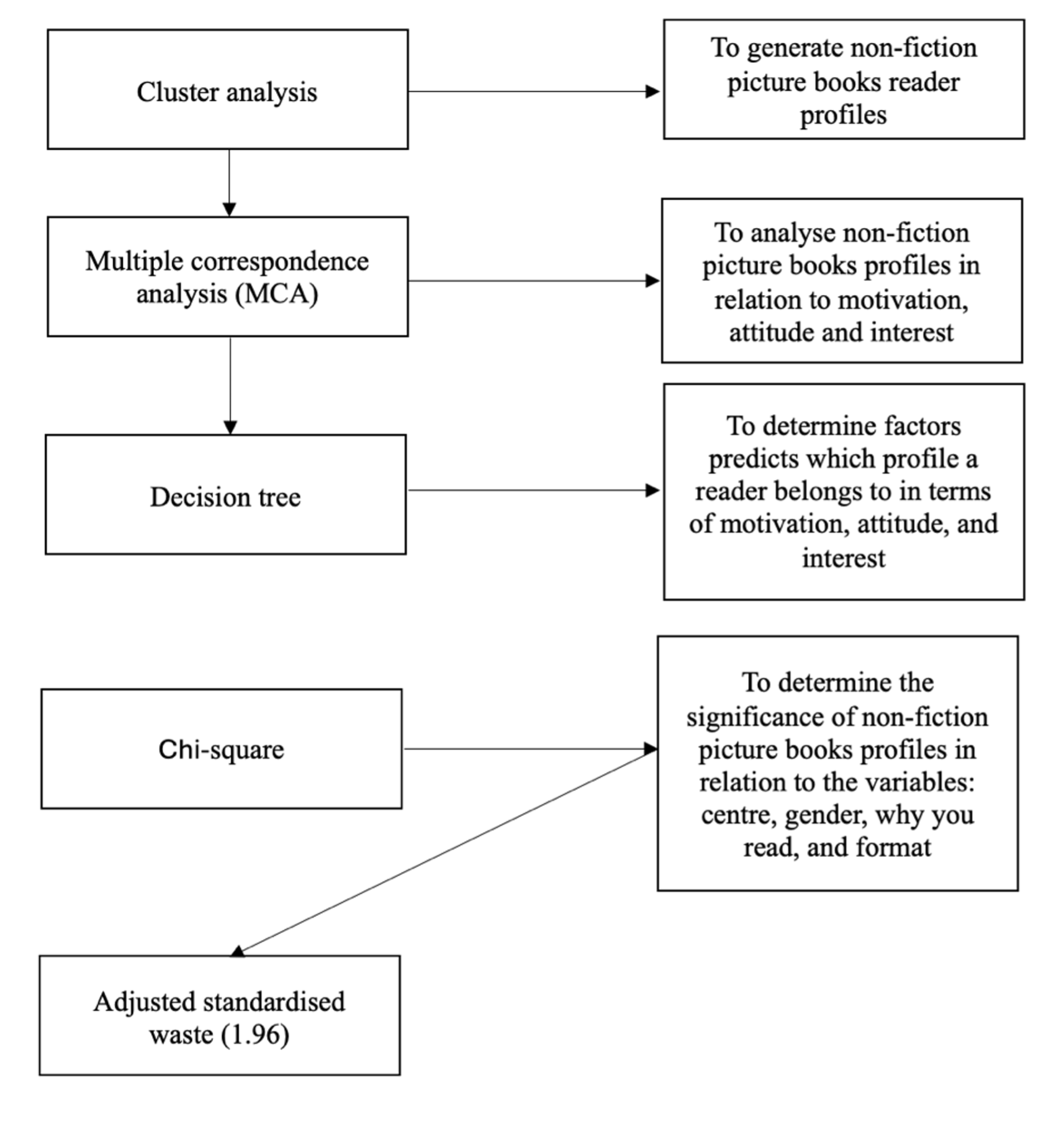
performing the statistical tests shown in Figure 1.
Figure 1Statistical testing process and its objectives
RESULTS
The different results are shown below, according to the statistical tests in Figure 1.
Generation of profiles
Initially, the aim is to identify profiles based on students’ affinity for the characteristics
of non-fiction picture books. To this end, a cluster analysis was used across the
different items [37-45] that measured the degree of preference or lack thereof for
the characteristics of this type of book.
Therefore, the initial aim was to identify the number of profiles that could be generated.
To this end, the elbow method was used through the sum of squares within clusters
(WCSS), determining the turning point at 3.
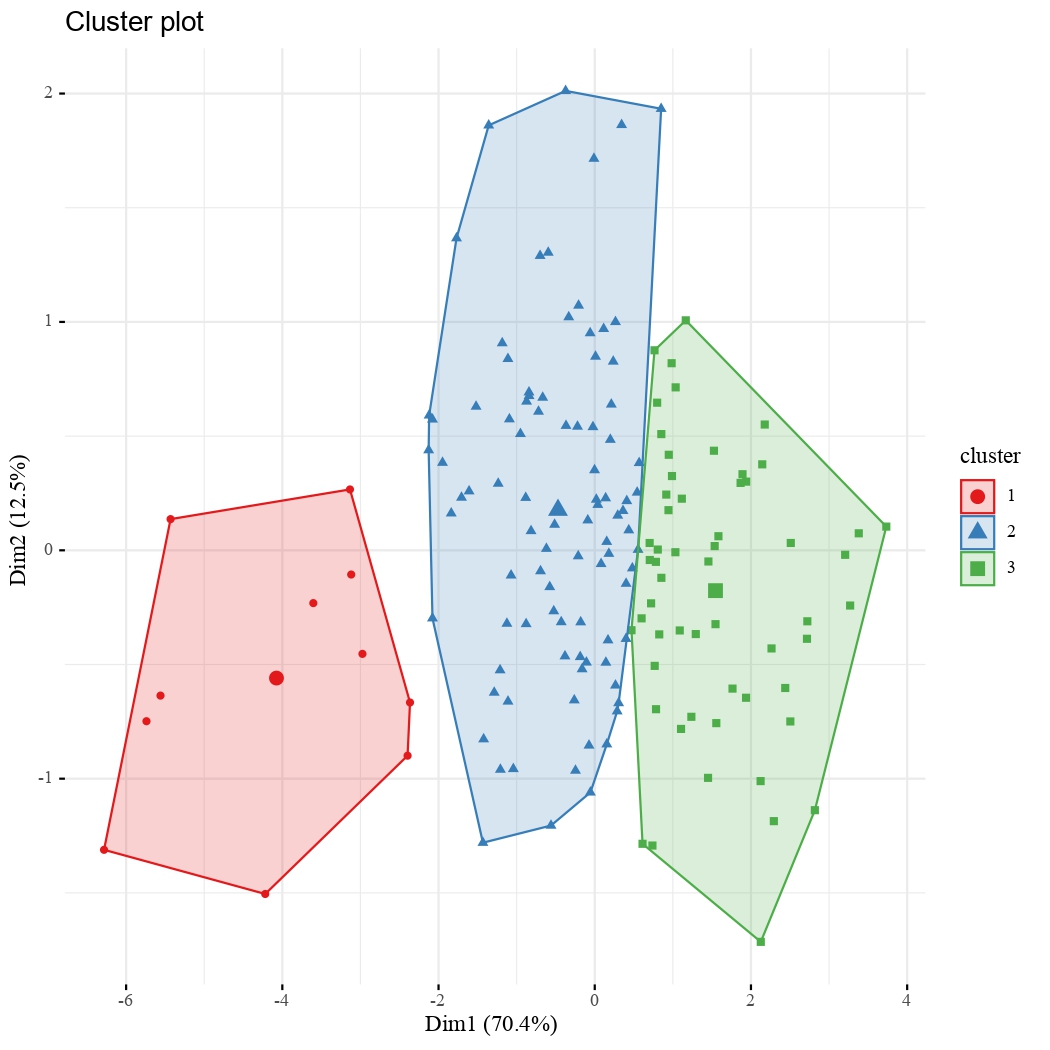
The graphical representation of the three profiles, obtained using K-means and projected
onto the first two axes of variability, shows a clear separation between the groups
(Figure 2). The first axis (Dim1), which explains 34.6% of the variance, and the second axis
(Dim2), which contributes 13.8%, allow us to clearly visualise the differentiation
between the clusters generated. In this regard, the first profile grouped 13.1% of
the sample, showing a low tendency to read non-fiction picture books; the second,
with 37.5%, has a high tendency to read them; and finally, the third profile groups
the majority, with 49.4%, and shows an intermediate tendency towards these books.
Figure 2Affinity profiles with non-fiction picture books
The relationship between profiles and motivation, interest and attitude
To relate the three profiles to the broad dimensions—motivation to read, interest
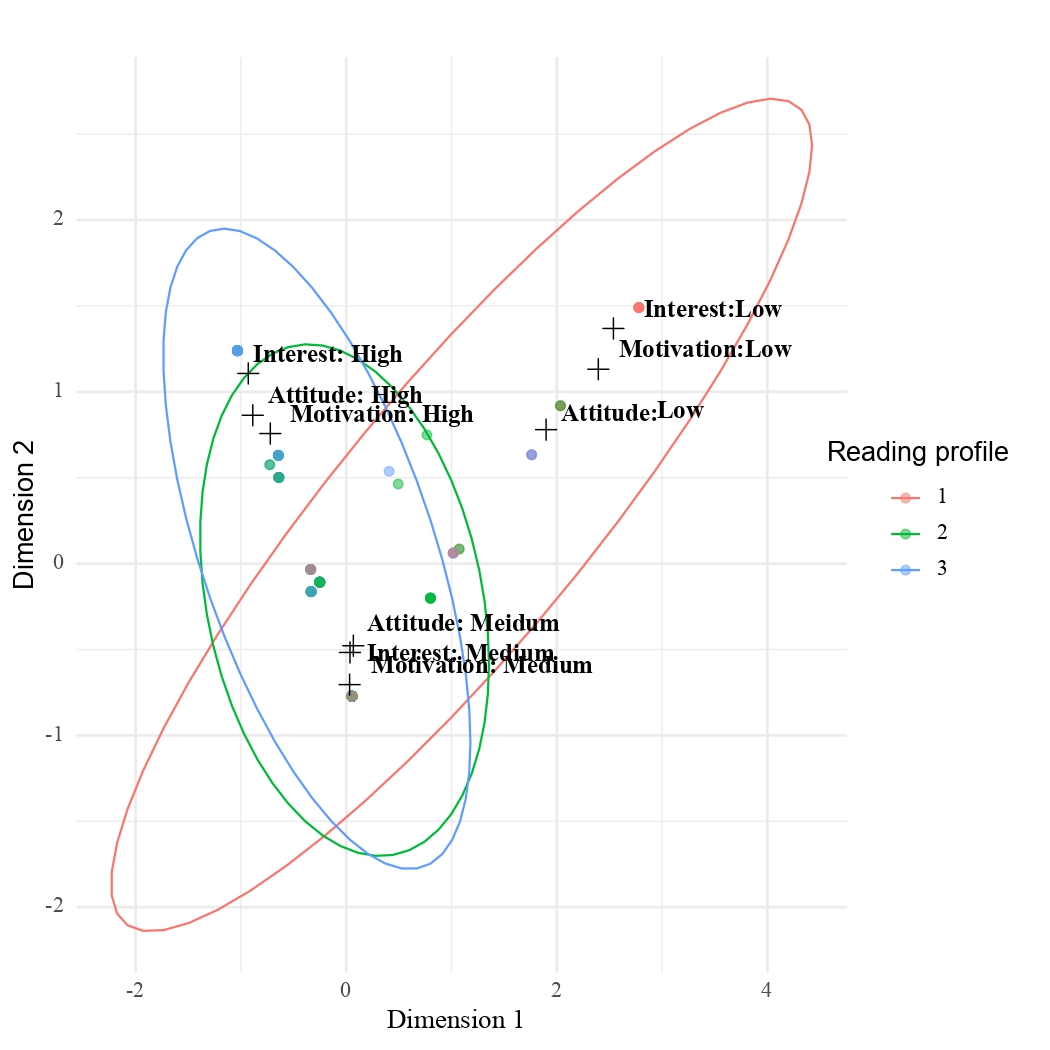
in reading, and attitude towards shared reading—MCA was performed. To this end, three
levels were created based on empirical tertiles, named high, medium, and low (Figure 3):
Figure 3Reader profiles and dimensions of motivation, interest and attitude
Of the three variables, only attitude and motivation were developed, since, in terms
of interest, the majority were at the average level. Profile 1 shows low motivation
(28.5 per cent) and a poor attitude (17.9 per cent). Therefore, they are not motivated
to read individually, nor do they have any motivation to read in groups. As for profile
2, it is identified with high motivation (9.2%) and attitude (13.6%), hence the coordinates
are positive. Finally, profile 3 has an average tendency in both motivation (16.7%)
and attitude (9%). In this case, there is a tendency towards indifference.
Decision tree model
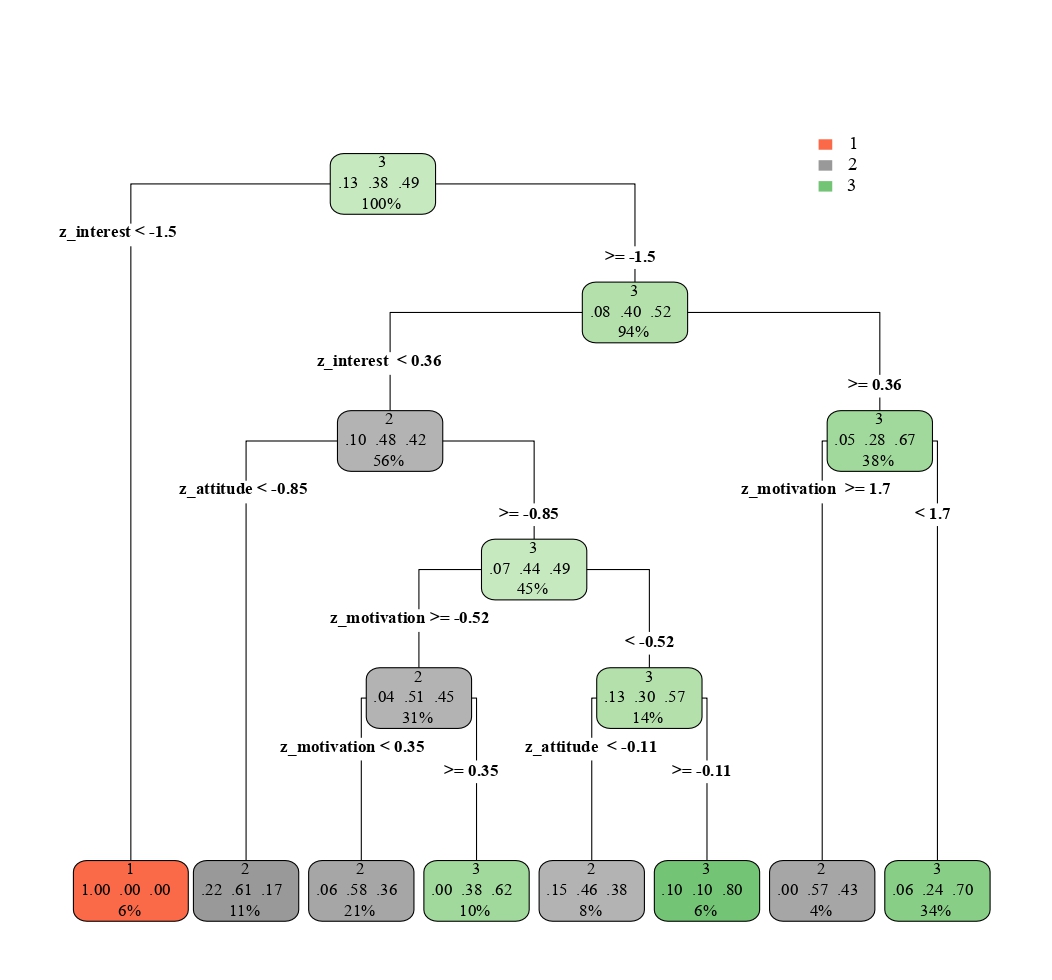
The variable reader interest is taken as the first criterion for dividing students:
those with a very low score (z_interests < –1.5) are classified as profile 1, i.e.,
those with a low reading affinity for non-fiction picture books. As a result of this
division, combinations of motivation and attitude made it possible to differentiate
between profiles 2 and 3.
The highest scores in the motivation variable (z ≥ 1.7) and positive attitude (z_attitude
≥ –0.11) are related to profile 2, which has a high affinity for non-fiction picture
books. In contrast, the average scores correspond to profile 3.
Therefore, the model (Figure 4) shows that the three reading dimensions have made it possible to clearly distinguish
between profiles and that reading interest acts as the main starting point for classification.
Figure 4Decision tree: reader profile for non-fiction picture books in relation to motivation,
attitude and interest
Analysis with contextual variables
Next, the profiles are analysed in relation to the contextual variables using the
Chi-square test. In the case of significance, a corrected typified residual analysis
was developed to identify where that significance occurs. In this research, |1.96|
was taken as the reference value, according to .
Regarding significance according to centres (Table 3), the Chi-square test indicated that there were no significant differences, since
p(.66) >.05 ( = 108.02, df = 110). It is noteworthy that centres 4 and 6 do not have any students
within profile 1.
Table 3Centres distributed by profile according to percentage
Schools
Profiles
Percentage
1
1
9.1%
2
63.6%
3
27.3%
2
1
8.3%
2
50%
3
41. %
3
1
3.8%
2
73.1%
3
23.1%
4
1
0%
2
36%
3
64%
5
1
12.3%
2
60%
3
27.7%
6
1
0%
2
57.1%
3
42.9%
Source: Research data R.
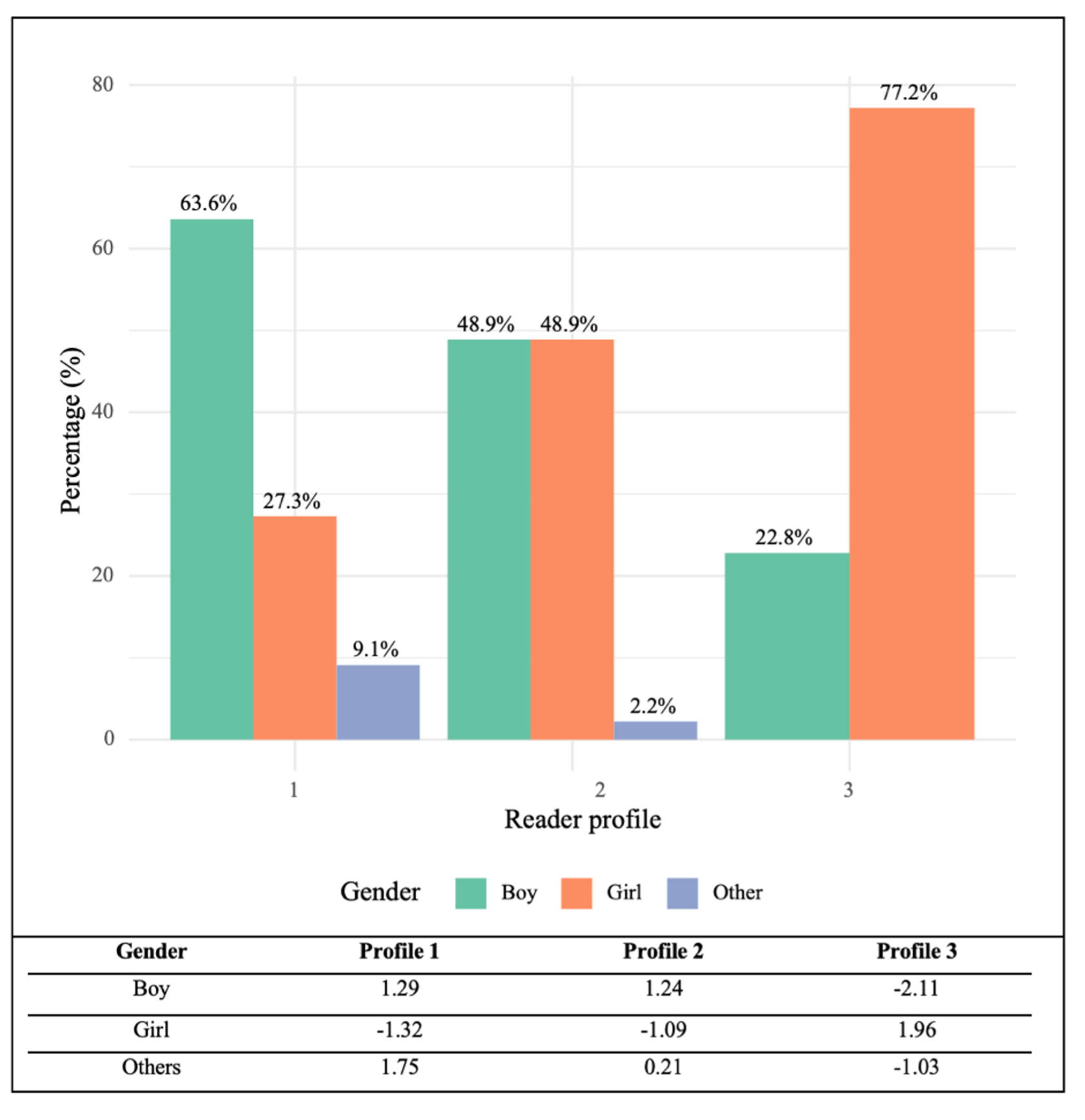
With regard to the gender variable (Figure 5), girls are more prevalent in profile 3, while boys are more prevalent in profile
1. The results indicated that there is significance, since p(.001)<.05 ((4) =18.38). The standardised residuals showed that boys were significantly underrepresented
in profile 3 (-2.11), compared to girls, who were right on the significance value
(1.96).
Figure 5Percentages and standardised residues distributed by gender according to profile
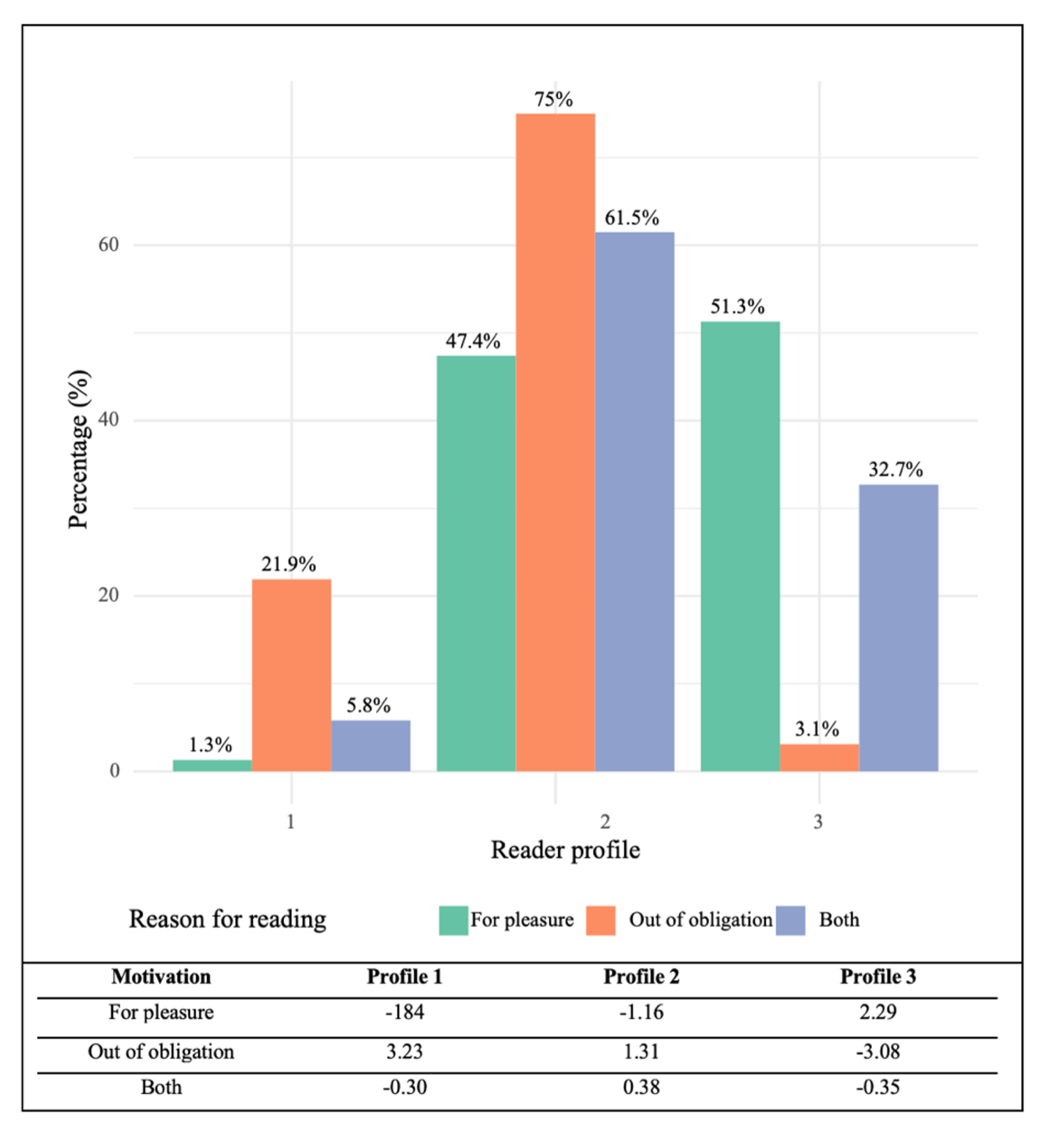
As for their motivation for reading (Figure 6), students in profile 2 read out of obligation rather than pleasure. This trend is
also seen in those in profile 1. On the other hand, reading for pleasure stands out
in profile 3. With regard to this variable, there are significant differences (p 1.86
× 10⁻⁶> .05; (4) = 32.06). Profile 1 shows that motivation “out of obligation” (3.23) is significantly
higher, in contrast to profile 3, which is significantly lower (-3.08). On the other
hand, motivation ‘for pleasure’ (2.29) stands out significantly in profile 3. What
is striking is what happens in profile 2, as there is no significant motivation “for
pleasure”, which was not expected.
Figure 6Percentages and standardised residues distributed by reading reasons according to
profile
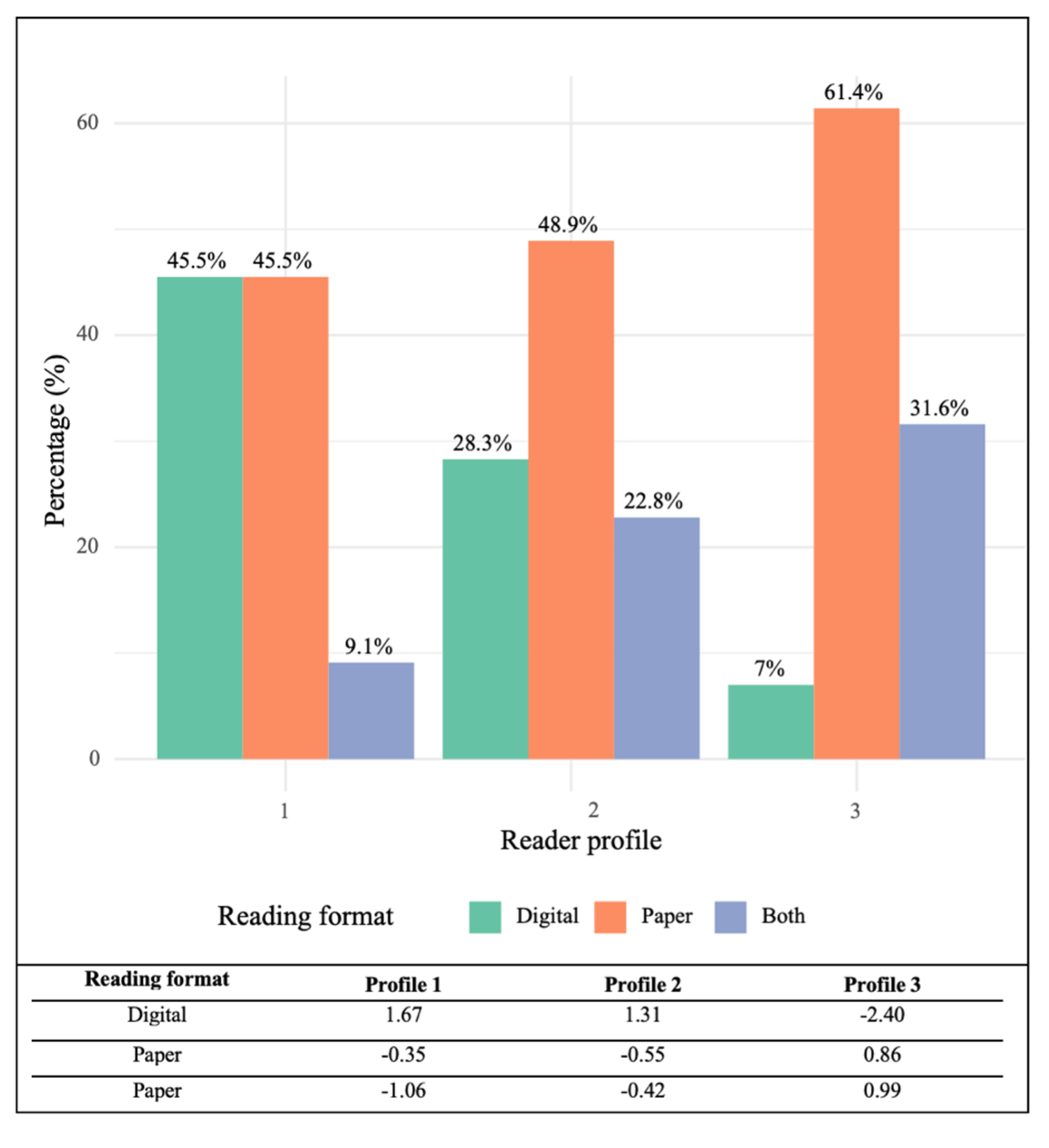
In terms of reading format, students in profiles 2 and 3 read more in paper format
than in digital format. However, the situation is different for students in profile
1, as reading in digital format and on paper are equally popular. There is significance
since p(.0008)<.05 ((4) = 13.70). Regarding the categorised waste, in profile 3 there are significantly
fewer students than expected who read in digital format. In contrast, in profile 1
(1.67), there are more students who read digitally, without reaching the established
value (1.96). In profile 2, it is positive, but it does not reach significance either.
Figure 7Percentages and standardised residues distributed according to the reading format
based on the profile
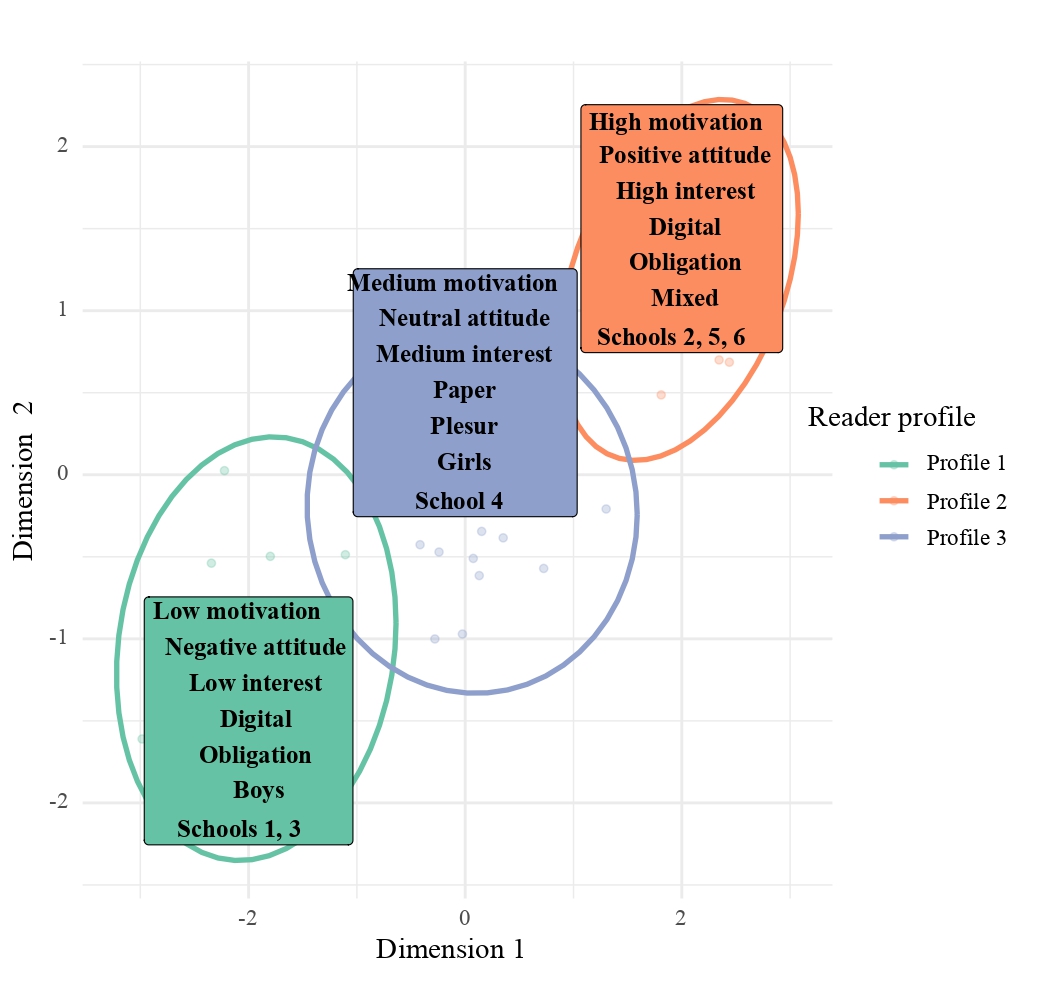
To conclude, we will proceed to define the profiles of a non-fiction reader —figure 8— in relation to what has been analysed above:
Figure 8Summary of non-fiction reader profiles
CONCLUSIONS AND DISCUSSION
This research identified three reader profiles based on the affinity shown towards
non-fiction picture books by Year 6 primary school pupils: one with low affinity (13.1%),
another with high affinity (37.5%) and another with intermediate affinity (49.4%).
This reflects that, although there is a high predisposition towards this type of book,
most students have a medium affinity for them, which may represent an opportunity
to encourage reading interest through educational proposals that integrate this resource.
In terms of motivation, the results reflect a significant relationship between the
three profiles identified and the variables of motivation and attitude towards reading.
In this regard, the profile that shows the greatest affinity for non-fiction picture
books coincides with those pupils who express high reading motivation and a positive
attitude towards shared reading. On the other hand, those who show little affinity
for these books are associated with low levels of motivation and attitude, resulting
in a lack of commitment to reading. These findings are consistent with previous research
highlighting the importance of these variables in the development of reading habits
().
With regard to contextual variables, the study has enabled the characteristics of
each profile to be analysed. On the one hand, in terms of gender, the data show a
notable representation of boys in the profile with the least affinity for reading,
which coincides with the research by . On the other hand, those who read “for pleasure” are in the intermediate or high
profile, while those who read “out of obligation” are in the low profile, coinciding
with the research of and . This may demonstrate that compulsory reading among students leads to a negative
attitude and motivation towards reading.
When it comes to reading formats, those most interested in non-fiction picture books
show a preference for paper. This format is relevant in this type of book, since,
as indicated by and , these books are distinguished by their aesthetic design, their manipulation as book-objects,
and their paratextual and playful elements, aspects that are more suited to the paper
format.
In general terms, the results show that reader interest, intrinsic motivation and
a positive attitude towards shared reading are determining factors in developing an
affinity for non-fiction picture books. These books are also a remarkable resource
for sparking interest and curiosity and, therefore, improving young people’s approach
to reading, especially those with average and low profiles.
Similarly, there are noteworthy aspects such as the fact that there are no significant
differences between centres, or that centres 4 and 6 do not have any pupils in profile
1. Other noteworthy findings include the fact that profile 2, which shows the greatest
affinity for this type of book, reads more out of obligation than for pleasure, which
differs from previous research and expectations.
However, the profiles in this study bear certain similarities to those identified
in the scientific literature (Table 1). In general terms, there are similarities with the profiles proposed by , who classifies readers as low, medium and high according to their level of involvement,
enjoyment of reading and reading interests. If we establish a relationship between
our profiles and those presented by , we could say that our profile 2 (greater affinity for non-fiction picture books,
greater motivation, positive attitude and reading in digital format) corresponds to
the so-called high reader; profile 1 (low affinity for non-fiction picture books,
low motivation, little interest and reading in digital format) corresponds to the
low reader; and profile 3 (medium motivation, medium interest, neutral attitude and
reading in printed format) is related to the average reader.
Similarly, our profiles can be related to others indicated in scientific literature.
In this vein, profile 2 shares similarities with the habitual reader presented by
, with the hybrid or poly-literate reader by Caride and Pose (2025), and with the
strategic reader presented by , as they all share high motivation, a certain degree of reading autonomy, and a combined
use of print and digital formats. Similarly, profile 1 resembles the non-reader profile
described by and the false reader profile described by , as they share a lack of involvement in reading, perceive reading as a compulsory,
unpleasant activity, and have low intrinsic interest. Finally, profile 3 could be
related to the analogue reader described by , for both have a preference for printed reading formats.
With regard to limitations, this study presents a non-probabilistic sample, as it
is intentional and limited to the province of Cádiz, which means that the results
cannot be extrapolated to other contexts. Furthermore, the cross-sectional design
shows results at a specific point in time, which does not allow for analysis of the
evolution of non-fiction reader profiles. As for future research, it would be interesting
to expand the sample, incorporate longitudinal designs, analyse the role of teachers
in promoting non-fiction picture books, and incorporate qualitative data.
In short, this study supports the incorporation of this type of book as an effective
resource for promoting reading in primary education. However, external experts are
needed to assess students' interests and take into account aspects such as gender,
age, and preferred media, among others, when designing reading proposals, with the
aim of achieving a more personalised and inclusive education.
AUTHORS’ CONTRIBUTIONS
Salvador Gutiérrez-Molero: Formal analysis; Conceptualisation; Data curation; Writing – review and editing.
Hugo Heredia-Ponce: Formal analysis; Conceptualisation; Data curation; Writing – original draft; Writing
– review and editing; Methodology; Validation.
Manuel-Francisco Romero-Oliva: Formal analysis; Conceptualisation; Data curation; Writing – review and editing;
Methodology; Validation.
FUNDING
This article is linked to project PID2021-126392OB-I00 Non-fiction readings for the
integration of critical citizens into the new cultural ecosystem (LENFICEC) and the
doctoral thesis Contribution of non-fiction picture books to the learning of non-linguistic
subjects. by Salvador Gutiérrez Molero.
REFERENCES
1
Artola, T., Sastre, S., Jiménez-Blanco, A., & Alvarado, J. M. (2021). Evaluación de
las actitudes, motivación e intereses lectores en preadolescentes y adolescentes.
Electronic Journal of Research in Education Psychology, 19(55), 651-670. https://doi.org/10.25115/ejrep.v19i55.3923
2
Artola, T., Sastre, S., & Barraca-Mairal, J. (2017). Diferencias de género en actitudes
e intereses lectores. Una investigación con alumnos españoles de primaria. Bordón, 69(1), 11-26. https://doi.org/10.13042/Bordon.2016.37925
3
Bauman, Z. (2019). Acerca de lo leve y lo líquido. Nueva Revista de Política, Cultura y Arte, (170), 34-43.
4
Bellver, C. (1996). Leer y escribir después de los libros. Net Conexión, 6, 40-43.
Castillo-Bravo, N. E., Briones-Guerrero, E. D., Gabriela-Belén, E. A., & Jaime-Andrés,
E. F. (2020). Factores que intervienen en el desinterés por la lectura e jóvenes bachilleres.
Perspectivas, 5(17), 59-68. https://doi.org/10.26620/uniminuto.perspectivas.5.17.2020.59-68
Errázuriz-Cruz, M. C., Becerra, R., Aguilar, P., Cocio, A., Davison, O., & Fuentes,
L. (2019). Perfiles lectores de profesores de escuelas públicas de la Araucanía, Chile.
Una construcción de sus concepciones sobre la lectura. Perfiles educativos, 41(164), 28-46. https://doi.org/10.22201/iisue.24486167e.2019.164.58856
11
Errázuriz-Cruz, M., Fuentes, L., Davison, O., Cocio, A., Becerra, R., & Aguilar, P.
(2020). Concepciones sobre la lectura del profesorado de escuelas públicas de la Araucanía:
¿Cómo son sus perfiles lectores? Revista signos, 53(103), 419-448. https://doi.org/10.4067/S0718-09342020000200419
12
Fabiana-Fabiana, E., Vega-Intriago, V. (2022). La motivación en el aprendizaje de
la lectura en los estudiantes. Revista Educare-UPEL-IPB-Segunda Nueva Etapa 2.0, 26(Extraordinario), 476-493. https://doi.org/10.46498/reduipb.v26iExtraordinario.1641
13
Galarraga-Arrizabalaga, H., Alonso-Amezua, E. y Antonio-Agirre, I. (2023). Percepciones
y necesidades formativas del profesorado en torno a las prácticas lectoras y el Plan
Lector de Centro. Revista Electrónica Interuniversitaria de Formación del Profesorado, 26(2), 143-160. https://doi.org/10.6018/reifop.549961
14
Garralón, A. (2013). Leer y saber: los libros informativos para niños. Tarambana Libros.
15
Granda-Asencio, L. Y., Ordóñez-Ocampos, B. P., & Aguirre-Labanda, J. E. (2023). Importancia
de la comprensión lectora en las áreas básicas del aprendizaje. Portal de la Ciencia, 4(2), 256-269. https://doi.org/10.51247/pdlc.v4i2.365
16
Gutiérrez-Molero, S., Heredia-Ponce, H., & Romero-Oliva, M. F. (2025a). Percepciones
de los estudiantes de 6.º de Educación Primaria en Conocimiento del Medio Natural,
Social y Cultural: competencia en comunicación lingüística, libro de texto y recursos
digitales. Pixel Bit, (74), 1-22. https://doi.org/10.12795/pixelbit.114519
17
Gutiérrez-Molero, S., Heredia-Ponce, H., & Romero-Oliva, M. F. (2025b). Competencia
digital en los jóvenes de la generación alfa: retos y oportunidades en la sociedad
tecnológica. IJERI, (24), 1–20. https://doi.org/10.46661/ijeri.12002
18
Gutiérrez-Molero, S., & Trigo-Ibáñez E. (2024). Los libros ilustrados de no ficción
como estrategia para concienciar hacia los Objetivos de Desarrollo Sostenible: una
experiencia con talleres de lectura. Didáctica. Lengua y Literatura, 36, 49-60. https://doi.org/10.5209/dill.98410
19
Heredia-Ponce, H., Gutiérrez-Molero, S., & Romero-Oliva, M. F. (2024). Comprensión
lectora y resolución de problemas matemáticos: Un estudio de caso. Perfiles educativos, 46(185), 69-89. https://doi.org/10.22201/iisue.24486167e.2024.185.61367
20
Hernández-Heras, L., Tabernero-Sala, R., & Muela-Bermejo, D. (2024). Creencias, representaciones
y saberes de profesores expertos sobre la lectura de los clásicos en ESO. Ocnos, 23(2), 1-17. https://doi.org/10.18239/ocnos_2024.23.2.445
21
Hernández-Sampieri, R., & Mendoza-Torres, C. P. (2018). Metodología de la investigación. Las rutas cuantitativa, cualitativa y mixta. McGrawHill Education.
22
Juárez-Calvillo, M. (2019). Influencia de la formación inicial del profesorado en
los hábitos lectores y en el concepto de educación literaria. Investigaciones Sobre Lectura, 12, 99-115. https://doi.org/10.24310/revistaisl.vi12.11110
23
Larrañaga, M. E., & Yubero, S. (2005). El hábito lector como actitud. El origen de
la categoría de “falsos lectores”. Ocnos , 1, 43-60. http://doi.org/10.18239/ocnos_2005.01.04
24
López-Valero, A., Jérez-Martínez, I., & Encabo-Fernández, E. (2016). Aproximación
educativa ante los nuevos formatos narrativos. Revista Chilena de Literatura, 94, 197-214. https://doi.org/10.4067/S0718-22952016000300010
25
Matruglio, E., & Vale, E. (2019). Transformation of text in the English classroom:
does ‘context’ really matter? Literacy, 53(3), 117-124. https://doi.org/10.1111/lit.12167
26
Merisuo-Storm, T., & Soininen, M. (2012). Young boys’ opinions about reading, literacy
lessons and their reading competence. In ICERI2012 Proceedings (pp. 4109–4118). IATED.
27
Molina-García, M. J. (2020). ¿Hablamos? Análisis del discurso y estrategias empleadas
en WhatsApp por estudiantes universitarios. Onomazéin, (VI), 274-294. https://doi.org/10.7764/onomazein.ne6.14
28
Montenegro, S., & Silva, T. (2019). Libros informativos para niños y jóvenes. Manual para mediadores de lectura. Curriculum
Nacional. https://bit.ly/4jTnNOh
Moreno-de-León, T. A., Rangel-Castillo, L., Vega-López, N. A., & De-León-Arellano,
E. (2024). Estrategias para la comprensión de múltiples textos históricos: perfiles
lectores de estudiantes de educación secundaria. Revista signos, 57(115), 494-522. https://doi.org/10.4151/S0718-0934202401150882
32
Muñoz, C., Valenzuela, J., Avendaño, C., & Núñez, C. (2016). Mejora en la motivación
por la Lectura Académica: la mirada de estudiantes motivados. Ocnos, 15, 52-68. http://doi.org/10.18239/ocnos_2016.15.1.941
33
Nogués-Bruno, M., Hernández-Heras, L., & Sanjuán-Álvarez, M. (2020). Elementos facilitadores
de la comprensión lectora en los libros ilustrados de no-ficción. Análisis de "Basura.
Todo sobre la cosa más molesta del mundo" (2019), de Gerda Raidt. En A. Díez-Mediavilla
& R. Gutiérrez-Fresneda (Coords.), Lectura y dificultades lectoras en el siglo XXI (pp. 382-399). Octaedro.
Parodi, G., Moreno-de-León, T., Julio, C., & Burdiles, G. (2019). Generación Google
o Generación Gutenberg: hábitos y propósitos de lectura en estudiantes universitarios
chilenos. Comunicar, 27(58), 85-94. https://doi.org/10.3916/C58-2019-08
36
Rivera-Jurado, P., & Romero-Oliva, M. F. (2020). El adolescente como lector accidental
de textos literarios: hábitos de lectura literaria en Educación Secundaria. Ocnos, 19(3), 7-18. https://doi.org/10.18239/ocnos_2020.19.3.2313
37
Romero-Oliva, M. F., Ambrós-Pallarés, A., & Trujillo-Sáez, F. J. (2020). Hábitos lectores
de los adolescentes en un ecosistema llamado escuela: factores determinantes en estudiantes
de educación secundaria. Investigaciones Sobre Lectura, (13), 1-34. https://doi.org/10.24310/revistaisl.vi13.11112
38
Romero-Oliva, M. F., & Trigo-Ibáñez, E. (2019). Entre la realidad y la experiencia
en la formación de nuevos lectores. Un análisis del discurso de especialistas más
allá de la propia teoría. En C. Tatoj, & S. Balches (Coords.), Voces y caminos en la enseñanza de español/LE: desarrollo de las identidades en el
aula (pp. 119-137). Wydawnictwo Uniwersytetu Śląskiego. https://rodin.uca.es/handle/10498/21155
39
Ruth-Gill, S. (2009). What teachers need to know about the “new” nonfiction. The reading teacher, 63(4), 260-267. https://doi.org/10.1598/RT.63.4.1
40
Sampériz, M., Tabernero, R., Colón, M. J., & Manrique, N. (2020). El libro de no ficción
para prelectores. Análisis de las claves de construcción del discurso. Cuadernos del centro de estudios de diseño y comunicación, 124, 73-90. https://doi.org/10.18682/cdc.vi124.4418
41
Sanjuán-Álvarez, M., & Cristóbal-Hornillos, R. (2022). Procesos emocionales de la
lectura y el aprendizaje en un libro ilustrado de no-ficción y en un libro de texto.
Publicaciones, 52(1), 57-99. https://doi.org/10.30827/publicaciones.v52i1.22294
42
Santos-Díaz, I. C., Romero-Oliva, M. F., Heredia-Ponce, H., & Trigo-Ibáñez, E. (2024).
Perfiles lectores adolescentes: lectura en papel versus digital. Revista electrónica de investigación educativa, 26. https://doi.org/10.24320/redie.2024.26.e02.4990
43
Tabernero-Sala, R., & Colón-Castillo, M. J. (2023). Leer para pensar. El libro ilustrado
de no ficción en el desarrollo del pensamiento crítico. Revista de Educación a Distancia, 23(75), 1-26. https://doi.org/10.6018/red.545111
44
Tabernero-Sala, R., Colón-Castillo, M. J., Sampériz-Hernández, M., & Campos-Bandrés,
I. O. (2022). Promoción de la lectura en la sociedad digital. El book-trailer del
libro ilustrado de no ficción como epitexto virtual en la definición de un nuevo discurso.
Profesional de la Información, 31(2), 1-17. https://doi.org/10.3145/epi.2022.mar.13; https://dialnet.unirioja.es/servlet/articulo?codigo=8402661
45
Tabernero-Sala, R., & Laliena, D. (2023). El libro ilustrado de no ficción en la formación
de lectores: análisis de las claves discursivas y culturales para leer en la sociedad
digital. Texto Livre, 16, 1-13. https://doi.org/10.1590/1983-3652.2023.41926
46
Torres-Adame, F. (2022). Perfiles del lector universitario: Gusto, importancia y vivencia
de la literatura. Revista Panamericana de Pedagogía, 33, 106-127. https://doi.org/10.21555/rpp.v33i33.2395