
Testing the direct and inferential mediation model of reading comprehension in Spanish students
Article Sidebar
Main Article Content
Abstract
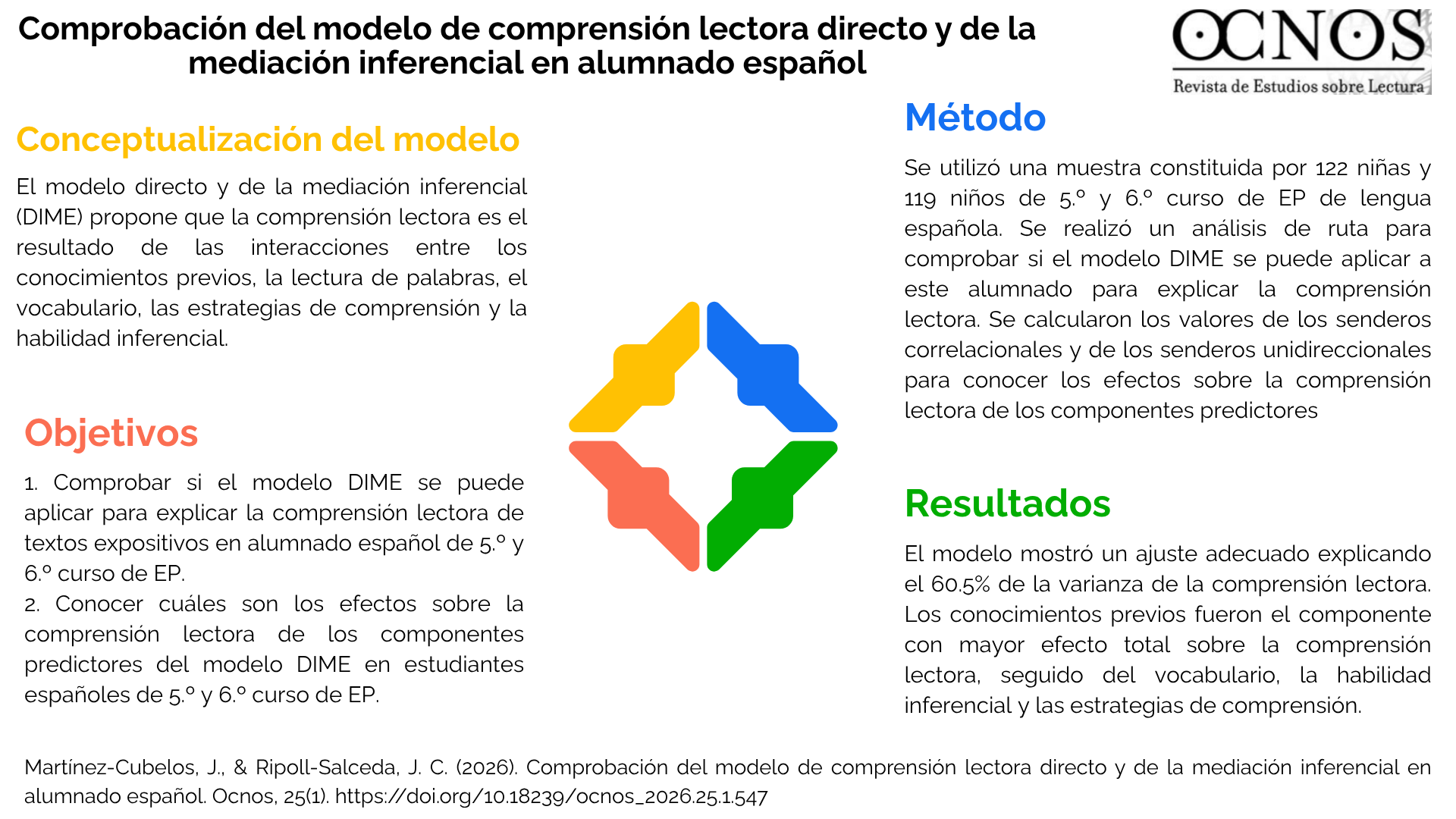
The direct and inferential mediation model (DIME) proposes that reading comprehension is the result of interactions between prior knowledge, word reading, vocabulary, comprehension strategies, and inference skill. In this study, its relevance was tested through structural equation modelling in a sample of 241 5th and 6th graders in primary education schools in Spain. The model showed an adequate relevance explaining 60.5% of the variance in reading comprehension of expository texts using general domain tests to measure the predictor components. Prior knowledge was the component with the greatest total effect on reading comprehension, followed by vocabulary, inference skill, and comprehension strategies. The total effect of word reading was not significant. The direct and indirect effects on reading comprehension of prior knowledge, vocabulary, and comprehension strategies were significant. The direct effects from prior knowledge to comprehension strategies and from vocabulary to comprehension strategies were not significant. The results found have important implications in the design of intervention programmes to improve reading comprehension.
Downloads
Article Details

This work is licensed under a Creative Commons Attribution-NonCommercial-NoDerivatives 4.0 International License.
The articles published at Ocnos will have a Creative Common Licence Creative Commons Attribution-Noncommercial-No Derivative Works 3.0 Unported
References
Afflerbach, P. (1990). The influence of prior knowledge on expert readers' main idea construction strategies. Reading Research Quarterly, 25(1), 31-46. https://doi.org/10.2307/747986 DOI: https://doi.org/10.2307/747986
Ahmed, Y., Francis, D. J., York, M., Fletcher, J. M., Barnes, M., & Kulesz, P. (2016). Validation of the direct and inferential mediation (DIME) model of reading comprehension in grades 7 through 12. Contemporary Educational Psychology, 44-45, 68-82. https://doi.org/10.1016/j.cedpsych.2016.02.002 DOI: https://doi.org/10.1016/j.cedpsych.2016.02.002
Ahmed, Y., Miciak, J., Taylor, P., & Francis, D. J. (2022). Structure altering effects of a multicomponent reading intervention: an application of the direct and inferential mediation (DIME) model of reading comprehension in upper elementary grades. Journal of Learning Disabilities, 55(1), 58-78. https://doi.org/10.1177/0022219421995904 DOI: https://doi.org/10.1177/0022219421995904
Baker, D. L., Crespo-Alberto, P., Monzalve-Macaya, M., García, I., & Gutiérrez Ortega, M. (2022). Relation between the essential components of reading and reading comprehension in monolingual Spanish-speaking children: a meta-analysis. Educational Psychology Review, 34, 2661-2696. https://doi.org/10.1007/s10648-022-09694-1 DOI: https://doi.org/10.1007/s10648-022-09694-1
Bowen, N. K., & Guo, S. (2011). Preparing for an SEM analysis. En N. K. Bowen, & S. Guo (Eds.), Structural equation modeling (pocket guides to social work research methods) (pp. 52-72). Oxford University Press. https://doi.org/10.1093/acprof:oso/9780195367621.003.0003 DOI: https://doi.org/10.1093/acprof:oso/9780195367621.003.0003
Cervetti, G. N., Fitzgerald, M. S., Hiebert, E. H., & Hebert, M. (2023). Meta-analysis examining the impact of vocabulary instruction on vocabulary knowledge and skill. Reading Psychology, 44(6), 672-709. https://doi.org/10.1080/02702711.2023.2179146 DOI: https://doi.org/10.1080/02702711.2023.2179146
Cohen, J. (1992). A power primer. Psychological Bulletin, 112(1), 155-159. https://doi.org/10.1037/0033-2909.112.1.155 DOI: https://doi.org/10.1037/0033-2909.112.1.155
Cromley, J. G., & Azevedo, R. (2006). Self-report of reading comprehension strategies: what are we measuring? Metacognition and Learning, 1, 229-247. https://doi.org/10.1007/s11409-006-9002-5 DOI: https://doi.org/10.1007/s11409-006-9002-5
Cromley, J., & Azevedo, R. (2007). Testing and refining the direct and inferential mediation model of reading comprehension. Journal of Educational Psychology, 99(2), 311-325. https://doi.org/10.1037/0022-0663.99.2.311 DOI: https://doi.org/10.1037/0022-0663.99.2.311
Cromley, J. G., Snyder-Hogan, L., & Luciw-Dubas, U. A. (2010). Reading comprehension of scientific text: a domain-specific test of the direct and inferential mediation model of reading comprehension. Journal of Educational Psychology, 102(3), 687-700. https://doi.org/10.1037/a0019452 DOI: https://doi.org/10.1037/a0019452
Cuadro, A., & Costa, D. (2019). Evaluación del nivel lector. Manual técnico del test de eficacia lectora revisado (TECLE-R). Prensa Médica Latinoamericana.
Davidson, R., & MacKinnon, J. G. (2000). Bootstrap tests: How many bootstraps? Econometric Reviews, 19(1), 55-68. https://doi.org/10.1080/07474930008800459 DOI: https://doi.org/10.1080/07474930008800459
Domínguez-Gutiérrez, A. B., Alegría-Iscoa, J., Carrillo-Gallego M., & Soriano-Bozalongo, J. (2013). PEALE. Pruebas de evaluación analítica de lengua escrita. Universidad de Salamanca. https://complydis.usal.es/wp-content/uploads/2019/02/PEALE.pdf
Domínguez-Gutiérrez, A. B., Carrillo-Gallego, M., González., V., & Alegría-Iscoa, J. (2016). How do deaf children with and without cochlear implants manage to read sentences: The key word strategy. Journal of Deaf Studies and Deaf Education, 21(3), 280-292. https://doi.org/10.1093/deafed/enw026 DOI: https://doi.org/10.1093/deafed/enw026
Duñabeitia, J. A., Griffin, K. L., Martín, J. L., Oliva, M., Sámano, M. L., & Ivaz, L. (2016). The Spanish general knowledge norms. Frontiers in Psychology, 7(1888), 1-5. https://doi.org/10.3389/fpsyg.2016.01888 DOI: https://doi.org/10.3389/fpsyg.2016.01888
Florit, E., & Cain, K. (2011). The simple view of reading: is it valid for different types of alphabetic orthographies? Educational Psychology Review, 23, 553-576. https://doi.org/10.1007/s10648-011-9175-6 DOI: https://doi.org/10.1007/s10648-011-9175-6
Härtig, H., Bernholt, S., Fraser, N., Cromley, J. G., & Retelsdorf, J. (2022). Comparing reading comprehension of narrative and expository texts based on the direct and inferential mediation model. International Journal of Science and Mathematics Education, 20, 17-41. https://doi.org/10.1007/s10763-022-10302-5 DOI: https://doi.org/10.1007/s10763-022-10302-5
Hernández-Sobrino, L., García-Navarro, M., González-Santamaría, V., & Domínguez-Gutiérrez, A. B. (2023). ¿Es el vocabulario profundo una habilidad necesaria para la comprensión lectora en los primeros cursos de Educación Primaria? Revista de Psicología y Educación, 18(1), 11-21. https://doi.org/10.23923/rpye2023.01.230 DOI: https://doi.org/10.23923/rpye2023.01.230
Hjetland, H. N., Brinchmann, E. I., Scherer, R., & Melby-Lervåg, M. (2017). Preschool predictors of later reading comprehension ability: a systematic review. Campbell Systematic Reviews, 14. https://doi.org/10.4073/csr.2017.14 DOI: https://doi.org/10.4073/csr.2017.14
Hoover, W. A., & Gough, P. B. (1990). The simple view of reading. Reading and Writing: An Interdisciplinary Journal, 2(2), 127-160. http://doi.org/10.1007/BF00401799 DOI: https://doi.org/10.1007/BF00401799
Kim, Y-S. G. (2020). Hierarchical and dynamic relations of language and cognitive skills to reading comprehension: testing the direct and indirect effects model of reading (DIER). Journal of Educational Psychology, 112(4), 667-684. https://doi.org/10.1037/edu0000407 DOI: https://doi.org/10.1037/edu0000407
Kline, R. (2016). Principles and practice of structural equation modeling (4.ª ed.). Guilford Press.
Leys, C., Delacre, M., Mora, Y. L., Lakens, D., & Ley, C. (2019). How to classify, detect, and manage univariate and multivariate outliers, with emphasis on pre-registration. International Review of Social Psychology, 32(1), 1-10. https://doi.org/10.5334/irsp.289 DOI: https://doi.org/10.5334/irsp.289
Malhotra, N. K., & Dash, S. (2011). Marketing research an applied orientation. Pearson Publishing.
Mar, R. A., Li, J., Nguyen, A. T. P., & Ta, C. P. (2021). Memory and comprehension of narrative versus expository texts: A meta-analysis. Psychonomic Bulletin & Review, 28(3), 732-749. https://doi.org/10.3758/s13423-020-01853-1 DOI: https://doi.org/10.3758/s13423-020-01853-1
Marín, J., & Carrillo, M. S. (1999). Test Colectivo de Eficacia Lectora (TECLE). Manuscrito no publicado. Departamento de Psicología Básica y Metodología. Universidad de Murcia. https://www.um.es/langpsy/Publicaciones/TECLE_Marin%20y%20Carrillo%20(1999).pdf
Martínez-Cubelos, J., & Ripoll-Salceda, J. C. (2022). Adaptación del modelo de comprensión lectora directo y de la medicación inferencial para hispanohablantes: una revisión sistemática. Revista de Psicodidáctica, 27(2), 186-193. https://doi.org/10.1016/j.psicod.2022.05.001 DOI: https://doi.org/10.1016/j.psicod.2022.05.001
McNamara, D. S., & Magliano, J. (2009). Toward a comprehensive model of comprehension. En B. Ross (Ed.), The psychology of learning and motivation (Vol. 51) (pp. 297-384). Elsevier. https://doi.org/10.1016/S0079-7421(09)51009-2 DOI: https://doi.org/10.1016/S0079-7421(09)51009-2
Miller, A. C., & Keenan, J. M. (2009). How word decoding skill impacts text memory: the centrality deficit and how domain knowledge can compensate. Annals of Dyslexia, 59(2), 99-113. https://doi.org/10.1007/s11881-009-0025-x DOI: https://doi.org/10.1007/s11881-009-0025-x
Puente, A., Jiménez, V., & Alvarado, J. (2009). Escala de conciencia lectora (ESCOLA). Evaluación e intervención psicoeducativa de procesos y variables metacognitivas durante la lectura. Editorial EOS.
Ramos, J., & Cuetos, F. (2005). Evaluación de los procesos lectores (PROLEC-SE). TEA Ediciones.
Ripoll-Salceda, J. C., Aguado-Alonso, G., & Castilla-Earls, A. P. (2014). The simple view of reading in elementary school: a systematic review. Revista de Logopedia, Foniatría y Audiología, 34(1), 17-31. https://doi.org/10.1016/j.rlfa.2013.04.006 DOI: https://doi.org/10.1016/j.rlfa.2013.04.006
Wright, T. S., & Cervetti, G. N. (2017). A systematic review of the research on vocabulary instruction that impacts text comprehension. Reading Research Quarterly, 52(2), 203-226. https://doi.org/10.1002/rrq.163 DOI: https://doi.org/10.1002/rrq.163