
Digital books, adult mediation, and language and emergent literacy. A literature review
Article Sidebar
Main Article Content
Abstract
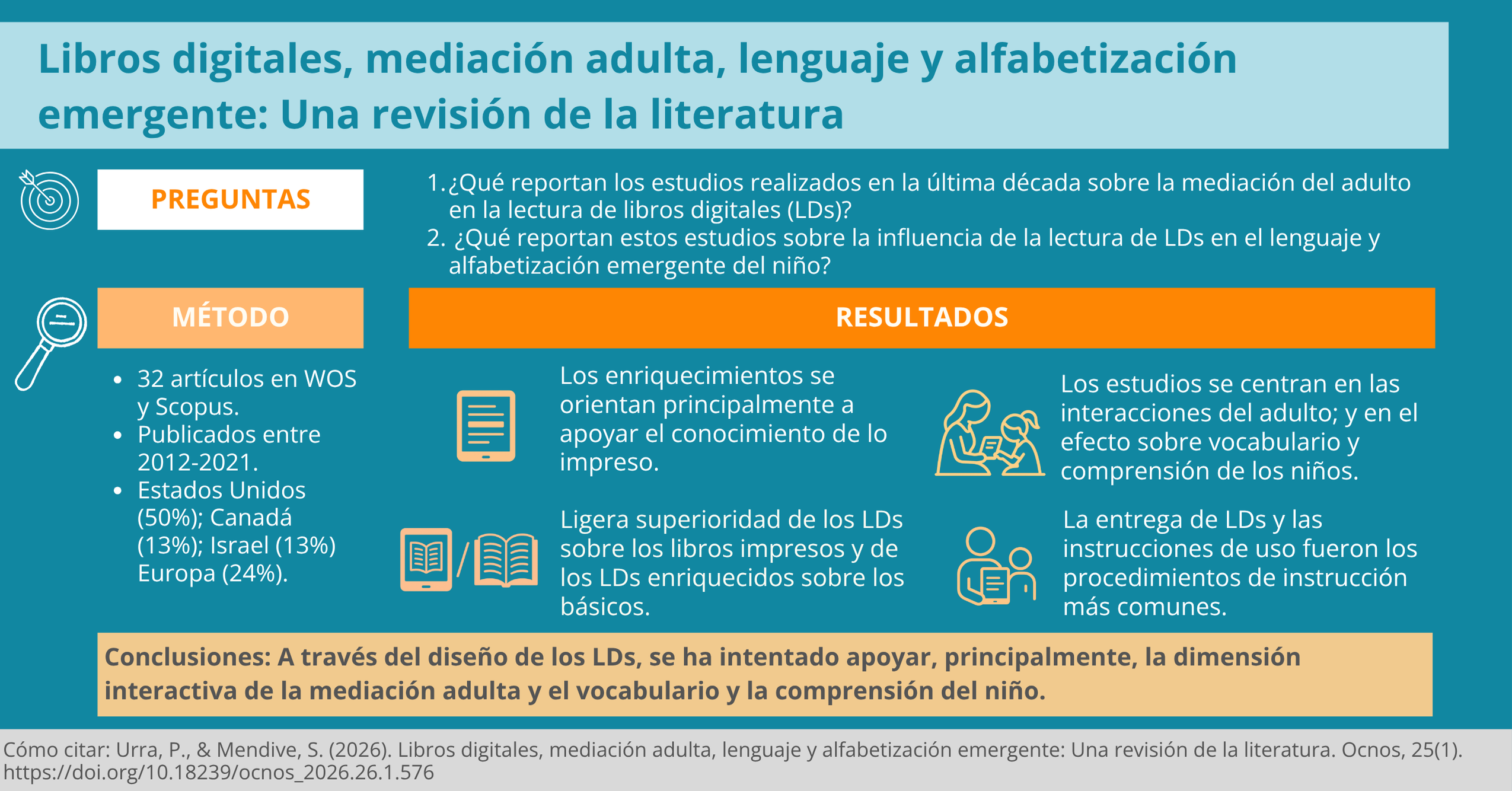
The influence of digital books on adult mediation and emergent literacy has joined the ongoing debate regarding the role of shared reading of print books. However, a systematic evaluation of the enhancements available in digital books, participants’ study conditions, and instructional methods in interventions is still lacking. This review analysed studies from the last decade on digital books, language skills, and adult mediation, considering these factors. A total of 32 articles from WOS and Scopus were reviewed. The findings indicated a widespread use of enhancements supporting print knowledge; research focused on interactions promoted by the adult reader and the assessment of children’s vocabulary and comprehension. Additionally, a slight superiority of digital books over print books and of enhanced digital books over basic ones was observed for children’s lexico-semantic skills and the interactive dimension of adult input. Book distribution and usage instructions were the most common instructional procedures. These findings reveal efforts to support adult mediation and children through digital books. The implications are relevant for families, educators, researchers, and software developers interested in promoting adult mediation and language skills through digital books.
Downloads
Article Details

This work is licensed under a Creative Commons Attribution-NonCommercial-NoDerivatives 4.0 International License.
The articles published at Ocnos will have a Creative Common Licence Creative Commons Attribution-Noncommercial-No Derivative Works 3.0 Unported
References
Aparici-Aznar, M., & Igualada, A. (2018). El desarrollo del lenguaje y la comunicación en la infancia. Editorial UOC.
Arslan-Ari, I., & Ari, F. (2021). The effect of visual cues in e-books on pre-K children’s visual attention, word recognition, and comprehension: An eye tracking study. Journal of Research on Technology in Education, 54(5), 800-814. https://doi.org/10.1080/15391523.2021.1938763
Biesta, G. J. J. (2010). Why “What Works” still won’t work: From evidence-based education to value-based education. Studies in Philosophy and Education, 29(5), 491-503. https://doi.org/10.1007/s11217-010-9191-x
Bus, A. G., Neuman, S. B., & Roskos, K. (2020). Screens, apps, and digital books for young children: The promise of multimedia. AERA Open, 6(1), 1-6. https://doi.org/10.1177/2332858420901494
Courage, M. L., Frizzell, L. M., Walsh, C. S., & Smith, M. (2021). Toddlers using tablets: They engage, play, and learn. Frontiers in Psychology, 12, Article 564479. https://doi.org/10.3389/fpsyg.2021.564479
Deasley, S., Evans, M. A., Nowak, S., & Willoughby, D. (2016). Sex differences in emergent literacy and reading behaviour in junior kindergarten. Canadian Journal of School Psychology, 33(1), 26-43. https://doi.org/10.1177/0829573516645773
Dore, R. A., Hassinger-Das, B., Brezack, N., Valladares, T. L., Paller, A., Vu, L., Golinkoff, R. M., & Hirsh-Pasek, K. (2018). The parent advantage in fostering children’s e-book comprehension. Early Childhood Research Quarterly, 44, 24-33. https://doi.org/10.1016/j.ecresq.2018.02.002
Dore, R. A., Logan, J., Lin, T.-J., Purtell, K. M., & Justice, L. (2020). Characteristics of children’s media use and gains in language and literacy skills. Frontiers in Psychology, 11, Article 2224. https://doi.org/10.3389/fpsyg.2020.02224
Dowdall, N., Melendez-Torres, G. J., Murray, L., Gardner, F., Hartford, L., & Cooper, P. J. (2020). Shared picture book reading interventions for child language development: A systematic review and meta-analysis. Child Development, 91(2), 383-399. https://doi.org/10.1111/cdev.13225
Eggleston, C., Wang, X. C., & Choi, Y. (2021). Mother-toddler shared reading with electronic versus print books: Mothers’ language use and perspectives. Early Education and Development, 33(7), 1152-1174. https://doi.org/10.1080/10409289.2021.1943638
Flack, Z. M., Field, A. P., & Horst, J. S. (2018). The effects of shared storybook reading on word learning: A meta-analysis. Developmental Psychology, 54(7), 1334–1346. https://doi.org/10.1037/dev0000512
Furenes, M. I., Kucirkova, N., & Bus, A. G. (2021). A comparison of children’s reading on paper versus screen: A meta-analysis. Review of Educational Research, 91(4), 483-517. https://doi.org/10.3102/0034654321998074
Grolig, L. (2020). Shared storybook reading and oral language development: A bioecological perspective. Frontiers in Psychology, 11, Article 1818. https://doi.org/10.3389/fpsyg.2020.01818
Guernsey, L., & Levine, M. (2015). Tap, click, read: Growing readers in a world of screens (First). Jossey-Bass. A Wiley Brand.
Guevara, J. P., Erkoboni, D., Gerdes, M., Winston, S., Sands, D., Rogers, K., Haecker, T., Jimenez, M. E., & Mendelsohn, A. L. (2021). Promoting early literacy using digital devices: A pilot randomized controlled trial. Academic Pediatrics, 21(6), 1001-1008. https://doi.org/10.1016/j.acap.2021.05.013
Haring-Biel, C., Buzhardt, J., Brown, J. A., Romano, M. K., Lorio, C. M., Windsor, K. S., Kaczmarek, L. A., Gwin, R., Sandall, S. S., & Goldstein, H. (2020). Language interventions taught to caregivers in homes and classrooms: A review of intervention and implementation fidelity. Early Childhood Research Quarterly, 50, 140-156. https://doi.org/10.1016/j.ecresq.2018.12.002
Hutton, J. S., Huang, G., Sahay, R. D., DeWitt, T., & Ittenbach, R. F. (2020). A novel, composite measure of screen-based media use in young children (ScreenQ) and associations with parenting practices and cognitive abilities. Pediatric Research, 87(7), 1211-1218. https://doi.org/10.1038/s41390-020-0765-1
Korat, O., & Falk, Y. (2019). Ten years after: Revisiting the question of e-book quality as early language and literacy support. Journal of Early Childhood Literacy, 19(2), 206-223. https://doi.org/10.1177/1468798417712105
Korat, O., & Shneor, D. (2019). Can e-books support low SES parental mediation to enrich children’s vocabulary? First Language, 39(3), 344-364. https://doi.org/10.1177/0142723718822443
Korat, O., & Segal-Drori, O. (2016). E-book and printed book reading in different contexts as emergent literacy facilitator. Early Education and Development, 27(4), 532-550. https://doi.org/10.1080/10409289.2016.1095613
Korat, O., Levin, I., Atishkin, S., & Turgeman, M. (2014). E-book as facilitator of vocabulary acquisition: Support of adults, dynamic dictionary and static dictionary. Reading and Writing, 27(4), 613-629. https://doi.org/10.1007/s11145-013-9474-z
Korat, O., Shamir, A., & Heibal, S. (2013). Expanding the boundaries of shared book reading: E-books and printed books in parent–child reading as support for children’s language. First Language, 33(5), 504-523. https://doi.org/10.1177/0142723713503148
Kucirkova, N. (2017). An integrative framework for studying, designing and conceptualising interactivity in children’s digital books. British Educational Research Journal, 43(6), 1168-1185. https://doi.org/10.1002/berj.3317
Kucirkova, N. (2019). Children’s reading with digital books: Past moving quickly to the future. Child Development Perspectives, 13(4), 208-214. https://doi.org/10.1111/cdep.12339
Kucirkova, N., Gattis, M., Spargo, T. P., De-Vega, B. S., & Flewitt, R. (2021). An empirical investigation of parent-child shared reading of digital personalized books. International Journal of Educational Research, 105, 1-12. https://doi.org/10.1016/j.ijer.2020.101710
Kucirkova, N., Messer, D., Sheehy, K., & Flewitt, R. (2013). Sharing personalised stories on iPads: a close look at one parent–child interaction. Literacy, 47(3), 115-122. https://doi.org/10.1111/lit.12003
Kucirkova, N., Sheehy, K., & Messer, D. (2015). A Vygotskian perspective on parent-child talk during iPad story sharing. Journal of Research in Reading, 38(4), 428-441. https://doi.org/10.1111/1467-9817.12030
Labbo, L. D., & Kuhn, M. R. (2000). Weaving chains of affect and cognition: A young child’s understanding of CD-ROM talking books. Journal of Literacy Research, 32(2), 187-210. https://doi.org/10.1080/10862960009548073
Madigan, S., McArthur, B. A., Anhorn, C., Eirich, R., & Christakis, D. A. (2020). Associations between screen use and child language skills: A systematic review and meta-analysis. JAMA Pediatrics, 174(7), 665–675. https://doi.org/10.1001/jamapediatrics.2020.0327
Munn, Z., Peters, M. D. J., Stern, C., Tufanaru, C., McArthur, A., & Aromataris, E. (2018). Systematic review or scoping review? Guidance for authors when choosing between a systematic or scoping review approach. BMC Medical Research Methodology, 18(1). https://doi.org/10.1186/s12874-018-0611-x
Munzer, T. G., Miller, A. L., Weeks, H. M., Kaciroti, N., & Radesky, J. (2019a). Differences in parent-toddler interactions with electronic versus print books. Pediatrics, 143(4). https://doi.org/10.1542/peds.2018-2012
Munzer, T. G., Miller, A. L., Weeks, H. M., Kaciroti, N., & Radesky, J. (2019b). Parent-toddler social reciprocity during reading from electronic tablets vs print books. JAMA Pediatrics, 173(11), 1076-1083. https://doi.org/10.1001/jamapediatrics.2019.3480
Neuman, S. B., Wong, K. M., & Kaefer, T. (2017). Content not form predicts oral language comprehension: The influence of the medium on preschoolers’ story understanding. Reading and Writing, 30(8), 1753-1771. https://doi.org/10.1007/s11145-017-9750-4
Noble, C., Sala, G., Peter, M., Lingwood, J., Rowland, C. F., Gobet, F., & Pine, J. (2019). The impact of shared book reading on children's language skills: A meta-analysis. Educational Research Review, 28, 100290. https://doi.org/10.1016/j.edurev.2019.100290
O’Toole, K. J., & Kannass, K. N. (2018). Emergent literacy in print and electronic contexts: The influence of book type, narration source, and attention. Journal of Experimental Child Psychology, 173, 100-115. https://doi.org/10.1016/j.jecp.2018.03.013
Parish‐Morris, J., Mahajan, N., Hirsh‐Pasek, K., Golinkoff, R. M., & Collins, M. F. (2013). Once upon a time: Parent–child dialogue and storybook reading in the electronic era. Mind, Brain, and Education, 7(3), 200–211. https://doi.org/10.1111/mbe.12028
Reich, S. M., Yau, J. C., & Warschauer, M. (2016). Tablet-based ebooks for young children: What does the research say? Journal of Developmental and Behavioral Pediatrics, 37(7), 585–591. https://doi.org/10.1097/DBP.0000000000000335
Reich, S. M., Yau, J. C., Xu, Y., Muskat, T., Uvalle, J., & Cannata, D. (2019). Digital or print? A comparison of preschoolers’ comprehension, vocabulary, and engagement from a print book and an e-book. AERA Open, 5(3). https://doi.org/10.1177/2332858419878389
Richter, A., & Courage, M. L. (2017). Comparing electronic and paper storybooks for preschoolers: Attention, engagement, and recall. Journal of Applied Developmental Psychology, 48, 92-102. https://doi.org/10.1016/j.appdev.2017.01.002
Rowe, M. L., & Snow, C. E. (2020). Analyzing input quality along three dimensions: Interactive, linguistic, and conceptual. Journal of Child Language, 47(1), 5-21. https://doi.org/10.1017/S0305000919000655
Rvachew, S., Rees, K., Carolan, E., & Nadig, A. (2017). Improving emergent literacy with school-based shared reading: Paper versus ebooks. International Journal of Child-Computer Interaction, 12, 24-29. https://doi.org/10.1016/j.ijcci.2017.01.002
Sarı, B., Başal, H. A., Takacs, Z. K., & Bus, A. G. (2019). A randomized controlled trial to test efficacy of digital enhancements of storybooks in support of narrative comprehension and word learning. Journal of Experimental Child Psychology, 179, 212-226. https://doi.org/10.1016/j.jecp.2018.11.006
Sénéchal, M., Lefevre, J.-A., Hudson, E., & Lawson, E. P. (1996). Knowledge of storybooks as a predictor of young children’s vocabulary. Journal of Educational Psychology, 88(3). https://doi.org/10.1037/0022-0663.88.3.520
Skibbe, L. E., Thompson, J. L., & Plavnick, J. B. (2018). Preschoolers’ visual attention during electronic storybook reading as related to different types of textual supports. Early Childhood Education Journal, 46(4), 419-426. https://doi.org/10.1007/s10643-017-0876-4
Smeets, D. J. H., & Bus, A. G. (2012). Interactive electronic storybooks for kindergartners to promote vocabulary growth. Journal of Experimental Child Psychology, 112(1), 36-55. https://doi.org/10.1016/j.jecp.2011.12.003
Smeets, D. J. H., & Bus, A. G. (2015). The interactive animated e-book as a word learning device for kindergartners. Applied Psycholinguistics, 36(4), 899–920. https://doi.org/10.1017/S0142716413000556
Strouse, G. A., & Ganea, P. A. (2016). Are prompts provided by electronic books as effective for teaching preschoolers a biological concept as those provided by adults? Early Education and Development, 27(8), 1190-1204. https://doi.org/10.1080/10409289.2016.1210457
Strouse, G. A., & Ganea, P. A. (2017a). Toddlers’ word learning and transfer from electronic and print books. Journal of Experimental Child Psychology, 156, 129-142. https://doi.org/10.1016/j.jecp.2016.12.001
Strouse, G. A., & Ganea, P. A. (2017b). Parent-toddler behavior and language differ when reading electronic and print picture books. Frontiers in Psychology, 8, Article 677. https://doi.org/10.3389/fpsyg.2017.00677
Takacs, Z. K., & Bus, A. G. (2016). Benefits of motion in animated storybooks for children’s visual attention and story comprehension. An eye-tracking study. Frontiers in Psychology, 7, Article 1591. https://doi.org/10.3389/fpsyg.2016.01591
Takacs, Z. K., & Bus, A. G. (2018). How pictures in picture storybooks support young children’s story comprehension: An eye-tracking experiment. Journal of Experimental Child Psychology, 174, 1-12. https://doi.org/10.1016/j.jecp.2018.04.013
Takacs, Z. K., Swart, E. K., & Bus, A. G. (2014). Can the computer replace the adult for storybook reading? A meta-analysis on the effects of multimedia stories as compared to sharing print stories with an adult. Frontiers in Psychology, 5, Article 1366. https://doi.org/10.3389/fpsyg.2014.01366
Takacs, Z. K., Swart, E. K., & Bus, A. G. (2015). Benefits and pitfalls of multimedia and interactive features in technology-enhanced storybooks: A meta-analysis. Review of Educational Research, 85(4), 698-739. https://doi.org/10.3102/0034654314566989
Troseth, G. L., Strouse, G. A., Flores, I., Stuckelman, Z. D., & Russo-Johnson, C. (2020). An enhanced eBook facilitates parent-child talk during shared reading by families of low socioeconomic status. Early Childhood Research Quarterly, 50, 45-58. https://doi.org/10.1016/j.ecresq.2019.02.009
Tzuriel, D. (2013). Mediated learning experience and cognitive modifiability. Journal of Cognitive Education and Psychology, 12(1), 59–80. https://doi.org/10.1891/1945-8959.12.1.59
Whitehurst, G. J., Falco, F. L., Lonigan, C. J., Fischel, J. E., DeBaryshe, B. D., Valdez-Menchaca, M. C., & Caulfield, M. (1988). Accelerating language development through picture book reading. Developmental Psychology, 24(4), 552–559. https://doi.org/10.1037/0012-1649.24.4.552
Whitehurst, G. J., & Lonigan, C. J. (1998). Child Development and emergent literacy. Child Development, 69(3), 848-872. https://doi.org/10.1111/j.1467-8624.1998.tb06247.x
Willoughby, D., Evans, M. A., & Nowak, S. (2015). Do ABC eBooks boost engagement and learning in preschoolers? An experimental study comparing eBooks with paper ABC and storybook controls. Computers and Education, 82, 107-117. https://doi.org/10.1016/j.compedu.2014.11.008
Xu, Y., Yau, J. C., & Reich, S. M. (2019). The added challenge of digital reading: Exploring young children’s page turning behaviors. In Proceedings of the 18th ACM International Conference on Interaction Design and Children, 432-438. https://doi.org/10.1145/3311927.3323121