
Assessing academic writing in Primary, Secondary, and Higher Education
Article Sidebar
Main Article Content

Abstract
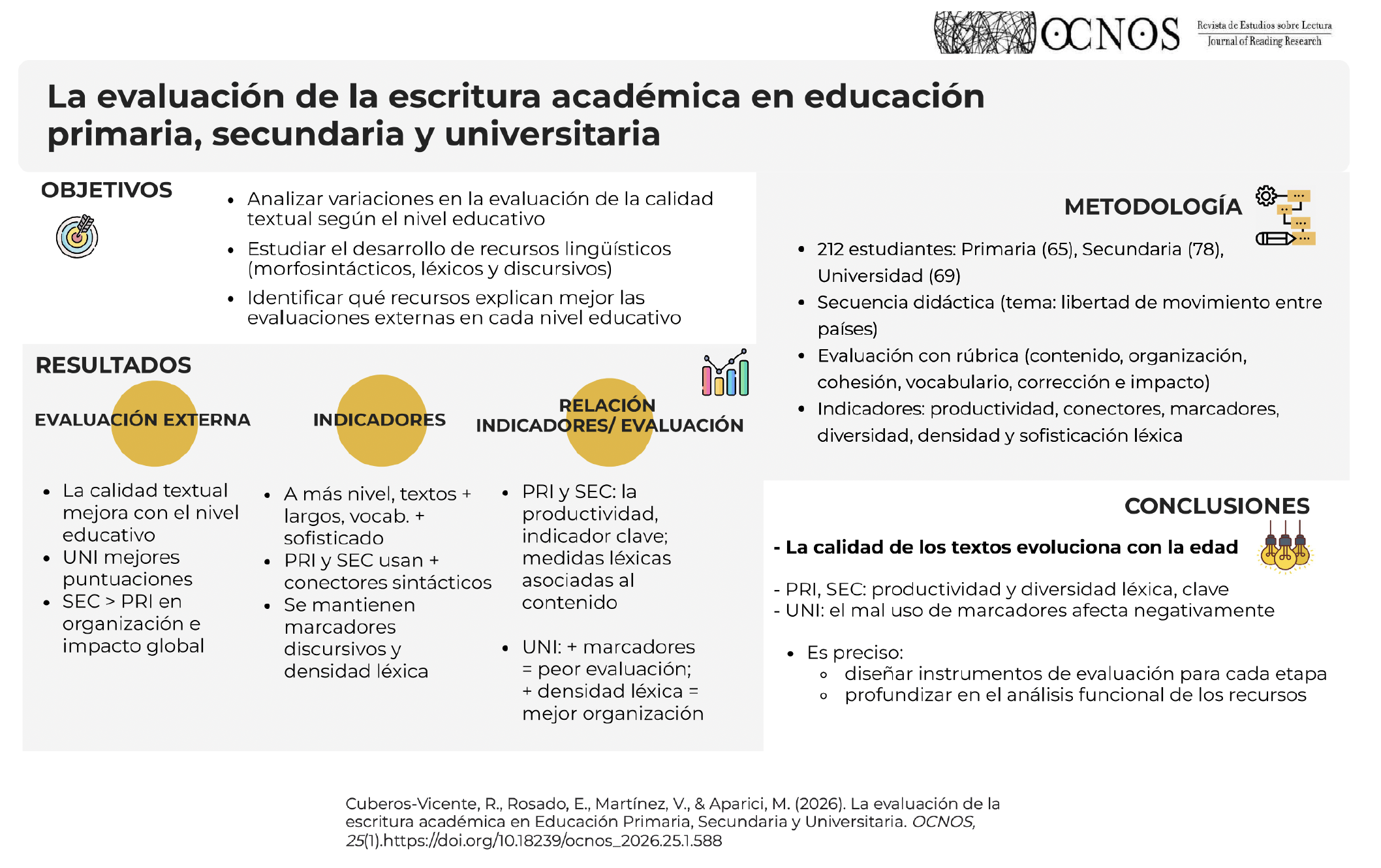
Mastering the linguistic skills required in academic writing becomes a challenge at all educational stages. The present study analyses the relationship between the use of linguistic resources and the perceived quality of academic texts with the aim of developing valid instruments for the assessment of text quality. A total of 212 argumentative-expository texts from 65 primary school pupils, 78 secondary school pupils, and 69 university students were analysed. In a first analysis, the morphosyntactic, lexical, and discursive resources of texts were coded. In a second phase, teachers at each educational level evaluated them with an analytical rubric designed to assess linguistic and rhetorical aspects. The results showed a developmental increase in most of the linguistic features analysed, except for the proportion of discourse markers and lexical density. External evaluations showed greater variability in primary and secondary education than at university level, although scores did increase with educational level. The perceived quality of the texts was associated with different features at each level: while productivity was strongly linked to higher scores in primary and secondary education, in higher education a negative correlation emerged between the use of discourse markers and teacher evaluations. These findings will inform the design of evaluation instruments tailored to the specific requirements of each educational stage.
Downloads
Article Details

This work is licensed under a Creative Commons Attribution-NonCommercial-NoDerivatives 4.0 International License.
The articles published at Ocnos will have a Creative Common Licence Creative Commons Attribution-Noncommercial-No Derivative Works 3.0 Unported
References
Alonso-Chacón, P. J. (2019). Uso de marcadores discursivos en el discurso académico oral y escrito de estudiantes universitarios costarricenses [Tesis doctoral, Universitat de Barcelona]. https://hdl.handle.net/2445/151342
Aparici, M. (2010). El desarrollo de la conectividad discursiva en diferentes géneros y modalidades de producción [Tesis doctoral, Universitat de Barcelona].
Aparici, M., Cuberos, R., Salas, N., & Rosado, E. (2021). Linguistic indicators of text quality in analytical texts: developmental changes and sensitivity to pedagogical work. Journal for the Study of Education and Development, 44(1), 9-46. https://doi.org/10.1080/02103702.2020.1848093 DOI: https://doi.org/10.1080/02103702.2020.1848093
Aparici, M., Rosado, E., Vilar, H., Cuberos, R., & Tolchinsky, L. (2024). The influence of students’ linguistic condition, school level, and pedagogical input on analytical essay features. Frontiers in Language Sciences, 3, 1480422. https://doi.org/10.3389/flang.2024.1480422 DOI: https://doi.org/10.3389/flang.2024.1480422
Berman, R. A., & Nir-Sagiv, B. (2010). The lexicon in writing–speech–differentiation. Developmental perspectives. Written Language and Literacy, 13(2), 183-205. https://doi.org/10.1075/wll.13.2.01ber DOI: https://doi.org/10.1075/wll.13.2.01ber
Berman, R. A., & Slobin, D. I. (1994). Relating events in narrative: A crosslinguistic developmental study. Erlbaum. https://doi.org/10.4324/9780203773512 DOI: https://doi.org/10.4324/9780203773512
Berman, R. A., & Verhoeven, L. (2002). Cross-linguistic perspectives on the development of text production abilities: Speech and writing. Written Language and Literacy, 5(2), 1-43. https://doi.org/10.1075/wll.5.1.02ber DOI: https://doi.org/10.1075/wll.5.1.02ber
Cohen, J. (1988). Statistical power analysis for the behavioural sciences. Erlbaum. https://doi.org/10.4324/9780203771587 DOI: https://doi.org/10.4324/9780203771587
Crossley, S. A., & McNamara, D. S. (2010). Cohesion, coherence, and expert evaluations of writing proficiency. En S. Ohlsson y R. Catrambone (Eds.), Proceedings of the 32nd Annual Conference of the Cognitive Science Society (pp. 984-989). Cognitive Science Society. https://escholarship.org/uc/item/6n5908qx
Crossley, S. A., Weston, J., McLain-Sullivan, S. T., & McNamara, D. S. (2011). The development of writing proficiency as a function of grade level: A linguistic analysis. Written Communication, 28(3), 282-311. https://doi.org/10.1177/0741088311410188 DOI: https://doi.org/10.1177/0741088311410188
Cuberos-Vicente, R. (2019). Indicadores léxicos de calidad textual en español nativo y no nativo [Tesis doctoral, Universitat de Barcelona]. https://diposit.ub.edu/dspace/handle/2445/178686
Cuenca, M. J. (2013). The fuzzy boundaries between discourse marking and modal marking. En L. Degand, B. Cornillie y P. Pietrandrea (Eds.), Discourse markers and modal particles. Categorization and description (pp. 181-216). John Benjamins. https://doi.org/10.1075/pbns.234 DOI: https://doi.org/10.1075/pbns.234.08cue
Field, A. (2009). Discovering statistics using SPSS (and sex and drugs and rock'n'roll) (3ª Ed.). SAGE Publications.
Galiana-Bea, P., Gras-Manzano, P., Rosado, E., & Mañas-Navarrete, I. (2024). Marcadores discursivos y otros mecanismos de marcación discursiva. Una propuesta holística para el análisis de narraciones orales en español como lengua extranjera. Rilce, 40(3), 937-69. https://doi.org/10.15581/008.40.3.937-69 DOI: https://doi.org/10.15581/008.40.3.937-69
Gavari-Starkie, E. I., & Tenca-Sidotti, P. (2017). La evolución histórica de los Centros de Escritura Académica. Revista de Educación, 378, 9-29. https://doi.org/10.4438/1988-592X-RE-2017-378-359; https://www.educacionfpydeportes.gob.es/revista-de-educacion/gl/dam/jcr:6b2bc342-a3f0-48dd-8148-0b3ee1a8fff5/01gavari-pdf.pdf
Hyland, K. (2002). Teaching and researching writing. Longman/Pearson. https://doi.org/10.4324/9781003198451 DOI: https://doi.org/10.4324/9781003198451
Johansson, V. (2009). Lexical diversity and lexical density in speech and writing: A developmental perspective. Working Papers Lund University, 53, 61-79. https://journals.lub.lu.se/LWPL/article/view/2273
Llauradó, A., & Tolchinsky, L. (2013). Growth of text-embedded lexicon in Catalan: From childhood to adolescence. First Language, 33(6), 628-653. https://doi.org/10.1177/0142723713508861 DOI: https://doi.org/10.1177/0142723713508861
López-Ferrero, C., & Atienza-Cerezo, E. (2006). Las conjunciones paratácticas en el Corpus 92. En E. Bernal y J. A. DeCesaris (Eds.), Palabra por palabra: estudios ofrecidos a Paz Battaner (pp. 147-160). Universitat Pompeu Fabra, Institut Universitari de Lingüística Aplicada. http://hdl.handle.net/10230/23683
MacWhinney, B. (2000). The CHILDES Project: Tools for analyzing talk (3ª Ed.). Erlbaum.
Malvern, D., Richards, B., Chipere, N., & Durán, P. (2004). Lexical diversity and language development. Quantification and assessment. Palgrave MacMillan. https://doi.org/10.1057/9780230511804 DOI: https://doi.org/10.1057/9780230511804
Martín-Zorraquino, M. A., & Portolés-Lázaro, J. (1999). Los marcadores del discurso. En I. Bosque, & V. Demonte (Eds.), Gramática descriptiva de la lengua española (Vol. 3, pp. 4051-4213). Espasa Calpe.
McMaster, K., & Espin, C. (2007). Technical features of curriculum–based measurement in writing. The Journal of Special Education, 41(2), 68-84. https://doi.org/10.1177/00224669070410020301 DOI: https://doi.org/10.1177/00224669070410020301
McNamara, D. S., Crossley, S. A., & McCarthy, P. (2010). Linguistic features of writing quality. Written Communication, 27(1), 57-86. https://doi.org/10.1177/0741088309351547 DOI: https://doi.org/10.1177/0741088309351547
Rosado, E., Mañas-Navarrete, I., Yúfera-Gómez, I., & Aparici-Aznar, M. (2021). El desarrollo de la escritura analítica: aprender a enlazar la información, aprender a posicionarse. Pensamiento Educativo, 58, 1-18. https://doi.org/10.7764/PEL.58.2.2021.10 DOI: https://doi.org/10.7764/PEL.58.2.2021.10
Salas, N., Llauradó, A., Castillo, C., Taulé, M., & Martí, M. A. (2016). Linguistic correlates of text quality from childhood to adulthood. En J. Perera, M. Aparici, E. Rosado, & N. Salas (Eds.), Written and spoken language development across the lifespan. Essays in honour of Liliana Tolchinsky (pp. 307-326). Springer. https://doi.org/10.1007/978-3-319-21136-7_18 DOI: https://doi.org/10.1007/978-3-319-21136-7_18
Schleppegrell, M. J. (2004). The language of schooling. a functional linguistics perspective. Lawrence Erlbaum. https://doi.org/10.4324/9781410610317 DOI: https://doi.org/10.4324/9781410610317
Snow, C. E., & Uccelli, P. (2009). The challenge of academic language. En D. R. Olson y N. Torrance (Eds.), The Cambridge handbook of literacy (pp. 112-133). Cambridge University Press. https://doi.org/10.1017/CBO9780511609664.008; http://nrs.harvard.edu/urn-3:HUL.InstRepos:11654980 DOI: https://doi.org/10.1017/CBO9780511609664.008
Strömqvist, S., Johansson, V., Kriz, S., Ragnarsdóttir, H., Aisenman, R., & Ravid, D. (2002). Toward a cross-linguistic comparison of lexical quanta in speech and writing. Written Language and Literacy, 5(1), 45-67. https://doi.org/10.1075/wll.5.1.03str DOI: https://doi.org/10.1075/wll.5.1.03str
Tolchinsky, L., Aparici-Aznar, M., & Rosado, E. (2017). Escribir para pensar y persuadir. Textos de Didáctica de la Lengua y la Literatura, 76, 14-21. https://hdl.handle.net/2445/122119
Tolchinsky, L., Aparici, M., & Vilar, H. (2021). Macro– and micro–developmental changes in analytical writing of bilinguals from elementary to higher education. International Journal of Bilingual Education and Bilingualism, 25(7), 2511-2526. https://doi.org/10.1080/13670050.2021.1923643 DOI: https://doi.org/10.1080/13670050.2021.1923643
Tolchinsky, L., Rosado, E., & Aparici, M. (2023). Internal and external appraisals of analytical writing. A proposal for assessing development and potential improvement. International Review of Applied Linguistics in Language Teaching, 62, 5-36. https://doi.org/10.1515/iral-2023-0012 DOI: https://doi.org/10.1515/iral-2023-0012
Toulmin, S. E. (2002). The uses of argument. Cambridge University Press. https://doi.org/10.1017/CBO9780511840005 DOI: https://doi.org/10.1017/CBO9780511840005
Uccelli, P. (2023). Midadolescents’ language learning at school: Toward more just and scientifically rigorous practices in research and education. Language Learning, 73(2), 182-221. https://doi.org/10.1111/lang.12558 DOI: https://doi.org/10.1111/lang.12558
Uccelli, P., Deng, Z., Phillips-Galloway, E. P., & Qin, W. (2019). The role of language skills in midadolescents’ science summaries. Journal of Literacy Research, 51(3), 357-380. https://doi.org/10.1177/1086296X19860206 DOI: https://doi.org/10.1177/1086296X19860206
Uccelli, P., Dobbs, C. L., & Scott, J. (2012). Mastering academic language: organization and stance in the persuasive writing of high school students. Written Communication, 30(1), 36-62. https://doi.org/10.1177/0741088312469013 DOI: https://doi.org/10.1177/0741088312469013
Zipf, G. K. (1932). Selected studies of the principle of relative frequency in language. Harvard University Press. https://pure.mpg.de/rest/items/item_2407800_3/component/file_2459540/content