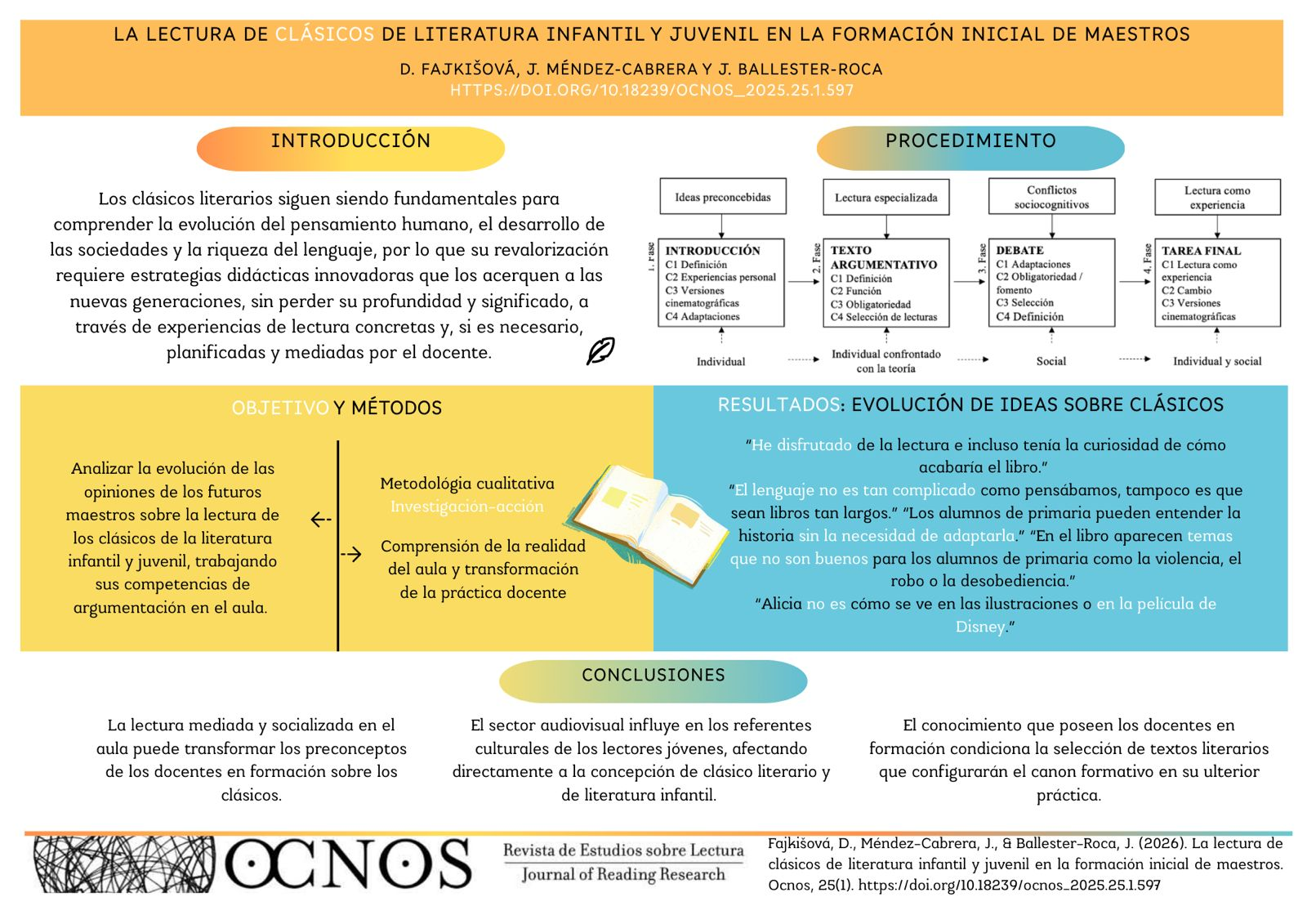
This paper presents an action research conducted in the context of teacher training, specifically, in the Degree of Primary Education Teacher, with the aim of qualitatively analysing the evolution of the opinions of future teachers on reading of the classics of children’s literature, working on their argumentation in the classroom, both orally and in writing. The research was conducted in four different stages, consisting of an introduction to the problem, the writing of argumentative texts, a debate for the creation of socio-cognitive conflicts and a final creative task, which included the collective reinterpretation of the works selected and read by the students. The categorical analysis of the data obtained in each stage of the research allows us to detect different emerging categories that make it possible to observe a clear evolution in the ideas and feelings of the future teachers about the reading of the classics of the children literature, which facilitates certain final reflections on the selection and mediation of works for reading and literary education.
Downloads
Download data is not yet available.
Article Details
How to Cite
Fajkišová, D., Méndez-Cabrera, J., & Ballester-Roca, J. (2026). Reading the classics of children’s literature in the initial training of teachers. Ocnos. Journal of reading research, 25(1). https://doi.org/10.18239/ocnos_2025.25.1.597
Fajkišová, Méndez-Cabrera, and Ballester-Roca: Reading the classics of children’s literature in the initial training of teachers
INTRODUCTION
The concept of a literature classic, generally accepted as a culturally representative
work that has endured over time due to the appreciation of its formal characteristics
and content as a milestone, can hardly be separated today from multimodal reading
experiences, the impact of audiovisual media, and so-called hybrid and transmedia
narratives (; ; ; ). Furthermore, reader training necessarily involves media and formats such as picture
books, comics, animated series, and video games (; ).In fact, there are intermedial studies that show that reading the classics and the
concept of children’s and young adult literature are determined by audiovisual references,
in which film adaptations go from being mere intertextual references to being considered
the initial experiences of contact with literary tradition (). This inevitably has an impact on what, in practice, the act of reading entails,
understood as the epicentre of literary education, together with reading motivation
and mediation in educational pathways.
Today, due by the immediacy of information, the predominance of digital media and
the overabundance of ephemeral content promoted by social networks, reading literature
classics faces multiple challenges. The lack of a deeply ingrained habit, the preference
for audiovisual formats, and the perception of classics as complex or irrelevant texts
have led to a devaluation of their reading and consideration as cultural references
(; ). Nevertheless, the classics remain fundamental to understanding the evolution of
human thought, the development of societies and the richness of language. Therefore,
their revaluation requires innovative pedagogical strategies that bring them closer
to new generations, without losing their depth and meaning, through specific reading
experiences that, if necessary, are planned and mediated by the teacher. In this regard,
the issue of the presence of the classics in the education system still requires reflection
on the following assumption. Many students claim that they “do not understand them”
or that they “are outdated”. To try to solve this problem, strategies can be used
to make the “obligation” to read them more flexible, but always with the requirement
of a rigorous selection of texts that takes into account, among other things, the
potential empathy with readers, the proximity of the content or characters to their
reading expectations, and the accessibility of the language ().
The problem of reading the classics therefore continues to this day in a context of
transmedia and digital complexity () which, at a cultural and educational level, poses no small number of challenges.
There are basically two general assessments that are often repeated ad nauseam when
referring to classical texts, whatever their type (): firstly, that they are very difficult texts for the developing reader because they
use an archaic vocabulary and a rhetorically elaborate style; and secondly, that they
are works that are far removed from the interests of young readers, because they are
set in historical and cultural contexts that are very different and far removed from
current concerns ().
However, authors such as remind us that, while it is true that the classics can save schools and universities
by making teaching more authentic, it is no less true that without schools and universities
it is difficult to imagine a prosperous and vital future for the classics. In this
regard, it should be added that, from certain initial research () to some other subsequent studies (; ; ; ; ), there are several interesting works on the complex link between trainee teachers
and reading, the classics and the concept of children’s and young adult literature.
In this regard, it is not only necessary to understand the beliefs and knowledge of
active teachers (), but it is also essential to address the need for children’s and young adult literature
in the initial training of teachers as occasional readers; and to do so through specific
teaching methods that include those theories and practices that produce real transformation
in university students, promoting literary education in their training as future teachers
(; ). Given that, in this educational context, it is the responsibility of the educational
institution and mediators to select how and when to read the classics, as well as
to encourage young people to engage with them ().
OBJECTIVES
Therefore, the main objective of this action research is to qualitatively analyse
the evolution of future teachers’ opinions on reading classics of children’s and young
adult literature, working on their argumentation skills in the classroom. To this
end, the following specific objectives are set:
1) to assess participants’ prior knowledge of literature classics;
2) to assess the influence of reading specialised literature;
3) to study the impact of collective debate on the conception of the problem; and
4) to analyse the effect of reading as an experience on the perception of the classics.
DESIGN AND PARTICIPANTS
The action research was conducted in Spanish Language for Teachers, a subject taught in the first year of the Bachelor’s Degree in Primary Education
Teacher at Universitat de València in the first semester of 2024, with a sample of
34 students. The course content focuses on the knowledge, creation and use of various
discursive genres and text types in different communicative contexts, with greater
emphasis on argumentative texts. Prior to this, the relevant authorisation was requested
for the collection and analysis of the works and the making of the audiovisual recordings
().
The research was conducted by three researchers who see themselves as subjects of
qualitative research in a dual role as researchers and teachers. Therefore, according
to and , these participants transform the socio-educational reality by evaluating (in order
to improve) their own teaching practice, something essential in action research, which
cannot be defined without the active participation of researchers.
The issue of reading children’s and young adult literature classics was brought into
the classroom in order to study students' preconceptions prior to teaching the second-year
course Literary Training for Teachers, and to meet the main objectives of the teaching guide for the first-year subject
called Spanish Language for Teachers.
Given the qualitative design of the research, sampling is intentional for convenience.
explains that participants selected in this way represent a limited group, chosen
based on their availability and proximity to the researcher, thus prioritising ease
of access and cost-effectiveness over randomness. It should be emphasised that qualitative
methodology does not seek generalisations that are the result of statistical procedures
(), but rather focuses inductively on educational and social reality, with the aim
of creating a new theory based on the results of the study rather than verifying an
existing one ().
INSTRUMENTS
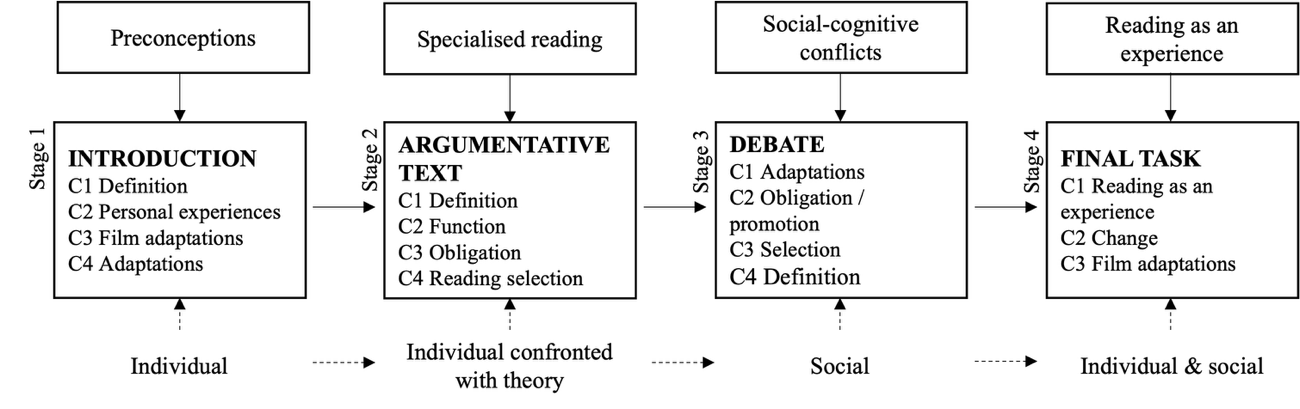
Four tasks with a progressively complex design were carried out during six non-consecutive
sessions of two hours each, over four months of teaching practice. Firstly, in order
to study students’ preconceived ideas about reading classics of children’s and young
adult literature, a Socratic dialogue was planned as an introduction to the issue.
Secondly, argumentative texts were written after reading the specialised bibliography
to investigate how it influences the construction of conceptual knowledge about the
issue. Thirdly, based on a debate, changes in opinions as a result of socio-cognitive
conflicts were analysed. Finally, certain literature classics were read, and the plot
of the selected works was subsequently reconstructed in a final creative task that
included an oral presentation in the classroom.
Based on these four tasks, the material was obtained (the students’ responses, the
argumentative texts, the reflections arising from the debate, the final products,
and the oral presentations), which was then analysed according to a coding system
that facilitates the construction of a grounded theory (; ). This way, four groups of independent categories (with interpretative codes) were
created, corresponding to each stage of the study, in order to discover the links
between them in the form of modifications and alterations of ideas, concepts and attitudes
surrounding the reading of classics in the primary school classroom. Furthermore,
repeated entry into the context under study allowed the project to be completed at
the point of data saturation (; ), ensuring constant comparison procedures and thus answering the main research questions:
− What do future teachers think about reading the classics?
− How do they argue about the issue of reading children´s literature classics at school?
− How do you read and interpret children´s literature classics from a personal and
educational perspective?
Figure 1Stages of the intervention
PROCEDURE
This section systematically outlines the development of action research, addressing
each of its stages in accordance with the principles of qualitative methodology. The
procedure followed to identify and verify emerging categories −which arise from an
analysis of the contextual reality− is described. Through data collection and interpretation,
links are established between observed experiences, specific examples, and analytical
explanations, allowing for the construction of knowledge that is situated and consistent
with the dynamics of the environment under investigation. This approach ensures a
deep understanding of the phenomenon, supported by constant interaction between theory
and practice.
Stage 1: Introduction
The educational objective was to learn about the students’ reflections on the issues
surrounding classics in children´s literature before beginning the learning process
as a means of constructing new knowledge. defines these initial reflections, also known as preconceptions, as unique ideas
about certain content that do not coincide with scientific knowledge. This way, they
present a preliminary stage in teacher training, based on personal experiences and
explanations. They are characterised by their cognitive and affective dimensions and
by their plasticity, which allows for subsequent modification, a process understood
by as meaningful learning.
To ascertain participants’ preconceptions, four open-ended questions were posed. This
formulation was the only intervention by the teacher-researcher in the development
of classroom interaction:
− What are literature classics?
− What experiences have you had with literature classics?
− What are the classics of children’s and young adult literature?
− Which classics do you know?
Analysis of the students’ responses and reactions made it possible to identify their
preconceived ideas about children's literature classics, giving rise to four interpretative
categories: Definition; Personal experiences; Film versions; Adaptations.
1. Definition
The most significant attributes for students when making an initial definition of
literature classics were aspects such as the longevity of the works, their recognition
as exemplary, the obligation to read them, and their length. Although they are underdeveloped,
the first two criteria are also crucial in the definition of classics in the context
of literary education (; ; ; ; ; ; ; ; ; ). While the latter two are directly linked to reading experiences that shape the
personal definition of the concept of a ‘literature classic’. Below are some transcribed
examples that verify the emergence of the category:
“They are the best known and most widely read works.”
“They have to be old books, usually thick ones, but ones that still spark interest.”
“They are books that are compulsory reading in schools. The same our parents read.”
2. Personal experiences
Initial communication demonstrated that students approach the subject of the classics
from a subjective and emotional perspective. And although positive experiences were
mentioned, there was a certain degree of rejection and disinterest in the titles prescribed
in the school curriculum, due to their difficulty, their remoteness in time, or the
teaching methods used. These findings coincide with other qualitative studies focusing
on the reading habits of future teachers (; ; ). Below are some examples of this category:
“(...) at times I was very bored, reading books that are no longer relevant.”
“We made many comments on the text. I understand that it is important, but it did
not motivate me.”
“I prefer contemporary books.”
“I often found it difficult to finish the books we read because they were so challenging.
And, in general, because of the plot.”
3. Film adaptations
When it came to mentioning classics of children´s literature, the students turned
to works from the Anglo-Saxon tradition, ignoring Hispanic authors. This is due to
media influence, that is, the dominance of the audiovisual sector in the cultural
references of young readers, which directly affects the conception of literature classics
and children’s literature today. (; ; ; ). Here are some selected examples from this category:
“I think it's works like Peter Pan or Alice, which are films too.”
“That’s right, Matilda is on Netflix too.”
“Pinocchio too, which my little brother likes. There is a new version now.”
“I do not know if Dumbo is also a classic book or just a film.”
“And now they are filming doing the one about the Chocolate factory, aren’t they?”
4. Adaptations
Although more anecdotal, there was also discussion of adapted versions of traditional
classics, such as Don Quixote or even Tirant lo Blanc.
“Well, they are works like Don Quixote, but perhaps shorter versions.”
“I didn't mind reading Tirant.”
Stage 2: Argumentative text
The students wrote an argumentative text of 350-400 words. The topic was presented
to them under the form of a question: To read or not to read the literature classics?
To that end, they first had to read two chapters from two reference monographs: chapter
5 of , dedicated to the literary canon, the classics and the school canon, and chapter
3 of Colomer’s book () on the legacy of classic children´s works; as well as an article on this issue (). This way, they had to use arguments based on the theory of literature teaching.
Next, the texts were analysed to identify emerging categories that group together
the most relevant information for the study according to its recurrence or significance.
This not only made it possible to code the material, but also to compare the categories
from Stage 1 with those from the Stage 2 in order to reflect the process of internalisation
and reconstruction of knowledge on the subject. The four categories that emerged in
this Stage 2, with their interpretative codes, are listed below.
1. Definition
Reading the aforementioned bibliography and reflecting on the requirements of writing
an argumentative text allowed us to observe a notable deepening in the students’ definitions
of literature classics. This deepening comes from the use of more objective vocabulary
and specific terminology, which has an impact on their argumentation skills. There
is also greater awareness of the issue. In this regard, the analysis identified four
different codes that present the criteria for defining a classic, according to the
participants:
− Persistence over time (timelessness of classics).
“Classics are literary works that have stood the test of time and provide a window
into different eras and societies.”
“These are high-quality works and have managed to maintain their relevance despite
the passage of time.”
− Collective consciousness (sense of tradition or collectivity).
“Classics, as a model of language and representation of other cultures, combine tradition
and innovation to educate students.”
“(...) classics manage to create a collective consciousness.”
“Through literature, we manage to culturalise them with what has been passed down
from generation to generation.”
− Artistic references and intertextualities.
“Through literature, children come to share linguistic, artistic, and cultural references
with previous generations.”
“They should read because they derive pleasure from recognising literary elements
in intertextual play.”
− General knowledge.
“I would begin earlier with their knowledge of the culture and social connections
shown in the classics.”
“They will be taught general knowledge from an early age.”
2. Function
Additionally, the students reflected in their essays on the functions of reading the
classics in educational contexts. The analysis facilitated their grouping into four
codes. In this regard, there is a clear connection between the functions identified
by the students and those highlighted in the specialised literature on children’s
literature. Thus, initially established three functions for children´s literature in general: to provide
access to the collective imagination; to promote language learning through forms of
literary discourse; and to offer an articulated version of the world that serves as
an instrument of cultural socialisation. The codes belonging to this category are
as follows:
− Imagination and creativity.
“Classics encourage most students to increase their imagination and creativity. Therefore,
by raising the level of imagination, you could raise your writing level to create
complex and correct texts.”
− Cognitive and affective abilities.
“They address ethical and moral issues, providing a solid foundation for the development
of critical thinking.”
“They are very important because of the development they provide and the feelings
they receive, through which they can become much happier.”
− Learning to read and write.
“When we read these classics as children, we improved many aspects of our reading.”
“Since it is written in older Spanish, there are words that can be learned by reading
it.”
− Literary education.
“These books are very important for understanding contemporary literature and also
for understanding how we got to where we are today.”
“It is necessary for them to read quality books, in order to help them develop their
learning and comprehension.”
3. Obligation
Four different codes were identified in this category; the first three (Length, Vocabulary,
Complexity) include the main objections that students raise to the compulsory reading
of classics, as required by the study programmes or curriculum for each stage of education.
However, the presence of the last code (Reading options) presents a possible solution
to this obligation, although this proposal appeared only sporadically in the students'
argumentative texts.
− Length.
“What cannot be denied either is that some classics are very long and dense, which
makes them difficult to read.”
− Vocabulary.
“There are certain classics that children may not yet understand (...)”.
“These writings’ language does not correspond to today’s language.”
− Complexity.
“Primary education students are still learning to read and are therefore not ready
to grasp the complexity of these texts.”
− Reading options.
“(...) A much more educational solution for including these types of classics would
be to give them a choice between three different classics, so that at least they would
read something that catches their attention.”
4. Selecting the readings
The emergence of this category is particularly significant, given the planning of
the final stage of the investigation. The analysis made it possible to identify which
specific titles students consider to be classics of children’s literature. In this
regard, four different codes were identified: adaptations, media influence, folk tales,
and classics from our own tradition (for adult readers). It should be noted that,
in general and in this study in particular, the concept of literature classics is
influenced by the sociolinguistic context of the students, where Catalan is also an
official language alongside Spanish, which means that works such as Tirant lo Blanc appear in the students’ reading intertext.
It is also noteworthy that, as observed in the previous category, knowledge of English
titles is very notable due to the influence of the audiovisual media. In this sense,
a concept of literature classic linked, effectively, to media reception appears predominantly
(). Let us look at the codes with examples from this category:
− Adaptations.
“[primary education students] do not yet have the capacity to retain the complex knowledge
contained in the classics in their original form.”
“Sometimes [adaptation] can function like a kind of broken telephone.”
“(...) If the classics are adapted so that students are able to understand them (...),
then they should be included in the classroom curriculum.”
− Influence of the media.
“What would some films be without the existence of the classics?”
“The Jungle Book, for example. Even if young people are familiar with these films, they are unaware
that a literary work exists unless someone has previously informed them.”
− Folk tales.
“There are a number of classic stories, such as Little Red Riding Hood, which are
often used.”
“We have all read Little Red Riding Hood at some point, which teaches us to value
our mothers’ advice and warnings.”
− Traditional classics.
“For years, there has been a debate about whether to make literature classics such
as Don Quixote de la Mancha, etc., compulsory reading.”
“From my personal experience, the books that fascinated me most were classics such
as: Tirant lo Blanc.”
Based on this category (Selecting the readings) and the category Film adaptations
from Stage 1, and taking into account the appearance of different children’s and young
adult literature titles in the students’ reflections, a list of works was compiled
which was subsequently used in the final assignment.
Below, we include the works cited by students throughout the classroom research, listed
alphabetically (according to their translation into English):
− Alice’s Adventures in Wonderland, by Lewis Carroll.
− Charlie and the Chocolate Factory, by Roald Dahl.
− Matilda, by Roald Dahl.
− Momo, by Michael Ende.
− Peter Pan, by James Matthew Barrie.
− The Jungle Book, by Rudyard Kipling.
− The Wonderful Wizard of Oz, by Lyman. Frank Baum.
− Treasure Island, by Robert Louis Stevenson.
− The Adventures of Pinocchio, by Carlo Collodi.
− The Adventures of Tom Sawyer, by Mark Twain.
− The Witches, by Roald Dahl.
− White Fang, by Jack London.
One work was randomly assigned to each group of students (five groups) from this selection,
created based on the students’ prior knowledge and information from their argumentative
texts. The works were the following: Matilda, Momo, Peter Pan, Alice in Wonderland, and Tom Sawyer.
Stage 3: Debate
An organised debate was then held aimed at creating a space for the emergence of socio-cognitive
conflicts (). This debate took the form of a simulation of a meeting of a hypothetical Ministry
of Education to discuss the introduction of the classics into primary school classrooms.
The teacher acts as a moderator, raising questions and supervising the progress of
the meeting. The activity is designed to resemble a focus group, that is, similar
to a group interview that aims to generate a group discussion in order to identify
various trends and patterns in the participants’ opinions (). A script was thus followed to guide the topics around the issue, consisting of
four sets of questions, ordered from most open to most closed:
0. Introduction What do we do with the classics? (brainstorming).
1. Definition. What is the literary canon? What are the classics?
2. Projection. Why should primary education students be obliged to read books? Why
read the classics?
3. Selection. How do I choose books for my students? Which books should I pick?
Given the total number of students (34), it was necessary to carry out the activity
in four subgroups of seven and one of six people to facilitate the presentation of
ideas. The following roles were assigned individually among the participants (assuming
that two roles were repeated in the subgroups of seven and one role in the subgroup
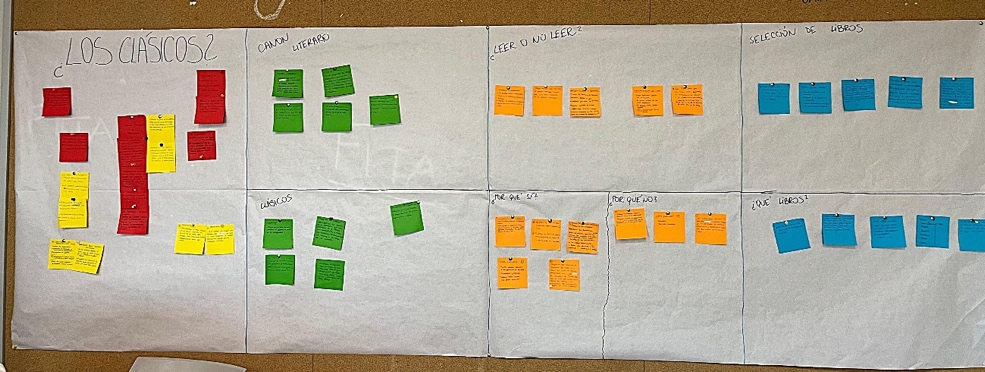
of six): presenter (verbally presented the arguments created by all the participants
in the group); writer (wrote down the ideas); informant (consulted information on
the Internet); supplier (collected and delivered the material); quality controller
(supervised the functioning of the group). The students’ task was to discuss the ideas,
select the most relevant ones to write down on different sticky notes, and then defend
them in front of the rest of the board.
Analysis of these posts identified four categories: Adaptations; Obligation; Selection
and Definition. In the first two categories, arguments in favour (accessibility and
literary quality) and against (loss of quality and difficulty) are distinguished.
Meanwhile, in the Selection, this time, criteria appear that would be applied by students
as future teachers. The identification of the last category brings together the definitions
of literature classics, which are very similar to those formulated in the previous
stage. Nevertheless, a higher level of internalisation and retrieval of information
can be observed without the need to use bibliography.
1.
Adaptations.
Arguments in favour:
“We are in favour of adaptations because they allow children to start reading classic
works at an earlier age, as the vocabulary is simpler.”
Arguments against:
“(...) If we adapt a literary work, we are telling the same story, but not in the
same way, and therefore we lose the author’s essence and richness.”
2.
Obligation.
“(...) We would encourage reading in a positive way, because through reading one can
acquire values and reflect critically on various aspects of life such as death, etc.”
“(...) they can work cooperatively and dynamically in the classroom to get children
interested in reading.”
Arguments in favour:
“They bring literary quality to children’s education.”
“Because classics show issues as they really are, rather than sugar-coating them like
Disney films do.”
“They help us understand where we come belong.”
Arguments against:
“I don’t think it should be compulsory because of the difficult vocabulary or its
length.”
“They often do not suit the students’ tastes.”
3.
Selection.
“Pay attention to what they read or the topics they discuss on a daily basis.”
“Free choice of theme (love, adventure, death or empathy).”
“Criteria such as the children's age, their socio-cultural context, and their interests
must be taken into account.”
“(...) for example, adventure (The Adventures of Tom Sawyer) or fantasy (Harry Potter).”
“Offer more types: comics, stories, theatre.”
4.
Definition.
“A literary canon is a list or catalogue that generally brings together what is considered
to be a model to follow.”
“Classics are highly valuable works of historical significance that stand the test
of time.”
“Classics are works that evoke emotion and aesthetic pleasure.”
Stage 4: Final task
In Stage 4, all the members of each group gathered so that each student could recount
their part of the classic they had read. This way, they obtained information about
the entire story, collectively reconstructing the works’ plot. Reading is conceived
as a meeting place, a playful space, in which the experience is not limited to the
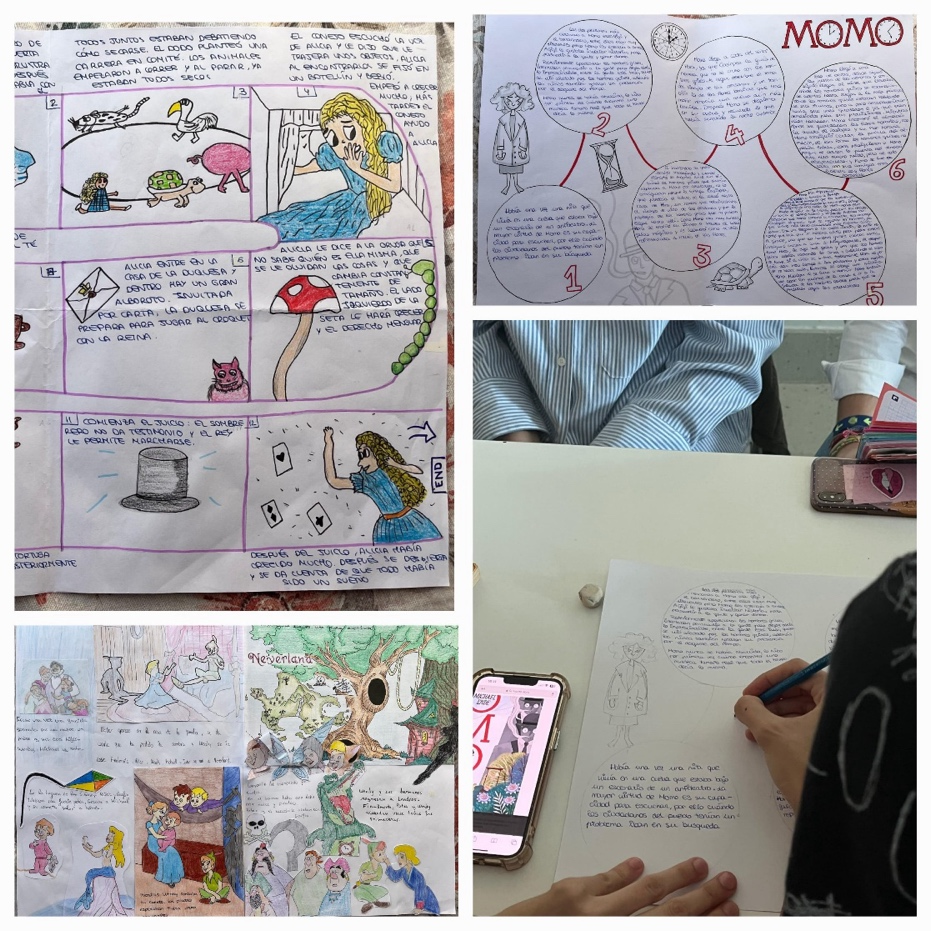
individual and private sphere, but is socialised with other readers (; ). The final product was an A1 paper project in which each group reconstructed the
play’s plot, observing the sequence of events through different graphic representation
options (comic strips, illustrations, diagrams, outlines).
The categorical analysis of this phase was carried out, on the one hand, based on
the teacher’s remarks sheet of the process of reconstructing the argument in groups
and creating the final project (marked with OP – teacher’s remark); and on the other
hand, based on the answers to the questions posed by the teachers during the oral
presentation in the classroom.
Three categories were identified: Reading as an experience, Change and Film adaptations.
The first category reflects the positive effects resulting from reading as an experience.
Meanwhile, in the second, it can be seen how some of the criteria (language, length,
adaptations) highlighted in the previous activities lost importance, while others
(theme) gained importance. The last category includes amazement at the difference
between books and their film adaptations.
1.
Reading as an experience.
“I enjoyed reading it and was even curious to see how the book would end.”
“I was motivated to share our parts of the book and then reconstruct the story on
paper.”
OP: A group stayed behind to discuss the play’s plot after class. Not all students
participated with the same level of interest. Two students are identified who did
not read their part or read it without understanding. There are at least three students
who have just finished reading the entire work.
2.
Change.
“The language isn't as complicated as we thought, nor are the books that long.”
“Primary education students can understand the story (Matilda) without it needing to be adapted.”
“Action does not take place in a time so distant that we cannot understand it.”
“The book contains themes that are not suitable for primary school pupils, such as
violence, theft and disobedience (The Adventures of Tom Sawyer).”
“We’re not sure it is good for children to learn about the original story without
softening it, without making it more appealing.”
3.
Film adaptations.
“The story is very different from how it is presented in the media.”
“Alice is not as she appears in the illustrations or in the Disney film. I cannot
stand her behaviour sometimes.”
OP: The sequence in the development of the projects corresponds to that of the book.
However, the illustrations created by the pupils tend to resemble the style in which
the media present and adapt the works.
RESULTS
Completion of the various tasks showed a clear evolution in the opinions of future
teachers about reading the classics. This section summarises the results obtained
in the categorical analysis detailed in the Procedure section, which includes the
justification for the emergence of the categories used with reference to the explicit
data submitted for analysis, as proposed by qualitative methodology (; ; ).
In Stage 1, analysis of the students’ responses made it possible to identify their
preconceived ideas about children's literature classics. The most significant characteristics
for students in an initial definition of literature classics were aspects such as
the persistence of the works, their value as models, the obligation to read them,
and their length. Students approach the subject of the classics from a subjective
and emotional perspective. There was a certain rejection of the titles prescribed
in the school curriculum. When it came to mentioning children´s literature classics,
the students referred to works from the Anglo-Saxon tradition.
In Stage 2, the planning and drafting of the argumentative text allowed for a notable
deepening of the definitions of literature classics, where criteria such as persistence
over time, a sense of tradition, or artistic references and intertextualities were
used. The students highlighted the following functions of reading the classics: fostering
imagination and creativity, improving cognitive and affective abilities, usefulness
in learning to read and write, and developing literary education. The main objections
that students raise to the compulsory reading of classics are length, vocabulary and
complexity. Solution provided: reading options. The analysis made it possible to identify
which specific titles students consider to be classics of children’s literature: adaptations,
folk tales, classics from their own tradition, and universal classics (Anglo-Saxon
tradition).
Stage 3 deals with: adaptations, compulsory reading, selection and definition of classics
in children’s and young adult literature. In the first two categories, arguments in
favour (accessibility and literary quality) and against (loss of quality and difficulty)
are distinguished. For the selection process, criteria appear that would be applied
by students as future teachers. The definitions of literature classics are very similar
to those formulated in the previous stage, but with a greater level of conceptual
internalisation.
In Stage 4, three categories were identified: Reading as an experience, Change and
Film adaptations. Positive effects are detected as a result of reading as an experience.
It can be seen how some of the previous objections (relating to the complexity of
the language, the length or the suitability of the adaptations) lose weight and how
other aspects (the subject matter of the works) become more relevant in favour of
reading. The last category includes observations on the differences between the works
and their film versions.
DISCUSSION AND CONCLUSIONS
The reading experiences of future teachers are marked by a certain aversion, mainly
due to the length, temporal and plot distance, or vocabulary of the classics. These
beliefs and opinions appear relevant in the form of preconceived ideas, even during
the study of specialised literature. However, they seem to lose importance in the
act of reading. In this regard, the results coincide with the observations of authors
such as and : the formal difficulties of classical works lie not so much in the text itself as
in their selection and didactic use.
Within the framework of teacher training, the university must create spaces for experimenting
with literary reading. This would coincide, as an educational approach, with the fact
that future teachers, in their reading autobiographies, express that the activities
they remember most positively were those that provided them with direct contact with
literary works, those that allowed them to discover reading for pleasure (; ). It should be emphasised that, in general, trainee teachers have sporadic reading
habits (; ). Therefore, they need meaningful reading experiences. According to this research,
it is precisely the mediated and socialised reading experience in the classroom that
has changed their preconceptions about children´s literature classics.
Children´s literature classics are recognisable to future teachers, primarily because
of their appearance in films and other audiovisual media. This clearly influences
their perception of literary tradition and affects their initial choice of reading
material. This is due to media influence, i.e., the dominance of the audiovisual sector
in the cultural references of young readers, directly affecting their conception of
literature classics and children’s literature (; ; ).
In the writing of argumentative texts, adaptations are discussed and their literary
quality is assessed. In general, they are described as useful, although, from the
perspective of the individual reader, there appears to be a certain degree of rejection.
In classroom discussions, problems such as language and text length arise. In this
regard, adaptations and their educational value are discussed. Arguments for and against
reading the classics at school age are presented. After reading the works, the personal
approach to the selected classics becomes evident. In this approach, the quality and
complexity of the works are valued more highly. However, in some cases, they are considered
to be of little or no value due to certain topics that trainee teachers deem inappropriate.
It should be added that studying specialised literature helps us to reflect on whether
or not to read the classics at school. However, without personal reading experience,
ideas about the works lack a more solid foundation, which affects students’ ability
to argue their points.
As for areas for improvement and future prospects, it should be noted that the study
sample may be small, but it is relevant, in accordance with the qualitative approach.
It is thus an inherent feature of the methodology used. However, we believe it would
be interesting to study students’ perceptions after completing their undergraduate
studies, in order to analyse the extent to which the concept of literature and children´s
literature classics continues to be related to knowledge of Anglo-Saxon works and
the influence of the media. To this end, longitudinal studies would be necessary.
Finally, this work does not focus solely on future teachers’ opinions about reading
literary classics, but also, and above all, on how these opinions change as a result
of new knowledge about the issue and diverse reading experiences. The results obtained
allow for an in-depth analysis that facilitates observing how, in a specific context,
future teachers perceive and interpret the appearance of literary classics in primary
school classrooms. This is of great interest, since their ideas will ultimately influence
the selection of literary texts that will shape the educational canon in their future
teaching practice.
FUNDING
This research is part of the R&D Project of the Spanish Ministry of Science, Innovation
and Universities PID2022-139640NB-I00 and the CIAICO/2023/104 project of the Department
of Education, Universities and Employment of the Autonomous Community of Valencia.
AUTHORS’ CONTRIBUTIONS
Dominika Fajkišová: Project management; Formal analysis; Conceptualisation; Data curation; Writing –
original draft; Research; Methodology; Resources; Validation; Visualisation.
Jerónimo Méndez-Cabrera: Formal analysis; Conceptualisation; Data curation; Writing – original draft; Writing
– review and editing; Research; Resources; Validation; Visualisation.
Aguilar-Ródenas, C. (2020). La necesidad de la educación literaria en LIJ en la formación
inicial de maestras y maestros. Lenguaje y Textos, 51, 29-40. https://doi.org/10.4995/lyt.2020.12315
2
Amat-Castells, V. (2023). La conversa literària en la formació inicial de mestres.
Un cas pràctic a partir de tres clàssics LIJ. Didacticae, 13, 6-21. https://doi.org/10.1344/did.2023.13.6-21
3
Arias-Valencia, M. M., & Giraldo-Mora, C. V. (2011). El rigor científico en la investigación
cualitativa. Investigación y Educación en Enfermería, 29(3), 500-514. https://doi.org/10.17533/udea.iee.5248
4
Ausbel, D. P. (1968). Educational psychology: A cognitive view. Holt, Rinehart and Winston of Canada.
5
Ballester-Roca, J., & Ibarra-Rius, N. (2019). Autobiografías lectoras y clásicos en
la educación literaria de los futuros docentes e investigadores. Tejuelo, 29, 31-66. https://doi.org/10.17398/1988-8430.29.31
6
Ballester-Roca, J., & Méndez-Cabrera, J. (2021). Los clásicos como resistencia: la
lectura literaria en el marco de una educación lectora transmedia. Tejuelo, 34, 195-220. https://doi.org/10.17398/1988-8430.34.195
7
Ballester-Roca, J., & Méndez-Cabrera J. (2023). La formación de lectores en el marco
de una educación literaria transmedia. En J. Ballester-Roca y J. V. Salido-López (Coords.)
Investigación y buenas prácticas en educación lectora (pp. 39-52). Octaedro.
8
Caro-Valverde, M. T. (2019). El clásico, irreductible. Historia de vida en didáctica
de la creación literaria mutimodal. Tejuelo: Didáctica de la Lengua y la Literatura, 29, 245-274. https://doi.org/10.17398/1988-8430.29.245
9
Cerrillo, P. C. (2007). Literatura infantil y juvenil y educación literaria. Octaedro.
10
Cerrillo, P. C. (2010). Lectura escolar, enseñanza de la literatura y clásicos literarios.
En G. Lluch (ed.) Las lecturas de los jóvenes. Un nuevo lector para un nuevo siglo (pp. 85-104). Anthropos.
11
Cerrillo, P. C., & Sánchez-Ortiz, C. (2019). Clásicos e hitos literarios. Su contribución
a la educación literaria. Tejuelo: Didáctica de la Lengua y la Literatura, 29, 11-30. https://doi.org/10.17398/1988-8430.29.11
12
Colomer, T. (2010). Introducción a la literatura infantil y juvenil actual. Síntesis.
13
Corbin, J.M. y Strauss, A.L. (2008). Basics of qualitative research: techniques and procedures. Sage.
14
Díez-Mediavilla, A. (2019). Los textos clásicos en la formación del lector literario.
Opciones y posibilidades para un lector actual. Tejuelo: Didáctica de la Lengua y la Literatura, 29, 105-130. https://doi.org/10.17398/1988-8430.29.105
15
Elche-Larrañaga, M., & Yubero-Jiménez, S. (2019). La compleja relación de los docentes
con la lectura: el comportamiento lector del profesorado de educación infantil y primaria
en formación. Bordón. Revista de Pedagogía, 71(1), 31-45. https://doi.org/10.13042/Bordon.2019.66083
16
Encabo-Fernández, E., Hernández-Delgado, L., & Sánchez-Sánchez, G. (2019). La Literatura
infantil y las narrativas híbridas. Canon, modos de pensamiento y educación. Contextos educativos: revista de educación, 23, 199-212. https://doi.org/10.18172/con.3496
17
Escandell-Montiel, D. (2020). Lecturas juveniles mediadas por las TIC: pantallas,
mundo digital y transmedialidad. Presencias y percepciones entre estudiantes. Contextos educativos: Revista de Educación, 25, 91-103. https://doi.org/10.18172/con.4270
18
Flick, U. (2015). Introducción a la investigación cualitativa. Morata.
García-Padrino, J. (2000). Los clásicos en las lecturas juveniles. En R. F. Llorens-García
(Coord.) Literatura infantil en la escuela (pp. 69-91). Universitat d’Alacant.
22
García-Única, J. (2016). El odio a los clásicos (y otras razones para llevarlos a
las aulas). Lenguaje y Textos, 43, 41-51. https://doi.org/10.4995/lyt.2016.5822
23
Gómez-Rubio, G. (2021). Las autobiografías lectoras de los futuros docentes de Infantil
y Primaria: algunos datos útiles para planificar su formación. En E. Zuloaga (Ed.)
Afrontando retos. Propuestas para la didáctica de la lengua y la literatura (pp. 97-110). Universidad del País Vasco.
24
Hernández-Heras, L., Tabernero-Sala, R., & Muela-Bermejo, D. (2024). Creencias, representaciones
y saberes de profesores expertos sobre la lectura de los clásicos en ESO. Ocnos, 23(2). https://doi.org/10.18239/ocnos_2024.23.2.445
25
Kostrub, D. (2022). Učiteľ - výskumník. Profesia založená na výskume/Dizajny výskumu a premeny výučby. Univerzita Komenského v Bratislave.
26
López-Valero, A., Hernández-Delgado, L., & Encabo-Fernández, E. (2017). El concepto
de literatura infantil. Un estudio de caso con maestros en formación inicial. Ocnos, 16(2), 37-49. https://doi.org/10.18239/ocnos_2017.16.2.1400
27
Mareš, J. (2013). Pedagogická psychologie. Portál.
28
Massot-Lafon, I., Dorio-Alcaraz, I, & Sabariego-Puig, M., Y (2014). Estrategias de
recogida y análisis de la información. En R. Bisquerra-Alzina (Coord.). Metodología de la investigación educativa (pp. 329-366). La Muralla.
29
McMillan, J. H., & Schumacher, S. (2005). Investigación educativa. Pearson.
30
Méndez-Cabrera, J. (2017). Les adaptacions de clàssics literaris en la formació de
mestres: la narrativa breu medieval. Lenguaje y Textos, 45, 71-88. https://doi.org/10.4995/lyt.2017.7643
31
Mirete, L., Bas-Peña, E., & Maquilón, J. J. (2023). Hábitos lectores del profesorado
de Educación Primaria en formación inicial, con perspectiva de género. RIFOP: Revista interuniversitaria de fomación del profesorado, 98(37.2), 313-330. https://doi.org/10.47553/rifop.v98i37.2.96202
32
Munita, F. (2013). Creencias y saberes de futuros maestros (lectores y no lectores)
en torno a la educación literaria. Ocnos, 9, 69-87. https://doi.org/10.18239/ocnos_2013.09.04
Navarro, R. (2018). Els clàssics a l’escola? I tant que sí! Articles de Didàctica de la llengua i la literatura, 79, 45-50.
36
Ordine, N. (2017). Clásicos para la vida. Una pequeña biblioteca ideal. Acantilado.
37
Rovira-Collado, J. (2019). Clásicos literarios en constelaciones multimodales. Análisis
de propuestas de docentes en formación. Tejuelo: Didáctica de la Lengua y la Literatura, 29, 275-312. https://doi.org/10.17398/1988-8430.29.275
38
Sagor, R. (2000). Guiding School Improvement with Action Research. ASCD.
39
Sales, A., Moliner, O., & Traver, J. A. (2019). Estrategias de investigación-acción
participativa para la transformación. En B. Ballesteros (Ed.), Investigación social desde la práctica educativa (pp. 225-266). UNED.
40
Soneira, A. J. (2006). La teoría fundamentada en los datos (Grounded Theory) de Glaser y Strauss. En I. Vasilachis-de-Gialdino (Coord.). (2006). Estrategias de investigación cualitativa (pp. 153-173). Gedisa.
Torres-Adame, F. (2023). De la lectura individual a la socialización de la lectura:
carácter ambital y personalista de la literatura y del club de lectura. Quién: revista de filosofía personalista, 17, 117-140. https://doi.org/10.69873/aep.i17.31
43
Valencia-Leguizamón, M., Rodríguez-León, D. M., & Raga-Prieto, L. M. (2023). Literatura
infantil y mediación lectora. Concepciones y creencias del profesorado en formación.
Enunciación, 28, 61-75. https://doi.org/10.14483/22486798.20568
44
Zúñiga-Lacruz, A. (2024). El reciclaje de cuentos clásicos en plataformas streaming: literatura transmedia en el aula universitaria. Ocnos, 23(1). https://doi.org/10.18239/ocnos_2024.23.1.417
APPENDICES
Appendix A. Post-it notes from the classroom discussion (Stage 3)