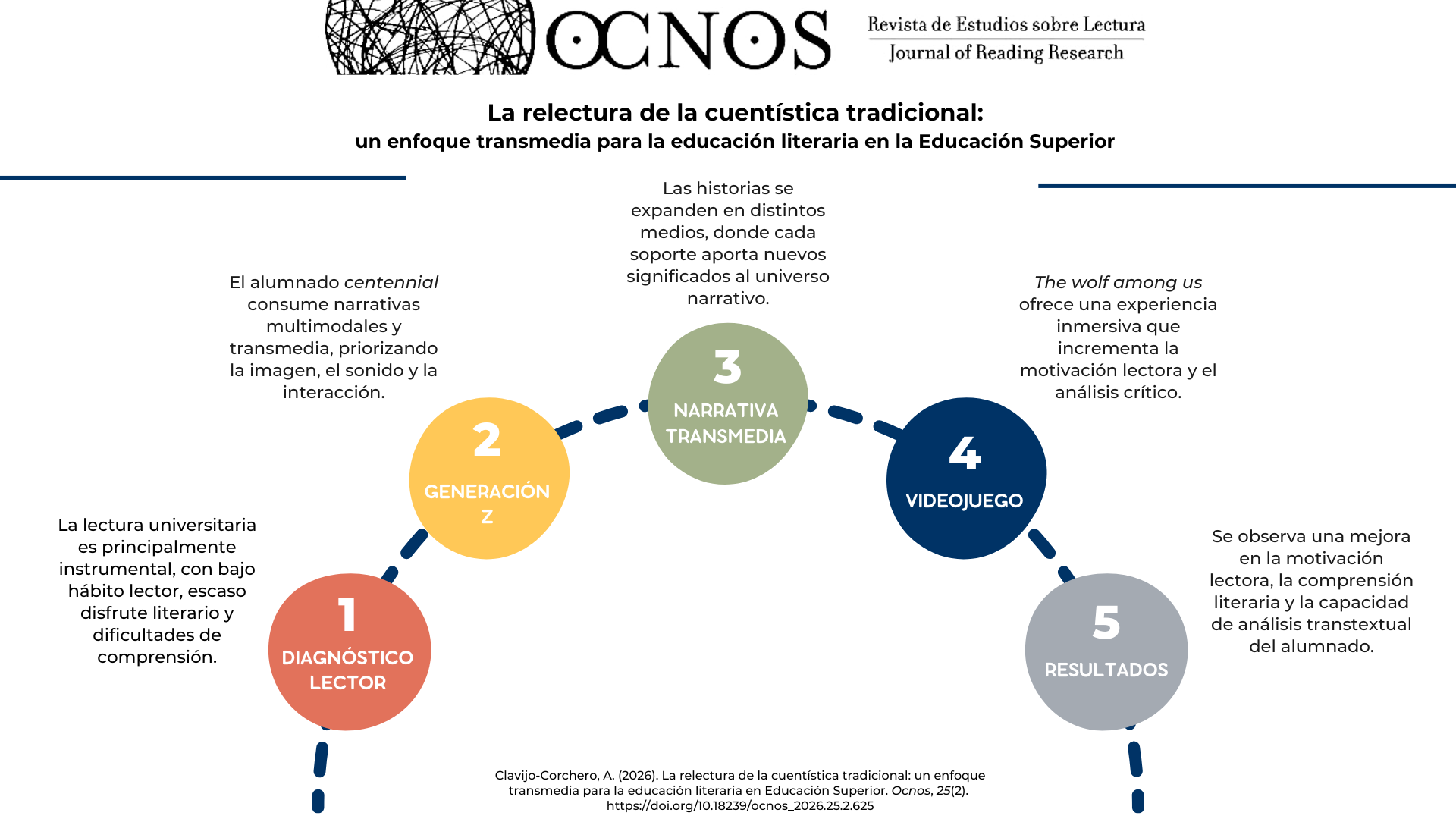
Traditional fairy tales is an essential component of the cultural and collective imagination because it plays a crucial role in understanding the origins of many traditions. Its incorporation in bachelor’s degrees in Education is fundamental in promoting a literary education that reveals the principles of human behaviour, universal issues and the referents that shape later literature. In order to make this approach meaningful, it is proposed to integrate current technological trends into the academic sphere through audiovisual resources that revive and reinterpret traditional stories. From a qualitative and descriptive approach, we analyse the didactic potential of the video game as a transmedia resource applicable to literary education. The study combines Genette’s (1989) transtextual perspective with Paz-Gago’s (2004) semiotic-textual method to examine the video game The Wolf Among Us in relation to its classic hypotexts. Likewise, didactic guidelines are presented that integrate reading and gaming experience, and encourage reading among members of Generation Z. Based on this approach, the analysis reveals the contemporary re-reading and re-signification of archetypes and symbols from classic tales, as well as the possibility of generating critical and comparative readings between the text and the video game.
Downloads
Download data is not yet available.
Article Details
How to Cite
Clavijo-Corchero, Álvaro. (2026). Re-reading traditional fairy tales: a transmedia approach to literary education in Higher Education. Ocnos. Journal of reading research, 25(2). https://doi.org/10.18239/ocnos_2026.25.2.625
Clavijo-Corchero: Re-reading traditional fairy tales: a transmedia approach to literary education in
Higher Education
INTRODUCTION
Several studies on the reading habits of university students following the introduction
of the European Higher Education Area (; ; ; ) agree that this group does not have stable reading habits. Instead, rather than
responding to personal motivation, reading tends to be driven by teachers’ demands,
a key conclusion in all of this research as and point out, this lack of motivation to read leads to difficulties in reading comprehension
and consequently reduced enjoyment of literary texts.
Given this situation, it is necessary to explore new strategies to stimulate reading
literacy, adapted to the textual and visual needs of Generation Z (), and to stimulate their taste for literature. To achieve this, digital audiovisual
resources, which students use in their leisure time, can be a valuable tool for connecting
with their interests, and enhancing their motivation to read ().
Therefore, this paper seeks to explore the didactic reading function of transmedia
media that recycle traditional fairy tales and are found in the world of video games,
with the aim of providing a literary education adapted to the interests of Gen Z university
students. As a paradigm of this fact, several scenes from the five episodes that make
up the video game The Wolf Among Us () are analysed in order to examine the transtextual and semiotic-textual relationships,
as well as the plot and the symbolic reimagining of the characters from different
traditional stories. In this way, the aim is on the one hand to demonstrate the reading
opportunities offered by video games inspired by the storytelling tradition, and on
the other the connections that are generated with the reading of the original stories
in order to boost reading literacy and the literary education of university students
from a transmedia perspective.
Modes and practices of reading among Generation Z university students
The reading habits of Generation Z, the generational cohort born between 1995 and
2010 that currently predominates in universities (), is characterised by the adoption of a format that is personalised to the interests
of Gen Z readers. This reading model is schematic in nature, supported by hyperlinks
and driven by the integration of multiple codes, such as text, image and sound (). Barrios-Andrade defines reading in Higher Education as: “[…] medio de inculturación,
esto es, como un mecanismo a través del cual acceder y participar de las producciones
culturales de una sociedad. Pero también funciona como una alternativa eficaz de aprendizaje
o acercamiento al conocimiento” (). Consequently, students recognise the instrumental value of reading as a way of
ensuring the learning of content, which favours functional rather than recreational
use. This reality demands the incorporation of accessible, interactive fully digital
media that satisfy the tastes and needs of Gen Z, in order to build coherent, personalised
and reinterpreted readings that are close to their lived experience ().
This aspect is supported by the Lectura infinita. Plan de Fomento de la Lectura 2021-2024. (), which establishes that the habit of reading must be consolidated in innovative
spaces that make it an enjoyable and routine activity. This is a goal yet to be achieved,
with a target completion date of 2030. It is also evident that current narrative proposals
are based on an intertextuality and transmediality that allow them to spread through
both analogue and technological media, such as sound albums, apps, comics, board games,
manga, films, streaming series and video games (; ). Generation Z is familiar with this transmedia consumption of multiple franchises,
such as DC, Harry Potter and Marvel, and as points out, “los jóvenes consumidores se han vuelto cazadores y recolectores de información,
les gusta sumergirse en las historias, reconstruir el pasado de los personajes y conectarlos
con otros textos” ().
Thus, the Gen Z learner group accesses the literary imaginary through different audiovisual
formats, although not always consciously. This underlines the need to teach cultural
heritage using media that are not purely literary and are adapted to their interests
(). Currently, the proliferation of transmedia content is influencing the academic
context and is notable for its educational benefits, as students adopt an interactive
role during the reading process in a variety of media (). This dynamic enriches the improvement of both productive and receptive communication
skills ().
Transmedia storytelling and the re-reading of traditional tales in video games
The study of the phenomenon of transmedia storytelling is relatively recent, as the
concept was established in 2003 with the contributions of Henry Jenkins. This researcher
defines the term as the set of stories that unfold in different media and semiotic
systems, whether linguistic, interactive, multimedia or visual, in which each contributes
specific elements that enhance the hypotext and ensure a comprehensive understanding
of the narrative universe (; ). Consequently, transmedia storytelling is not merely a film or literary adaptation;
rather, it is a “una estrategia que va mucho más allá y desarrolla un mundo narrativo
que abarca diferentes medios y lenguajes” ().
distinguishes between two narrative modalities: multiplatform narrative (adaptation)
and transmedia narrative (expansion). This author argues that transmedia storytelling
is more complete, because it allows the story to unfold not only through the brand
itself, but also with the participation of the public through fan fiction. Transmedia
storytelling enhances the hypotext in two ways: through transmedia worlds, or through
transmedia characters (). Character-based narrative expansion is the most widespread among brands because,
as explains, it allows for greater independence from the hypotext, whether at a structural
or space-time level. In this way, the narrative universe of the franchise adapts to
the tastes of the audience and ensures their continued engagement through different
physical and digital media.
In light of the above, this transmedia narrative deployment finds particularly fertile
ground in traditional stories (; ). These stories, as asserts, possess “[…] la capacidad de adaptarse a los tiempos, de reciclarse de manera
permanente para permanecer vivos” (). This process of recycling shows how these narratives are reinterpreted to reflect
the values of each social generation. As points out, this updating implies “[…] nuevos planteamientos para adaptar los contenidos
de los cuentos clásicos a las necesidades contemporáneas” () such as their expansion in digital and audiovisual media. From an educational perspective,
the importance of its revival in the classroom lies in the fact that traditional fairy
tales constitute a valuable literary heritage (), whose re-reading allows students to identify archetypes, narrative structures and
socio-cultural values that survive in the cross-cultural collective imagination ().
This intertextuality, a concept that explores the relationship between “[…] los textos
(por ejemplo, cómo el contenido específicamente narrativo de un libro –la historia
que cuenta– influye en el desarrollo del guion –historia también de un videojuego)”
(), is particularly relevant in the field of video games. As Albarrán-Ligero warns,
“los mundos ficcionales encuentran en el videojuego un prototipo de la experiencia
para expandir, absorber y reconducir universos que provienen de otras modalidades
narrativas dominantes –cómic, cine y literatura–” (). Clear examples of this intertextual potential are titles such as 007 First Light (IO Interactive), Dante’s Inferno (Electronic Arts) or The Adventures of Sherlock Holmes (Frogwares). Indeed, right from the beginning, many video games have been inspired
by literary sources and, for this reason, some of these media have opted for literary
recycling (), that is, the revival of literary tradition from an updated perspective to adapt
it to contemporary culture ().
Nowadays video games are an undeniable form of entertainment, especially for Generation
Z, 86 % of whom in Spain reported playing video games in 2023 (). However, play, in its multiple forms, has historically been used as a pedagogical
resource to reinforce different types of knowledge and skills (). Along these lines, Gros argues that the incorporation of video games into the academic
context “no se trata solo de aprender competencias relativas al uso de la tecnología
y a unos contenidos concretos, sino que el juego también permite el trabajo de competencias
como la negociación, la toma de decisiones, la comunicación y la reflexión” (). Consequently, and in light of the results obtained from various studies (; ; ), it is possible to affirm that gaming can be conceived as a Learning and Knowledge
Technology (LKT), as it promotes the acquisition of knowledge and offers a multitude
of learning experiences. It is also an interactive approach to the real or fictional
world, and for this reason can influence not only individual but also social behaviour.
In particular, when the video game is played cooperatively, it enables public participation
and enriches learning through a plurality of experiences and perspectives (), which brings it closer to Empowerment and Participation Technologies (EPT).
In line with its educational potential, the video game is presented as an innovative
medium capable of transforming traditional reading habits by offering an immersive
and interactive narrative experience that places the player-student at the centre
of both the narrative construction and the reading process. In the words of , “los videojuegos son alternativas de promoción que en este contexto, facilitan la
aproximación del entretenimiento a la lectura a través de una narrativa atractiva
y diferente, potenciando el hábito de lectura en los jóvenes” ().
All of these conceptualisations apply to The Wolf Among Us (), distributed by LCG Entertainment (Telltale Games) and based on the comic book Fables (2002-2024) by Bill Willingham. It is available on multiple platforms: from past
and current generation game consoles to handheld devices. The interesting thing about
this videoludic medium is that it deploys a transmedia narrative articulated through
the use of intermedial characters from classic fairy tales (Beauty and the Beast, Snow White, Bluebeard and The Three Little Pigs) and from cultural and literary folklore (Through the Looking Glass and What Alice Found There, Beowulf and the urban legend Bloody Mary). Hence, its intertextuality makes it a genuinely transmedia resource, and like other
media such as comics, series or films, it becomes an educational tool with which to
promote reading animation and mediation in the university setting (; ).
METHOD
The analysis of The Wolf Among Us was carried out using a qualitative descriptive methodology, based mainly on content
analysis. To this end, two approaches particularly suited to the study of transmedia
were incorporated.
Firstly, the transtextual approach proposed by was used, which allows for the examination of the different forms of relationship
between texts. These include:
- intertextuality: the explicit or implicit presence of one or more texts in another;
- paratextuality: refers to the elements that accompany a work, such as the title
or illustrations;
- metatextuality: understood as the critical relationship of one text to another;
- hypertextuality: which refers to the transformations and rewritings of a previous
text; and
- architextuality: understood as the system of abstract categories that determine
generic properties, such as genre, discursive typology or enunciation.
Secondly, Paz-Gago’s () comparative semiotic-textual method was used, which, although developed to analyse
the relationships between literature and film, is equally valid for this medium. This
is because both films and video games share a structural affinity, as they articulate
an audiovisual narrative (). Thus, the characteristics of the story and those of the corresponding scene in
the video game that draws on certain spaces, plot elements or characters were studied
first, and then the convergences, divergences, and interferences between the two media
were examined comparatively.
Scenes were selected after a complete gaming experience, based on several criteria:
the appearance of recognisable characters, the presence of plot elements linked to
the storytelling universe, and attention to the short story genre. To ensure a rigorous
contrastive analysis, the fragments were cross-checked with reference text versions,
such as the compilation produced by and the fairy tales of the Brothers .
The didactic experience was implemented with a total population of 97 students studying
for the Bachelor’s Degree in Primary Education who were taking the subject Didactics
of Languages during the 2023-2024 academic year. Overall, 60.82 % were women and 39.18
% men, aged between 20 and 26. The project was carried out in person, using participatory
methods to encourage reading and critical reflection on traditional fairy tales and
its transmedia reinterpretation.
The teaching guidelines for comparing classic stories and the video game were organised
into four phases. First, an individual reading of the story or a significant fragment
of the story that revealed key feature of the plot or of the main characters was carried
out. The recommended length of the texts was not to be more than ten pages to prevent
the act of reading from becoming an excessive burden and to maintain student motivation.
Furthermore, to stimulate the curiosity of the class, we suggested offering versions
that were not aimed at children, as this would subvert student expectations based
on childhood memories.
Next, a discussion on the story was held in the classroom. Through dialogue, students
began to identify semiotic-textual information to recognise the characteristic features
of the traditional fairy tale.
The gaming experience was then approached in two ways: through cooperative or individual
play of selected chapters, and through collective viewing of scenes in the classroom.
In both cases, the students were asked to observe the correspondences between the
literary text and its representation in the video game.
Finally, a discussion was held in which the two analytical methods described above
were applied. The aim was for the group of students to reflect on the scenes in the
video game and to examine the transtextual elements and similarities, and the divergences
and interferences identified with respect to the original text.
RESULTS
Literary and transmedia analysis of scenes fromThe Wolf Among Us
The Wolf Among Us () is a single-player adventure game, intended for audiences aged 16+ according to
the Pan European Game Information (PEGI) age rating. The video game features Bigby
Wolf, the Big Bad Wolf of traditional fairy tales. The plot, divided into five episodes,
is set in New York City during the 1980s, following the invasion of the fairytale
characters’ homelands by a tyrant called The Adversary, an identity that corresponds
to Geppetto, the creator of Pinocchio. This invasion forced many characters into exile
in the human world, specifically in the United States.
In New York they found Fabletown, a secret community in the borough of Manhattan,
where they live together incognito. To fit in without being discovered, the characters
that do not look human must repeatedly resort to the expensive ‘glamour spell’, which
allows them to take on human form; otherwise, they are sent to the Farm, an isolated
place where they are kept in captivity.
Bigby Wolf, in his human guise, serves as the sheriff of Fabletown under the supervision
of Snow White and Acting Mayor Ichabod Crane, in the absence of King Cole. His main
function is to maintain order and ensure the secrecy of his community. The story begins
with the discovery of the decapitated body of the Donkey Skin Princess. Following
this, the investigation undertaken by Bigby and Snow White reveals a web of corruption,
inequality and violence that threatens to destroy coexistence between the inhabitants
of traditional folk tales.
Thus, through interactive choices that shape Bigby’s behaviour and influence the development
of the plot, the player must prevent further deaths among the various characters and
discover the identity of the person responsible. In this sense, The Wolf Among Us is a narrative expansion that brings the classic tales into a video game format.
This is possible because the characterisation of each character incorporates, as part
of their diegetic past, the events present in their respective hypotexts, reinforcing
transmedia coherence. This aspect not only encourages a new re-reading of traditional
stories, but also the active participation of the audience through interaction.
We now present the analysis of three representative scenes and their corresponding
correlates. First, a brief contextual description of the video game and the reference
hypotext is provided for each of them, Subsequently, two tables are developed in order
to facilitate a clear and concise reading. The first focuses on the transtextual analysis
proposed by and the second on Paz-Gago’s () semiotic-textual approach. Finally, some teaching guidelines for classroom use are
included.
The first scene chosen corresponds to the prologue of the first episode of the video
game (). In it, Bigby Wolf intervenes in an altercation in a flat, after being alerted by
Mr. Toad, the protagonist of Grahame’s The Wind in the Willows (1908). On arrival, Bigby finds the Woodsman assaulting the Donkey Skin Princess.
The argument between the two men culminates in a violent fight. This scene refers
to the final passage of Little Red Riding Hood (), when the Wolf, after devouring the grandmother and the girl, is surprised by a
hunter/woodsman, who, in the version used, cuts open its belly in order to rescue
them.
Table 1Transtextual analysis of the first scene
Video game (Episode 1.Faith)
Story: Little Red Riding Hood ()
Paratext
Foreword by Faith. Introductory and tutorial function.
No explicit paratexts. In this case, illustrations are used to emphasise the conflict.
Architext
Interactive episodic video game.
European folk tale.
Intertext
Explicit references to Little Red Riding Hood, The Wind in the Willows and The Donkey Skin Princess. Fusion of characters and role reversal.
Autonomous text without external references.
Hypertext
Contemporary rewriting of the motif. Updates the conflict moving towards gender-based
violence.
Original hypotext in which the victims are rescued.
Metatext
Implicit criticism of male violence and abuse of power. Social condemnation.
Traditional moral dichotomy: good (Woodsman) versus evil (Wolf) to restore balance.
Table 2Semiotic-textual analysis of the first scene
Video game (Episode 1. Faith)
Story: Little Red Riding Hood ()
Convergences
Preservation of the archetypes of the story: the Wolf, the Woodsman and a woman in
a vulnerable situation. Intervention of the hero to save the victim from the antagonist.
Symbolic presence of the knife or axe.
Divergences
Role reversal (Wolf protector and Woodsman aggressor). The home is redefined as a
space of risk. Non-lethal resolution.
Tragic outcome: death of the Wolf. Fixed roles within a moral framework.
Interferences
Contemporary conventions (alcoholism, marginalisation and gender-based violence) interfere
with the original moral framework.
Classical framework with no thematic contamination.
Working on the first scene, key elements can be analysed, such as:
- The reversal of traditional roles, as both male characters swap their roles. Bigby
becomes the hero, while the Woodsman takes on the antagonistic role.
- Onomastic symbolism, such as the derivation of Big Bad Wolf into Bigby, which re-defines
the archetype of the traditional villain.
- The professions of each of the characters, as Bigby plays the role of sheriff, in
charge of protecting the inhabitants of Fabletown, while the Woodsman is an aggressive
figure.
- The interrelationship with characters from other stories, such as the Donkey Skin
Princess, which broadens the intertextual universe.
- The reinterpretation of spaces, given that the grandmother’s house in Little Red Riding Hood is reinterpreted as a hostile flat in The Wolf Among Us.
- The symbolic object, represented by the Woodsman’s axe, is used to resolve the conflict.
- The divergence in the final resolution of the confrontation, as the story ends with
a moral message (even if mistakes are made, rescue is possible), while the video game
adopts a contemporary conclusion with no moral.
The second scene selected takes place in the third episode of the video game (). In it, Bigby visits the office of Tarari and Tarara, characters from Carroll’s
novel Through the Looking-Glass and What Alice Found There (1871). There he meets Flycatcher, who is in charge of the clean-up. His biography
reveals that he was once a prince but was turned into a toad by a witch, and after
the death of his wife and children during the invasion of the fairytale lands, he
performs maintenance work in the human world to get over this traumatic event (). This character alludes to the protagonist of the fairy tale The Frog King or Iron Henry, by the Brothers .
Table 3Transtextual analysis of the second scene
Video game (Episode 3. My Kingdom)
Story: The Toad King ()
Paratext
My Kingdom
No explicit paratexts. In this case, illustrations are used to emphasise the conflict.
Architext
Interactive episodic video game.
European folk tale.
Intertext
Incorporation of classic characters: Little Red Riding Hood, The Wolf and the Seven Little Kids, The Three Little Pigs (via Bigby) and The Frog King. Resignification of roles.
Autonomous text without external references.
Hypertext
Contemporary rewriting of the metamorphic motif, displaced towards marginality, social
precariousness and mental health.
Original hypotext, based on metamorphosis, promise and the restoration of order.
Metatext
Implicit critique of social inequality.
Implicit morality regarding commitment.
Table 4Semiotic-textual analysis of the second scene
Video game (Episode 3. My Kingdom)
Story: The Frog King ()
Convergences
Few convergences, although the stigma associated with the frog as a socially despised
figure remains, despite its royal origin.
Divergences
The character remains marginalised and scarred by trauma. Metamorphosis does not occur.
Final transformation into a prince and restitution of original identity, upon fulfilment
of a promise.
Interferences
Contemporary problems (evictions, social exclusion and loss of loved ones) interfere
with the classical motif.
Classical framework with no thematic contamination.
When teaching the second scene, the following issues can be addressed:
- The onomastic symbolism of the name Flycatcher, a designation that alludes to the
metamorphosis undergone by the character.
- The character’s profession, linked to cleaning work and water, an element traditionally
associated with amphibians.
- Psychologically, the character is defined by his kindness and loyalty, traits that
are consistent with the classic tale.
- The biographical expansion, as in the video game he is presented as a widower and
as stripped of his former royal power, which contrasts with the traditional representation.
- The symbolic element of the frog-shaped visor serves as a vestige of the spell cast
on him in his youth and maintains the iconography of the hypotext.
The third scene chosen is from the fourth episode of the video game. Bigby interrogates
Beauty and the Beast in their flat, due to their possible involvement in the events
in Fabletown. There, he discovers that the home is luxuriously decorated, which is
striking given the couple’s precarious financial situation. Finally, it is revealed
that the Beast has fallen into debt in an effort to maintain their previous lifestyle.
The scene reflects a marked distrust between the spouses, in stark contrast to the
romantic imagery of the most popular version of Jeanne-Marie Leprince de Beaumont’s
Beauty and the Beast (1756), where the bond of love is based on honesty and inner transformation rather
than on material convenience as in the video game.
Table 5Transtextual analysis of the third scene
Video game (Episode 4. Past Due)
Story: Beauty and the Beast ()
Paratext
Past Due
No explicit paratexts. In this case, illustrations are used to emphasise the conflict.
Architext
Interactive episodic video game.
An 18th-century tale of French origin, characterised by its moral tone and criticism
of the wedding customs of the time.
Intertext
Fusion of characters from different classic stories: Little Red Riding Hood, The Wolf and the Seven Little Kids, The Three Little Pigs (through Bigby) and Beauty and the Beast.
Autonomous text without external references.
Hypertext
Contemporary rewriting that updates the love relationship: emphasis is placed on mistrust,
economic tensions and the toxic couple model.
Original hypotext, based on the transformation of monstrosity through virtuous love.
Metatext
Implicit criticism of emotional dependency, materialism and toxic relationships.
Exaltation of true love as a cure for moral and personal monstrosity.
Table 6Semiotic-textual analysis of the third scene
Video game (Episode 4. Past due)
Story: Beauty and the Beast ()
Convergences
Perpetuation of the couple as a stable but tense symbolic unit. Presence of a domestic
space associated with intimate coexistence and the symbol of the relationship.
Divergences
Decorative ostentation based on debt and lies; absence of the redemptive dimension
of love; jealousy and possessiveness on the part of the Beast.
Emotional balance at the end of the story; moral transformation of the Beast; honesty
and virtue as the cornerstones of the romantic relationship.
Interferences
Incorporation of contemporary problems (social image, consumerism and emotional dependence),
which corrupt the classic love framework.
Idealised sentimental model.
Finally, to address the third scene, different aspects can be explored in greater
depth, such as:
- The conversion of the archetype of princess and prince into commoners, which allows
for reflection on social mobility with other stories where social advancement occurs:
Cinderella, The Brave Little Tailor and Rapunzel () or downward social mobility: Snow White, The Frog King and Rumpelstiltskin ().
- The contrasting of life experience - economic ambition and poverty predominate in
the video game - with the humility and material modesty that are exalted as virtues
in the story.
- The configuration of the love relationship, contrasting classic love, based on honesty
and moral transformation, with a relationship built on appearances and material convenience.
- The reinterpretation of the domestic space, as the luxuriously decorated apartment
acts as the backdrop to an economic and marital crisis, whereas the castle is a space
for emotional resolution in the traditional story.
- The reversal of roles, as Beauty ceases to embody submission and rebels against
male authority, while the Beast fails to achieve redemption in love and is portrayed
as a jealous and controlling man.
Impact on teaching
In order to assess the educational relevance of the proposal, the programme was used
with 97 students (n=97) studying for a Bachelor’s Degree in Primary Education. Although
the sample was limited to a single educational context and the results cannot therefore
be generalised, an overall improvement in literary interpretation was observed as
a result of combining both analogue and video game media.
During the classroom experience, an increase in motivation to read was noted in the
first phase, especially after reading traditional stories, which generated interest
when approached from an adult perspective. This initial reaction led to active participation
in the discussions that structured the second and, later, the fourth phase.
In the initial discussions, the group of students, organised in small teams, began
to identify the archetypes, narrative structures and themes of each hypotext. By the
fourth phase of the teaching programme, during the analytical discussions, the students
(who remained in the same groups) showed greater sensitivity to transtextuality and
the semiotic-textual process, pointing out changes in the way the characters were
portrayed, the setting and the symbolism. This comparison reflected a growing ability
to recognise Genette’s () transtextual elements and Paz-Gago’s () convergences, divergences and interferences, demonstrating the development of more
attentive and critical re-reading.
In relation to the video game experience, covered in the third phase, there was some
heterogeneity in accessing the video game. A significant number of students acquired
the title and played it both individually and cooperatively outside the classroom,
which contributed to a more in-depth exploration of the transmedia medium. However,
part of the class group was unable to access the game due to financial constraints
or issues of technical incompatibility with their devices. Therefore, to ensure equity
among the learning group, it was decided to collectively view the different scenes
in the classroom, using previously recorded gameplays. This solution facilitated guided
observation and maintained attention, although for some of the students it meant a
reduction in the interactive component of the video game itself. Nevertheless, viewing
the game helped the learning group to establish connections between the verbal and
visual codes and their knowledge of the story, which enabled them to identify the
symbolic construction and characterisation of each character. Furthermore, during
this phase, teaching support was necessary to maintain analytical focus, as a large
part of the student body tended to focus on the video game, without noting the contrast
with the literary text. This mediation allowed the rereading to be redirected towards
a well-grounded comparison.
However, certain limitations were detected, linked to various factors. Firstly, interpretative
difficulties were noted, for example, at the intertextual level. Some students correctly
identified the character but did not recognise the hypotext from which it came. Lacking
knowledge of the source, this group of students had problems identifying the hypertextual
and metatextual relationship, as well as distinguishing convergences, divergences
and interferences. Specifically, they did not recall the presence of the Big Bad Wolf
in stories other than Little Red Riding Hood.
Secondly, problems were encountered in differentiating between adaptation and transmedia
expansion, as a significant number of students did not consider the transformation
and expansion of characters and spaces. To address this difficulty, a terminological
reminder was needed to familiarise the class group with transtextual and semiotic-textual
concepts.
Finally, difficulties were observed in relation to attention management during the
video game experience. Systematic breaks were required to ensure the identification
and interpretation of narrative transformations, transtextual references, and semiotic-visual
resources. Without this support, part of the class group prioritised playful progression
outside the classroom over comparison with the literary hypotext.
To evaluate the process and the limitations identified, systematic observation was
carried out using checklists to record the degree of transtextual and semiotic-textual
identification, as well as the quality and validity of the students’ arguments. The
analysis of this evidence revealed progressively more in-depth reading, which enabled
the students to recognise the nuances present in traditional stories, and understand
their narrative expansion in The Wolf Among Us.
DISCUSSION AND CONCLUSIONS
In the field of literary education and transmedia storytelling, as yet no research
has been identified that integrates a transtextual and semiotic-textual analysis of
classic stories in the classroom with an audiovisual transmedia expansion, making
it difficult to contrast the results obtained, which could be extended, if there were
previous empirical evidence. Although some studies have addressed this transmedia
relationship from analytical or theoretical perspectives (; ), the most representative being the one by , these studies do not report findings derived from real educational experiences.
The educational evidence obtained coincides with research that highlights the potential
of video games to enhance reading education and encourage reading habits (; ), as the strengthening of the interpretation of symbolic elements, the identification
of narrative patterns, and reading identity were observed during the process of rereading
traditional stories. This result favoured the students to undertake a deeper reading
of each story, supported by an interactive audiovisual text that enhanced the semiotic-narrative
re-signification, as predicts.
In this regard, by taking a transmedia literacy approach, the teaching programme enabled
the class group to recognise the transformations and rewritings linked to both characterisation
and the configuration of spaces, thanks to the transtextual focus, while the semiotic-textual
method facilitated the comparison between different verbal and audiovisual codes.
However, the difficulties encountered in interpretative, conceptual and attentional
processes highlight the need to continue formulating training proposals that integrate
transmedia resources, without neglecting teaching guidance.
In short, the aim of this study was to explore the educational use of transmedia texts
to familiarise students with traditional fairy tales, and to strengthen their literary
motivation and competence.
NOTE
This study is part of the research project “Lectura, identidad, cuerpo y emociones” (PPI16_25) carried out by the Lectunir Research Group at the International University
of La Rioja, Spain.
References
1
Albarrán-Ligero, J. (2019). El videojuego como texto esencial en la narrativa transmedia:
el mundo ficcional de Zone of the Enders. Caracteres. Estudios culturales y críticos de la esfera digital, 8(1), 140-167. https://dialnet.unirioja.es/servlet/articulo?codigo=7105379
Andrade-Velásquez, M. R., & Fonseca-Mora, M. C. (2021). Las narrativas transmedia
en el aprendizaje de lenguas extranjeras. Revista Mediterránea de Comunicación, 12(12), 159-175. https://doi.org/10.14198/MEDCOM.17795
Barrios-Andrade, D. F. (2023). Universidad y Lectura. Una mirada crítica a las mediaciones
del hábito lector. Rastros Rostros, 25(2), 1-20. https://doi.org/10.16925/2382-4921.2023.02.07
7
Cabañes, E., & Jaimen, N. (2021). Videojuegos para la participación ciudadana. Cuadernos de Estudios en Diseño y Comunicación, 98, 151-161. https://doi.org/10.18682/cdc.vi98.3978
8
Capell-Masip, N., Tejada-Fernández, J., & Bosco, A. (2017). Los videojuegos como medio
de aprendizaje: un estudio de caso en Matemáticas en Educación Primaria. Pixel-Bit, 51, 133-150. https://doi.org/10.12795/pixelbit.2017.i51.09
Clavijo-Corchero, Á. (2025). Integración de la narrativa transmedia en el aula de
Lengua Castellana y Literatura: un recurso motivador para la educación literaria.
Didáctica. Lengua y Literatura, 37, 71-80. https://doi.org/10.5209/dill.93120
Escalante-Varona, A., Soto-Vázquez, J., & Gutiérrez-Gallego, J. A. (2023). Aproximación
a los hábitos de lectura en el alumnado de Letras y Educación en la Universidad de
La Rioja. Investigaciones Sobre Lectura, 18(1), 58-80. https://doi.org/10.24310/isl.v18i1.15757
13
Falcón-Díaz-Aguado, L. (2013). Hacia una nueva metamorfosis cinematográfica y televisiva
del cuento clásico infantil: conciencia metanarrativa y responsabilidad social. Arte y Ciudad, 4, 65-100. https://doi.org/10.22530/ayc.2014.N4.257
14
Galindo-Domínguez, H. (2019). Los videojuegos en el desarrollo multidisciplinar del
currículo de Educación Primaria: el caso Minecraft. Pixel-Bit, 55, 57-73. https://doi.org/10.12795/pixelbit.2019.i55.04
15
García-Carcedo, P. (2018). Desde los cuentos tradicionales hacia la escritura creativa
2.0. Propuesta didáctica. Lenguaje y Textos, 47, 37-48. https://doi.org/10.4995/lyt.2018.9940
16
García-Delgado, B. (2011). Estudio de los hábitos lectores de los estudiantes de la
Universidad Europea de Madrid. Ibersid: revista de sistemas de información y documentación, 5, 99-108. https://doi.org/10.54886/ibersid.v5i.3890
17
García-Pedreira, R. (2024). La expansión narrativa transmedia del arquetipo de princesa
en el juego de mesa Rebel Princess. Investigaciones sobre Lectura, 19(1), 1-22. https://doi.org/10.24310/isl.19.1.2024.18068
18
García-Rivera, G., & Bravo-Gaviro, A. (2019). Narrativa transmedia y textos tradicionales
para la educación literaria. Contextos educativos, 23, 161-178. https://doi.org/10.18172/con.3388
19
Genette, G. (1989). Palimpsestos. La literatura en segundo grado. Taurus.
González-Ramírez, C. M., Gladic-Miralles, J., & Contador-Pergelier, N. (2022). Conceptualizaciones
sobre mediación, animación y promoción de la lectura: acercamiento a sus procesos
y actividades. Tejuelo, 36, 41-68. https://doi.org/10.17398/1988-8430.36.41
22
Grimm, J., & Grimm, W. (2018). Cuentos de los hermanos Grimm. Austral.
23
Gros, B. (2008). Juegos digitales y aprendizaje: fronteras y limitaciones. In Gros-Salvat,
B. (Coord.), Videojuegos y aprendizaje (pp. 9-29), Graó.
24
Hilario-Silva, P. (2023). Presencia y reciclaje de los cuentos maravillosos en la
era transmedia. In B. Regueiro-Salgado, P. García-Carcedo, A. Dotras-Bravo, & G. Fernández-San
Emeterio (Eds.), Érase otra vez: paradigmas de reciclaje en la literatura infantil y juvenil (pp. 43-58). Síntesis.
25
Jenkins, H. (2006). Convergence culture: where old and new media collide. New York University Press.
Lozano, A. (2017). Encuentros y desencuentros entre videojuegos y literatura. Jugabilidad
y narrativa en The Stanley Parable. Caracteres. Estudios culturales y críticos de la esfera digital, 6(1), 34-58.
28
Lynch, P. J., Casas, G., Sánchez Aguilar, A., & Antón, F. (2014). La Bella y la Bestia y otros cuentos maravillosos. Vicens Vives.
29
Martínez-Fabre, M. P. (2013). Gameplay abierta. Intertextualidad, intermedialidad y autorreferencia en la partida de juego.
LifePlay. Revista académica internacional sobre videojuegos, 1, 9-26.
Paz-Gago, J. M. (2004). Propuestas para un replanteamiento metodológico en el estudio
de las relaciones de literatura y cine: el método comparativo semiótico-textual. Signa, 13, 199-232. https://doi.org/10.5944/signa.vol13.2004.6095
32
Pérez-Parejo, R., Gutiérrez-Cabezas, Á., Soto-Vázquez, J., Jaraíz-Cabanillas, F. J.,
& Gutiérrez-Gallego, J. A. (2018). Hábitos de lectura de los estudiantes de la Universidad
de Extremadura (España). Aproximación estadística. Investigación bibliográfica, 33(79), 119-147. https://doi.org/10.22201/iibi.24488321xe.2019.79.57980
33
Pratten, R. (2015). Getting started with transmedia storytelling: a practical guide for beginners. CreateSpace Independent Publishing Platform.
34
Regueiro-Salgado, B. (2022). El reciclaje digital de los cuentos tradicionales como
traducción de la tradición al siglo XXI. Tejuelo, 36, 127-150. https://doi.org/10.17398/1988-8430.36.127
35
Rosendo-Sánchez, N. (2016). Mundos transmediales: revisión conceptual y perspectivas
teóricas del arte de crear mundos. Icono 14, 14, 49-70. https://doi.org/10.7195/ri14.v14i1.930
36
Santos-Díaz, I. C., Juárez-Calvillo, M., & Trigo-Ibáñez, E. (2021). Motivación por
la lectura académica de futuros docentes. Educação & Formação, 6(1), 1-21. http://doi.org/10.25053/redufor.v6i1.3535
37
Scolari, C. A. (2013). Narrativas transmedia. Cuando todos los medios cuentan. Deusto.
38
Shorette, P. (2013). The wolf among us. LCG Entertainment.
39
Sotomayor-González, A., Gértrudix-Barrio, F., & Rivas-Rebaque, B. (2020). Los videojuegos
como medio de transmisión de aprendizajes en la educación formal. Una revisión bibliográfica
en el contexto luso-español. Revista Colombiana de Educación, (85), 123-146. https://doi.org/10.17227/rce.num85-12744
40
Torres-Toukoumidis, Á., Romero-Rodríguez, L., Pérez-Rodríguez, M. A., & Björk, S.
(2016). Desarrollo de habilidades de lectura a través de los videojuegos: Estado del
arte. Ocnos, 15(2), 37-49. https://doi.org/10.18239/ocnos_2016.15.2.1124
41
Varela-Tembra, J. J. (2007). Los cuentos clásicos: “ars lucendi et ars docendi”. In
M. García-Hurtado (Coord.), El futuro de las humanidades (pp. 119-126). Universidade da Coruña.
42
Viveros-Lorenzo, C. (2023). El distanciamiento al hábito de la lectura por parte de
la Generación Z en el nivel superior. Ciencia Latina Revista Científica Multidisciplinar, 7(1), 9575-9585. https://doi.org/10.37811/cl_rcm.v7i1.5158
Zúñiga-Lacruz, A. (2024). El reciclaje de cuentos clásicos en plataformas streaming:
literatura transmedia en el aula universitaria. Ocnos, 23(1), 1-17. https://doi.org/10.18239/ocnos_2024.23.1.417