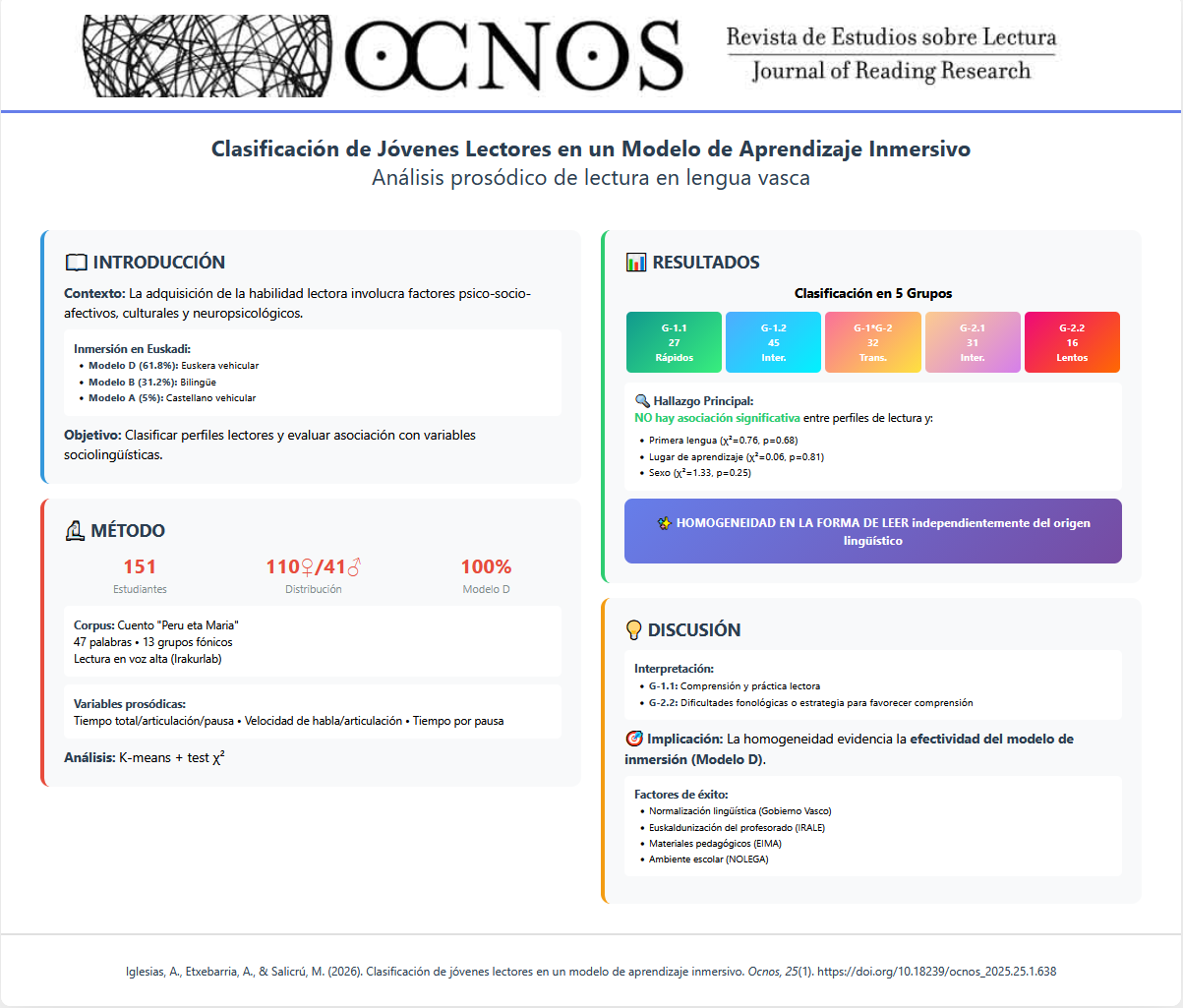
Using data obtained upon reading aloud of a narrative text in the Basque language, 151 university students were categorised into different reading profiles, and the link between these profiles and a number of sociolinguistic variables was assessed. The study used K-means clustering based on six prosodic variables (total reading time, total articulation time, total pause time, speech rate, articulation rate, and time per pause), which yielded a stable classification into five groups. The quantitative characterisation of the profiles ranged from fast readers with short pauses to slow readers with longer, more frequent pauses. Contingency table analysis revealed no significant links between the reading profiles and the categorical variables analysed (first language, Basque language acquisition setting, and gender). Moreover, the homogeneity observed in reading style—regardless of linguistic background—highlights the effectiveness of immersive learning. The methodology used here can be applied to other types of texts, in other languages, with readers at any stage of learning. It also allows for contrasting results between educational models.
Downloads
Download data is not yet available.
Article Details
How to Cite
Iglesias, A., Etxebarria, A., & Salicrú, M. (2026). Classification of young readers within an immersive learning model. Ocnos. Journal of reading research, 25(1). https://doi.org/10.18239/ocnos_2025.25.1.638
Iglesias, Etxebarria, and Salicrú: Classification of young readers within an immersive learning model
Introduction
While the capacity for language acquisition is sometimes regarded as an innate human
ability (), it has also been linked to imitation, repetition, correction and reinforcement,
as well as to pattern processing through neural networks. In addition, social interaction
and cultural context are thought to play a role (; ; ; ; ; ). The acquisition of reading skills, however, is more complex. This process involves
psycho-socio-affective, environmental, cultural, neuromotor, and neuropsychological
factors (). Furthermore, the ability to read depends on the phonological identification of
letters and syllables —i.e. decoding and phonological awareness—as well as the visual-
orthographic recognition of words, and semantic identification (; ).
Reading is an interactive process through which meaning is constructed (; ; ). Within this process, several strategies have been observed, consisting of intentional,
cognitive operations performed by learners to derive meaning (; ; ; ; ; ). These cognitive strategies are: abstraction, analysis, synthesis, inference, prediction,
and comparison (). Predictive processes are conducted prior to reading, using cues such as the title
or an image, while abstraction and inference help to understand vocabulary, expressions,
and the central theme of the text. Finally, the learner’s comprehension is verified
by means of synthesis, comparison, and contrasting ideas (). Thus, these processes occur before, during, and after reading a text (; ; ). Furthermore, the entire process of decoding and comprehension is influenced by
word recognition, text complexity, environmental conditions, mood, interest or motivation,
and health status, among other factors (; ).
Some of the factors mentioned are related to the language being learned, both at the
cognitive level (such as vocabulary identification and text difficulty) and at the
affective-emotional level (such as motivation, interest, and mood). In general, reading
can become challenging when the reader’s first language differs from the teaching
language and lacks the resources required for lexical and syntactic decoding (), or when confronted with a specialised text from a specific field (). Language immersion is an educational method used to aid second language acquisition
through intensive exposure within the school setting. In multilingual environments,
language immersion programmes are among the most common learning strategies applied
at school level. Becoming proficient in a second language in the shortest possible
time requires not only a thorough knowledge of vocabulary and grammar, but also the
optimal development of communicative competence. To implement this approach effectively,
the learning model must be adapted to the specific context; therefore, it is essential
to take into account the sociolinguistic and sociocultural factors that are unique
to each community (; ; ).
Modern language immersion originated in Saint-Lambert (Canada) in 1965, in response
to demand from anglophone parents for their children to become bilingual. This led
to anglophone students being educated in French (). Today, language immersion in Canada remains one of the most established and successful
models worldwide. With steady growth, and waiting lists due to a lack of teaching
resources, more than 400,000 students are enrolled in the programme (; ; ). In the United States, the aim of language immersion is to integrate immigrant students
while preserving linguistic heritage. Inspired by the Canadian model, immersion programmes
are delivered in either a single language (typically English) or two languages (dual
immersion), with more than 3,600 programmes opting for the latter ().
In Europe, multilingualism is present both at the continental level (European Union)
and nationally (within member states). The European Union itself has 24 official languages,
while several member states have more than one official language at the country level
(e.g. Belgium: Dutch, French and German; Finland: Finnish and Swedish; Ireland: Irish
and English), and more than 60 official languages at the regional level. Given this
multilingual context, language immersion takes place using a combination of one or
two languages as the medium of instruction ().
In the case of Spain, Spanish coexists with three co-official languages (Catalan,
Basque, and Galician). In Catalonia, language immersion is delivered in a single language:
Catalan. In the Basque Country, both monolingual and dual-medium (Basque-Spanish)
models coexist. In Galicia, a bilingual (Galician-Spanish) model is implemented, which
varies depending on educational stage and subject area (; ; ; ; ).
Aside from public acceptance and what motivates parents to enrol their children in
immersion models (), their characteristics, benefits, and limitations have been widely discussed in
the literature. From a political and technical perspective, language immersion finds
strong support in numerous studies that highlight its significant contribution to
students’ academic performance, as well as to their linguistic and literary development
in two or more languages, while simultaneously fostering cognitive skills (; ; ; ; ; ; ; ).
Currently, in the Autonomous Community of the Basque Country, 73.5% of students have
Spanish or a language other than Basque as their first language. Nonetheless, the
majority of parents (61.8%) send their children to Model D schools, (), where Basque is the main medium for teaching. In this model, everything is taught
in Basque except for the subjects of Spanish Language, Spanish Literature, and English.
In this context, immersion facilitates the linguistic normalisation of Basque, addressing
the existing imbalance between the two official languages and nurturing social equality
in their use. Going beyond identity and cultural aspects, bilingualism supports equal
opportunities among students. To achieve its aims, this programme is supported by
a number of specific schemes, such as the government’s reading initiative.
Alternatively, parents may opt to enrol their children in one of the other available
linguistic models. In Model A, the medium of instruction is Spanish, with all subjects
taught in Spanish except for Basque Language, Basque Literature, and English. This
option, chosen by 5% of parents, does not ensure balanced bilingualism of the community’s
two official languages. Spanish is the dominant language both at school and in the
students’ home environment (). Meanwhile, Model B schools teach some subjects in Spanish and others in Basque.
This option is preferred by 31.2% of parents.
The Department of Education of the Basque Government has established three strategic
pillars linked to reading acquisition: learning to read; reading to learn; and fostering
a love of reading, i.e. a reading habit. These correspond to the stages of Early Childhood
Education, Primary Education, and Compulsory Secondary Education, respectively, each
with a set of clear reading phases and specific skills to be developed.
In the first two stages, up to the fifth year of Primary Education, learning-to-read
consists of three reading phases: a) familiarity with print b) naming speed; and c)
phonological awareness. The last two stages develop the skills of lexical awareness,
syllabic awareness, and phonemic awareness. The ‘phonetic’ reading phase also falls
under learning to read, encompassing specific skills such as the alphabet and punctuation
marks. Another part of learning to read is the ‘reading fluency’ phase, which corresponds
to the third and fourth years of Primary Education and includes specific skills in
reading accuracy, intonation, and speed.
From the fifth year of Primary Education onwards, reading to learn is applied, focusing
on the stages of vocabulary, reading comprehension, and effective reading. For the
first two phases, emphasis is placed on comprehension strategies, treating them as
specific skills, while the final phrase—effective reading—focuses on comprehension
strategies and techniques (see Table 1).
To encourage recreational reading among students, the platform e-irakurzaletasuna enables them to read from anywhere at any time, creating virtual communities in which
to share reading experiences, with challenges and quizzes to motivate learners.
Table 1Reading strategy for the Basque education system (Source: Department of Education
of the Basque Government)
School’s Reading Strategy
Stage
Level
Age
Pillar
Reading phases
Specific skills
Infant Education
1
1
Fostering reading
Reading habit
Knowledge of print
2
2
3
3
Learning to read
1. Naming speed
2. Phonological awareness
Lexical awareness;
Syllabic awareness;
Phonemic awareness
4
4
5
5
Primary Education
1
6
3. Phonetics
The alphabet;
Punctuation marks
2
7
3
8
4. Reading fluency
Reading precision;
Intonation;
Velocidad
4
9
5
10
Reading to learn
5. Vocabulary
6. Reading comprehension
Comprehension strategies
6
11
ESO
1
12
7. Effective reading
Comprehension strategies
Comprehension techniques
2
13
3
14
4
15
Reading is the gateway to knowledge and, in multilingual environments, can serve as
an indicator of linguistic inclusion. To advance in this direction, we classified
151 young university students into reading profiles based on the reading aloud of
a narrative text, and assessed to what extent their reading profile has any relationship
to their first language (Basque/Spanish, or both), their Basque-learning environment
(home/school), or gender (female/male). Classification by reading profile offered
a breakdown of the linguistic reality. Narrative is the literary genre most commonly
used by teachers in compulsory education (), and the extent to which a learner’s reading profile is influenced by their sociolinguistic
background —as revealed by contingency tables— can reflect the degree of linguistic
inclusion within the school setting.
Methodology
Text and Informants
The text used was a traditional Basque-language story entitled ‘Peru eta Maria’ (). It consists of 47 words distributed among 13 phonetic groups, where ‘phonetic group’
is understood as a chunk of discourse occurring between two successive pauses, indicated
by punctuation marks (). The story alternates between the voice of the narrator and those of the characters,
with all sentences being declarative, with the exception of one interrogative and
three imperative sentences. The original text in Basque is as follows:
Peruk zeukan oholezko etxea, Mariak zeukan gatzezkoa.
Peruk Mariari: “Emaidazu gatz pixkatxo bat” eta “Ez!”
Ekarri zuen euri zaparrada handia. Urtu zitzaion Mariari etxea eta gero Peruren etxera
joan zen, oholezko etxera.
Eta ez zuen hartu. “Zeuk ere ez didazu gatzik eman, ezta? Orain egin lo kalean”.
English translation:
Peru had a house made of wood, Maria had one made of salt.
Peru said to Maria: “Give me some salt” and she said “No!"
There was a big rainstorm, and Maria’s house dissolved, so she went to Peru’s house,
to the wooden house.
But he didn’t open the door. “Well, you didn’t give me any salt either, did you? Now
you’re going to sleep out on the street.”
The informants consisted of 151 young university students from the Education Degree
program —110 female and 41 male. All of them are bilingual and completed their studies
in the Model D educational option. 116 acquired Basque at school, and 35 at home.
Basque was the first language for 19 students, Spanish for 113, both Basque and Spanish
for 18, and Arabic for one. The oral reading of the text was recorded in the Irakurlab reading laboratory using a ZOOM H1n recorder, after participants had first read through
the story, since numerous authors agree that prior silent reading helps prepare the
intonation and expressiveness necessary for oral reading (; ; ). The transcription and labelling of the text were conducted using Praat software
().
Statistical Analysis
The classification of readers was based on information provided by six prosodic variables
that comprise the ‘reading fluency’ phase: total reading time (seconds), total articulation
time (seconds), total pause time (seconds), articulation rate (syllables pronounced/articulation
time), speech rate (syllables pronounced/total reading time), and time per pause (total
pause time/number of pauses, in milliseconds). Since these are continuous quantitative
variables without qualitative significance, similarities and differences between readers
were quantified using Euclidean distance. To remove the influence of differing units
and scales, standardisation was applied to the dataset.
The classification of readers was obtained using the K-means method, which minimises
variability among readers within each group. To determine the number of groups, two
statistics were used: the Pseudo-F statistic and the Silhouette statistic (; ). In both cases, the absolute and relative maxima were identified when testing group
numbers g = 2, g = 3, g = 4, g = 5, g = 6 (where g is the number of groups). To characterise
the groups, the mean value for each variable was calculated, and the groups were represented
in a reduced-dimensional space using the metric multidimensional scaling (MDS) visualisation
procedure. For each variable, the Fisher–Snedecor F-test was used to assess the significance
of differences between group means.
To assess the potential relationship between the reading profiles obtained from the
classification and the variables of first language (Basque/Spanish, or both), Basque
learning environment (home/school), and gender (male/female), contingency tables were
constructed and the test was employed to assess possible homogeneity.
Results
Classification into Groups
At g = 2 the Pseudo-F and Silhouette are maximised when considering the range of values
at g = 1, g = 2, ..., g = 6 (Pseudo-F = 132.04, Silhouette = 0.4121) and a relative
maximum is obtained at g = 5 (Pseudo-F = 98.07, Silhouette = 0.3070). Consequently,
the structure of the information provided by the six variables assessed is consistent
with a classification into both two and five groups. The two-group classification
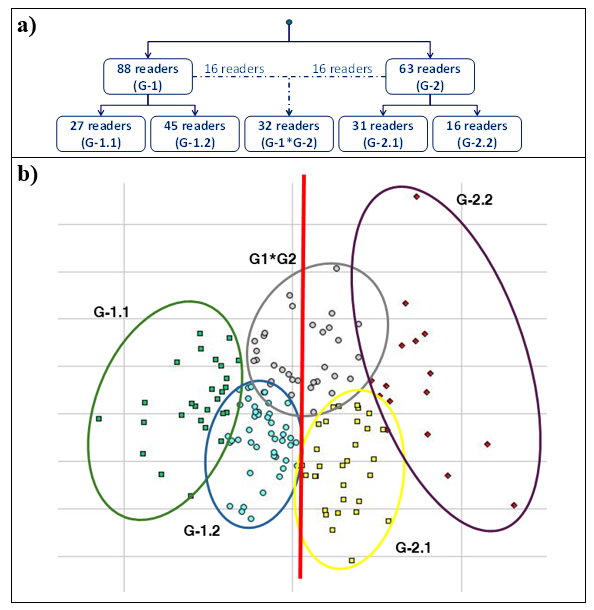
yielded a partition in which group G-1 comprises 88 readers and group G-2 comprises
63 readers. The five-group partition subdivided group G-1 into three parts, where
27 readers form group G-1.1, 45 readers form group G-1.2, and the remaining 16 readers
are combined with the other 16 readers from group G-2 to form a transition group:
G-1*G-2. Meanwhile, group G-2 was also subdivided into three parts: 31 readers make
up group G-2.1, 16 readers make up group G-2.2, and the remaining 16 readers belong
to the transition group G-1*G-2 (see Figure 1).
Figure 1Classification of readers into two and five groups (g = 2 y g = 5): a) distribution
into groups and subgroups; b) MDS representation of the groups and subgroups
Interpretation of the Groups
In simple terms, the classification into two groups (g = 2) yielded two reading profiles.
Readers in group G1 read faster and had shorter pauses between phonetic groups than
those in group G2. In both cases, no repetitions or slips were observed. For a more
detailed evaluation, the classification into five groups (g = 5) revealed a gradient
with two extreme groups and three intermediate groups. The 27 readers in group G-1.1
read the fastest, made the fewest pauses, and had the shortest pauses between phonetic
groups. In contrast, the 16 readers in group G-2.2 read the slowest, made the highest
number of pauses, and these were also longest. The 45 readers in group G-1.2 and the
31 readers in group G-2.1 exhibited intermediate characteristics across all variables.
The positive correlation between articulation time (speed in reading prosodic groups)
and pause duration characterises the gradient across groups G-1.1, G-1.2, G-2.1 and
G-2.2. Meanwhile, the 32 readers in group G-1*G-2 displayed characteristics of both
groups (fast reading, as in group G1; but longer pause duration, as in group G2).
Descriptive statistics for each group and subgroup are shown in Table 2.
Table 2Reading variable means (TT: total time, AT: articulation time, PT: pause time; SR:
speech rate; AR: articulation rate, TpP: time per pause)
Group
TT
AT
PT
SR
AR
TpP
g = 2
G-1
21.46
15.99
5.47
4.97
6.66
411.73
G-2
26.48
17.98
8.50
4.03
5.94
573.81
g = 5
G-1.1
19.68
15.08
4.60
5.41
7.03
345.37
G-1.2
22.03
16.69
5.34
4.82
6.37
404.42
G-1*G-2
24.11
15.94
8.17
4.42
6.67
578.55
G-2.1
25.55
18.56
6.99
4.16
5.72
477.61
G-2.2
29.41
18.52
10.88
3.63
5.78
721.17
Contingency tables
To evaluate and analyse the relationship between the reading profiles for g = 2 (G-1
and G-2) and the categorical variables of Basque learning context, first language,
and gender, three contingency tables were compiled (Table 3; a, b and c). According to the collected data, no dependency relationship was observed between
the reading profiles for g = 2 and the place of Basque language acquisition (school/home),
, p = 0.8137. Similarly, no association was found between the reading profiles for g
= 2 and first language (Basque/Spanish, or both), , p = 0.6826. Nor was any connection observed between the reading profiles for g = 2
and the reader’s gender (female/male), , p = 0.2491.
Table 3Contingency tables for reading profiles (g = 2) and categorical variables
a) Acquisition
b) First language
c) Gender
School
Home
Basque
Spanish
Both
Female
Male
G1
67
21
10
66
12
67
21
G2
49
14
9
47
6
49
14
With lower statistical power in the hypothesis tests, no association was observed
between the reading profiles for g = 5 (G-1.1, G-1.2, G-1*G-2, G-2.1 and G-2.2) and
the categorical variables analysed: and p = 0.6938, for place of Basque language acquisition; and p = 0.9256, for first language; and and p = 0.4451 for gender. The gender imbalance observed in the sample reflects the actual
composition of first-year students in education and does not affect the results, which
remain homogeneous for this variable.
Discussion
The results obtained from the classification of readers revealed five distinct reading
profiles (g = 5). Readers in group G-1.1 read quickly, with brief pauses corresponding
to the number of phonetic units indicated in the text. Conversely, readers in group
G-2.2 read slowly, producing longer pauses that exceed the number of phonetic units
marked in the text. Forming a continuum, readers in groups G-1.2, G-1*G-2, and G-2.1
display intermediate characteristics across all the variables assessed. More generally,
the classification into two groups (g = 2) differentiates between readers who read
faster and those who read more slowly (Figure 1b and Table 2).
From an interpretative standpoint, our attention is focused on the extreme groups.
The particular characteristics of readers in group G-1.1 may be linked to comprehension
and habitual reading practice. Meanwhile, for texts of lower difficulty, slow reading,
prolonged pauses, and a greater number of pauses than those marked by punctuation
are thought to be associated with difficulty recognising and converting letters into
sounds or reading unfamiliar words, as well as slow cognitive processing, anxiety
or nervousness that may be elicited by reading aloud, or the reader’s effort to aid
the listener’s understanding (, ; ; ; ; ; ).
Furthermore, the results obtained regarding the reading of a narrative text demonstrate
homogeneity in the reading profile (reading style), regardless of the first language
or the place of language acquisition (school/home). The academic achievement reflected
by the absence of repetitions or slips during reading, and by the participation of
younger students, could be thanks to the Basque Government’s active language normalisation
policies, as well as the reading acquisition strategy promoted by the Department of
Education and implemented by schools.
Article 17 of of 24 November, the Basic Law for the Normalisation of Basque Language Use (the revised
version in force since 16 July 2022), establishes that:
The Government shall adopt measures aimed at guaranteeing that students have a real
opportunity, on an equal footing, to acquire sufficient practical knowledge of both
official languages upon completion of compulsory education, and shall ensure the environmental
use of Basque, making it a normal means of expression in both internal and external
activities, as well as in administrative procedures and documents.
Furthermore, Article 20 specifies that all teaching staff must be proficient in this
language:
The Government, to ensure the effective right to education in Basque, shall establish
means aimed at teaching staff’s progressive proficiency in Basque. Furthermore, it
shall determine the teaching roles or units for which knowledge of Basque shall be
compulsory.
In 1981, the Basque Government created IRALE to train bilingual teaching staff in
the Autonomous Community’s two official languages. One year later, in 1982, the Basque
Service of the Basque Government’s Department of Education launched EIMA, a scheme
to promote the production of teaching materials in Basque aimed at non-university
education (). Furthermore, in 1984, NOLEGA was established for the creation and implementation
of the abovementioned Normalisation Law. NOLEGA’s work focuses on two main areas:
the promotion of Basque within the school environment and the Basque proficiency of
the Education Administration. These initiatives take place outside formal Basque lessons
in schools but significantly influence students’ acquisition, development, consolidation
and use of Basque. Among these efforts are the design of Basque normalisation school
projects (the Ulibarri scheme), oral expression activities (theatre, songs, storytelling
and radio), extracurricular courses, linguistic immersion stays, school partnerships,
literary competitions, and talks by professionals such as writers and journalists.
To address diversity, specific inclusion schemes for immigrant students have been
implemented during the periods 2003–2007, 2007–2010, 2012–2015, and 2016–2020. These
schemes focused on reinforcing and advancing oral and written language skills, promoting
positive linguistic attitudes, and fostering academic, social, professional, and intercultural
development. Additionally, the Framework Plan for the Development of Inclusive Schools
(2019–2022) () identifies the development of basic competencies —both transversal and discipline-specific—
as one of the most important principles of education. It encourages autonomy in the
approach taken by each educational centre according to its needs, as well as collaboration
between schools, universities, and families.
As part of diversity-focused efforts, other specific initiatives and schemes have
been implemented to address linguistic needs, including targeted linguistic and educational
reinforcement, support outside school hours, curricular diversification, and complementary
schooling programmes ().
Limitations
The results obtained apply to narrative texts and young university students. Narrative
texts are the simplest and most commonly used genre to promote linguistic inclusion,
including in extracurricular activities. To consolidate and expand on these findings,
further replication of the study is required using other types of texts, in educational
institutions with readers at different stages of education and other socioeconomic
profiles. Furthermore, prosodic features that complement segment duration include
intonation, reading speed, and segmental intensity. For this reason, it would be worthwhile
refining the classification obtained by incorporating data on intonational patterns.
Conclusions
The results of the prosodic analysis conducted have significant practical value for
the improvement and development of reading aloud, as they provide empirical evidence
on the acoustic parameters that characterize reading performance. The objective identification
of these prosodic patterns enables the design of specific and personalized pedagogical
interventions, aimed at improving reading fluency through strategies focused on temporal
management and discourse segmentation. In particular, the diagnosis derived from this
study provides insights to optimize didactic-methodological work with students who
exhibit a slower reading pace, characterized by longer and more frequent pauses.
Authors’ Contributions
Aitor Iglesias: Conceptualization; Data Curation; Writing - Original Draft; Writing - Revision and
Editing; Research; Methodology; Resources; Software; Supervision; Validation; Visualization;
Fundraising.
This work is part of the research project GIU 21/016, sponsored and funded by the
University of the Basque Country / Euskal Herriko Unibertsitatea (UPV/EHU).
References
1
Adler, C. R. (2001). Put reading first: The research building blocks for teaching children to read. National Institute for Literacy.
2
Alliende, F., & Condemarín, M. (2002). La lectura: teoría, evaluación y desarrollo. Andrés Bello.
3
American Councils for International Education. (2022). Dual language immersion programs in U.S. public schools (Infographic). National Clearinghouse for English Language Acquisition (NCELA)
4
Amorrortu, E. & Ortega, A. (2009). Zergatik eskolaratzen dituzte gurasoek seme-alabak
euskarazko hizkuntza-ereduetan? Euskera, 54(2-1), 579-602. https://doi.org/10.59866/eia.v2i54.241
Baker, C. (2011). Foundations of bilingual education and bilingualism. Multilingual matters.
7
Baker, L., & Brown, A. L. (1984). Metacognitive skills and reading. In P. D. Pearson,
R. Barr, M. L. Kamil, & P. Mosenthal (Eds.), Handbook of reading research (pp. 353-394). Longman.
8
Binder, K. S., Tighe, E., Jiang, Y., Kaftanski, K., Qi, C., & Ardoin, S. P. (2013).
Reading expressively and understanding thoroughly: An examination of prosody in adults
with low literacy skills. Reading and writing, 26, 665-680. https://doi.org/10.1007/s11145-012-9382-7
9
Block, C. C., & Pressley, M. (2002). Introduction. In C. C. Block & M. Pressley (Eds.),
Comprehension instruction: Research-based best practices (pp. 1-7). Guilford Press Inc. https://doi.org/10.1057/97802305013861
10
Boersma, P., & Weenik, D. (2025). Praat: doing phonetics by computer. University of Amsterdam.
Caliński, T., & Harabasz, J. (1974). A dendrite method for cluster analysis. Communications in Statistics-theory and Methods, 3(1), 1-27. https://doi.org/10.1080/03610927408827101
14
Canadian Parents for French. (2023). Annual report. https://cpf.ca
15
Carrell, P. L., & Eisterhold, J. C. (1983). Schema theory and ESL reading pedagogy.
TESOL quarterly, 17(4), 553-573. https://doi.org/10.2307/3586613
16
Cassany, D. (2008). Prácticas letradas contemporáneas. Ríos de tinta.
17
Cassany, D., Luna, M., & Sanz, G. (1994). Enseñar lengua. Grao.
Condemarín, M., & Medina, A. (1998). Estrategias de lectura: antes, durante y después. Lenguaje integrado II. Universidad Diego Portales, Chile.
21
Condemarín, M., & Medina, A. (2000). Evaluación auténtica de los aprendizajes. Un medio para mejorar las competencias en
lenguaje comunicación. Andrés Bello.
22
Coyle, D., Hood, P., & Marsh, D. (2010). CLIL: Content and language integrated learning (Vol. 1). Cambridge university press. https://doi.org/10.1017/9781009024549
23
Cummins, J. (2000). Language, power, and pedagogy: Bilingual children in the crossfire. Multilingual matters. https://doi.org/10.2307/jj.27195459
24
Dennis, D. V. (2008). Are assessment data really driving Middle school reading instruction?
What we can learn from one student’s experience. Journal of Adolescent and Adult Literacy, 51, 578-587. https://doi.org/10.1598/JAAL.51.7.5
25
Elman, J. L., Bates, E., Johnson, M. H., Karmiloff-Smith, A., Parisi, D., & Plunkett,
K. (1996). Rethinking innateness: A connectionist perspective on development (Vol. 10). MIT press. https://doi.org/10.7551/mitpress/5929.001.0001
26
Erdocia, I. (2020). The politics of plurilingualism: Immersion, translanguaging, and
school autonomy in Catalonia. Linguistics and Education, 60, 100865. https://doi.org/10.1016/j.linged.2020.100865
27
Eusko Jaurlaritza / Gobierno Vasco (2016). EAEko hezkuntza sistema hobetzo plana. bikaintasunerantz ekitatean oinarrituta. Heziberri
2020. Eusko Jaurlaritza / Gobierno Vasco.
Eustat-Instituto Vasco de Estadística. (2025). Alumnado matriculado en Enseñanzas de Régimen General no universitarias en la C.A.
de Euskadi por territorio histórico y nivel de enseñanza, según titularidad del centro
y modelo lingüístico. Avance de datos. 2024-2025.
Genesee, F. (1987). Learning through two languages: Studies of Immersion and Bilingual Education. Newbury House Publishers.
35
Gil, J. (2007). Fonética para profesores de español: de la teoría a la práctica. Arco/Libros.
36
Gilakjani, A. P., & Sabouri, N. B. (2016). A study of factors affecting EFL learners’
reading comprehension skill and the strategies for improvement. International journal of English linguistics, 6(5), 180-187. https://doi.org/10.5539/ijel.v6n5p180
37
Grabe (2003). Revalorización del término interactivo. In E. Rodríguez, & E. Lager
(Eds.), La lectura (pp. 91-97). Universidad del Valle.
38
Hermanto, N., Moreno, S., & Bialystok, E. (2012). Linguistic and metalinguistic outcomes
of intense immersion education: How bilingual? International journal of bilingual education and bilingualism, 15(2), 131-145. https://doi.org/10.1080/13670050.2011.652591
Keene, E., & Zimmermann, S. (1997). Mosaic of thought: Teaching comprehension in a reader’s Workshop. Heinemann.
41
Lai, S. F., Li, C. H., & Amster, R. (2013). Strategically smart or proficiency-driven?
An investigation of reading strategy use of EFL college students in relation to language
proficiency. Contemporary Issues in Education Research, 6(1), 85-92. https://doi.org/10.19030/cier.v6i1.7606
42
Lambert, W. E., & Tucker, G. R. (1972). Bilingual education of children: The St. Lambert experiment.
43
Landi, N., & Ryherd, K. (2017). Understanding specific reading comprehension deficit:
A review. Language and linguistics compass, 11(2), e12234. https://doi.org/10.1111/lnc3.12234
44
Lasagabaster, D. (2001). Bilingualism, immersion programmes and language learning
in the Basque Country. Journal of Multilingual and Multicultural Development, 22(5), 401-425. https://doi.org/10.1080/01434630108666443
45
Lazaruk, W. (2007). Linguistic, academic, and cognitive benefits of French immersion.Canadian Modern Language Review, 63(5), 605-627. https://doi.org/10.3138/cmlr.63.5.605
46
Ley 10/1982, de 24 de noviembre, básica de normalización del uso del Euskera Euskera
(revisión vigente desde 16 de Julio de 2022). BOPV, 160, de 16/12/1982, BOE, 100, de 26/04/2012. https://www.boe.es/eli/es-pv/l/1982/11/24/10/con
47
Loredo, X., & Vázquez-Grandío, G. S. (2022). La lengua gallega en el sistema educativo:
impacto en las competencias, prácticas y actitudes del estudiantado. Caracol, 24, 170-201. https://doi.org/10.11606/issn.2317-9651.i24p170-201
48
Lorenzo, J. R. (2001). Procesos cognitivos básicos relacionados con la lectura. Primera
parte: la conciencia fonológica. Interdisciplinaria, 18(1), 1-33. https://www.redalyc.org/pdf/180/18011326001.pdf
49
Miller, J., & Schwanenflugel, P. J. (2006). Prosody of syntactically complex sentences
in the oral reading of young children. Journal of educational psychology, 98(4), 839-853. https://doi.org/10.1037/0022-0663.98.4.839
50
Miller, J., & Schwanenflugel, P. J. (2008). A longitudinal study of the development
of reading prosody as a dimension of oral reading fluency in early elementary school
children. Reading research quarterly, 43(4), 336-354. https://doi.org/10.1598/RRQ.43.4.2
51
Nicolay, A. C., & Poncelet, M. (2013). Cognitive advantage in children enrolled in
a second-language immersion elementary school program for three years. Bilingualism: Language and cognition, 16(3), 597-607. https://doi.org/10.1017/S1366728912000375
52
Nicolay, A. C., & Poncelet, M. (2015). Cognitive benefits in children enrolled in
an early bilingual immersion school: A follow up study. Bilingualism: Language and Cognition, 18(4), 789-795. https://doi.org/10.1017/S1366728914000868
53
Pearson, P. D., & Gallagher, M. C. (1983). The instruction of reading comprehension.
Contemporary educational psychology, 8(3), 317-344. https://doi.org/10.1016/0361-476X(83)90019-X
54
Pressley, M. (2006). Reading instruction that works: the case for balanced teaching. Guilford Press.
55
Purić, D., Vuksanović, J., & Chondrogianni, V. (2017). Cognitive advantages of immersion
education after 1 year: Effects of amount of exposure. Journal of Experimental Child Psychology, 159, 296-309. https://doi.org/10.1016/j.jecp.2017.02.011
56
Riedel, B. W. (2007). The relation between DIBELS, reading comprehension, and vocabulary
in urban first grade students. Reading research quarterly, 42(4), 546-567. https://doi.org/10.1598/RRQ.42.4.5
57
Rousseeuw, P. J. (1987). Silhouettes: a graphical aid to the interpretation and validation
of cluster analysis. Journal of computational and applied mathematics, 20, 53-65. https://doi.org/10.1016/0377-0427(87)90125-7
Solé, I. (1992). Estrategias de comprensión de la lectura. Cuadernos de pedagogía, 216(3), 25-27.
61
Sozilinguistika Klusterra (2021). 2021 urteko txostena. Soziolinguistika Klusterra euskara biziberritzeko ikergunea.
62
Spada, N., & Lightbown, P. M. (2006). How languages are learned. Oxford University Press.
63
Tan, K. H., Wheldall, K., Madelaine, A., & Lee, L. W. (2007). A review of the simple
view of reading: Decoding and linguistic comprehension skills of low progress readers.
Australian Journal of Learning Difficulties, 12(1), 19-30. https://doi.org/10.1080/19404150709546827
64
Trabasso, T., & Bouchard, E. (2002). Teaching readers how to comprehend text strategically.
In C.C. Block, & M. Pressley (Eds.), Comprehension instruction: Research-based best practices (pp. 176-200). Guilford.
65
Trebits, A., Koch, M. J., Ponto, K., Bruhn, A. C., Adler, M., & Kersten, K. (2022).
Cognitive gains and socioeconomic status in early second language acquisition in immersion
and EFL learning settings. International Journal of Bilingual Education and Bilingualism, 25(7), 2668-2681. https://doi.org/10.1080/13670050.2021.1943307
66
Urquijo, S. (2007). Procesos cognitivos y adquisición de la lectoescritura. In III Congreso Marplatense de psicología, de alcance nacional e internacional. Facultad de Psicología, Universidad Nacional de Mar del Plata. https://www.aacademica.org/sebastian.urquijo/54.pdf
67
Valdés-León, G. (2022). Producción de textos narrativos en el aula de historia: análisis
lexicométrico de una propuesta interdisciplinar. Onomázein, 55, 32-49. https://doi.org/10.7764/onomazein.55.09
68
Vygotsky, L. S. (1978). Mind in society: The development of higher psychological processes (Vol. 86). Harvard University Press.
69
Wang, Z., Sabatini, J., & O’Reilly, T. (2020). When slower is faster: Time spent decoding
novel words predicts better decoding and faster growth. Scientific studies of reading, 24(5), 397-410. https://doi.org/10.1080/10888438.2019.1696347
70
Yana, M., Arocutipa, A., Alanoca, R., Adco, H., & Yana, N. (2019). Estrategias cognitivas
y la comprensión lectora en los estudiantes de nivel básica y superior. Revista Innova Educación, 1(2), 211-217. https://doi.org/10.35622/j.rie.2019.02.007
71
Zhang, H., Diaz, M. T., Guo, T., & Kroll, J. F. (2021). Language immersion and language
training: Two paths to enhanced language regulation and cognitive control. Brain and Language, 223, 105043. https://doi.org/10.1016/j.bandl.2021.105043