
Clasificación de jóvenes lectores en un modelo de aprendizaje inmersivo
##plugins.themes.bootstrap3.article.sidebar##
##plugins.themes.bootstrap3.article.main##

Resumen
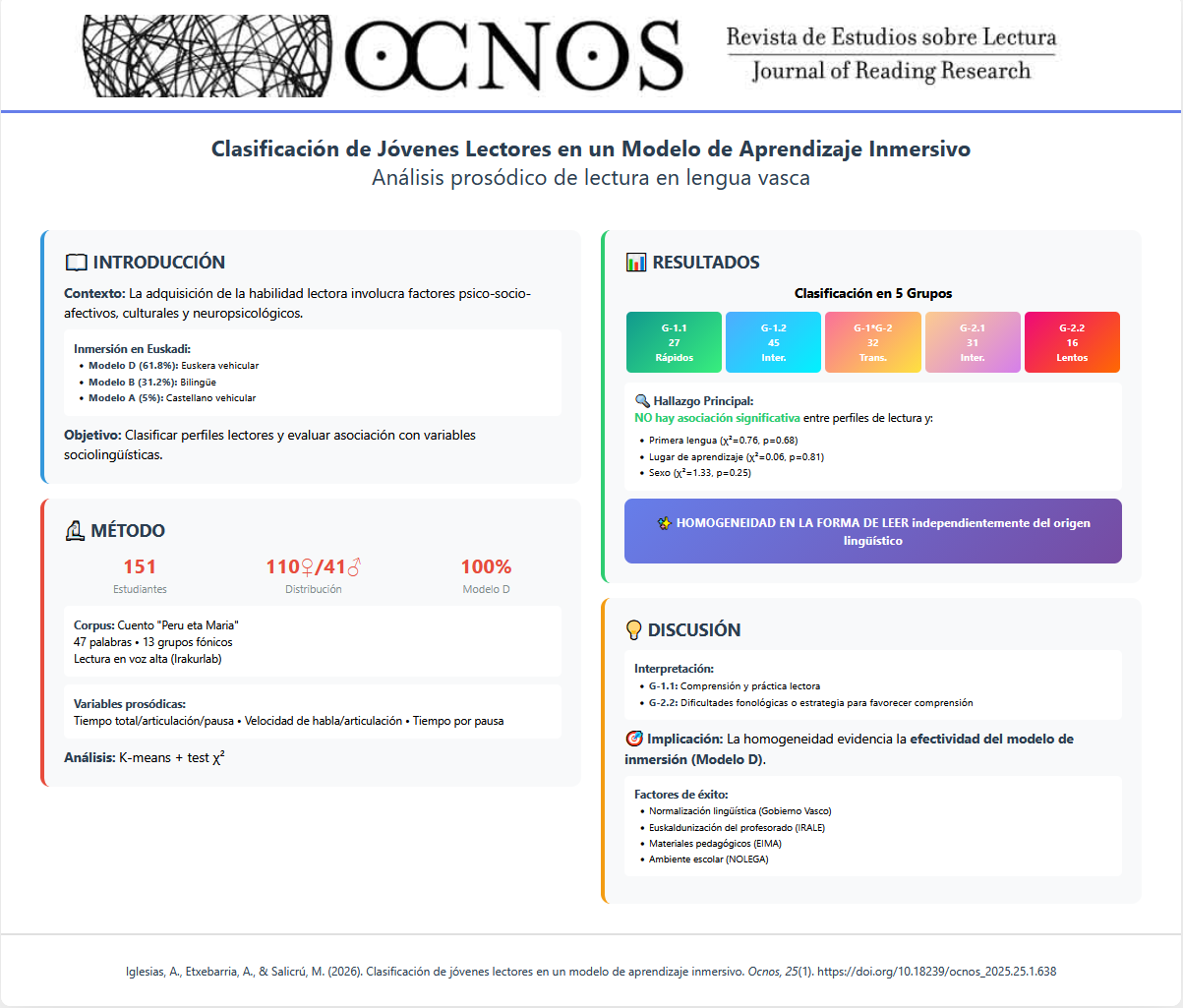
Con información obtenida en la lectura en voz alta de un texto narrativo en lengua vasca se ha clasificado a 151 jóvenes universitarios en perfiles lectores y se ha evaluado la asociación entre estos perfiles y variables sociolingüísticas. La clasificación K-mean basada en seis variables prosódicas (tiempo total de lectura, tiempo de articulación, tiempo de pausa, velocidad de habla, velocidad de articulación y tiempo por pausa) ha proporcionado una clasificación estable en cinco grupos. La caracterización cuantitativa de los perfiles ha revelado un gradiente desde lectores rápidos con pausas cortas hasta lectores lentos con pausas más largas y numerosas. El análisis mediante tablas de contingencia no ha mostrado asociaciones significativas entre los perfiles de lectura y las variables categóricas estudiadas (primera lengua, ámbito de aprendizaje del euskera y sexo). La homogeneidad observada en la forma de leer, independientemente del origen lingüístico, ha evidenciado la efectividad del modelo de aprendizaje inmersivo. Este planteamiento metodológico es reproducible con otro tipo de textos, con lectores en otras etapas de aprendizaje y en otras lenguas. También permite contrastar resultados entre modelos educativos.
Descargas
##plugins.themes.bootstrap3.article.details##

Esta obra está bajo una licencia internacional Creative Commons Atribución-NoComercial-SinDerivadas 4.0.
Aquellos autores/as que tengan publicaciones con esta revista, aceptan los términos siguientes:
- Los autores/as conservarán sus derechos de autor y garantizarán a la revista el derecho de primera publicación de su obra, el cuál estará simultáneamente sujeto a la Licencia de reconocimiento de Creative Commons Reconocimiento-NoComercial-SinObrasDerivadas, que permite a terceros compartir reconociendo adecuadamente la auoria del texto, no utilizar el material con fines comerciales, y si remezcla, transforma o crea a partir del material, no puede difundir el material modificado.
- Se permite y recomienda a los autores/as difundir su obra a través de Internet (p. ej.: repositorios institucionales o en su página web) solo después de la aceptación y publicación del envío, lo cual puede producir intercambios interesantes y aumentar las citas de la obra publicada. (Véase El efecto del acceso abierto).
Citas
Adler, C. R. (2001). Put reading first: The research building blocks for teaching children to read. National Institute for Literacy.
Alliende, F., & Condemarín, M. (2002). La lectura: teoría, evaluación y desarrollo. Andrés Bello.
American Councils for International Education. (2022). Dual language immersion programs in U.S. public schools (Infographic). National Clearinghouse for English Language Acquisition (NCELA)
Amorrortu, E. & Ortega, A. (2009). Zergatik eskolaratzen dituzte gurasoek seme-alabak euskarazko hizkuntza-ereduetan? Euskera, 54(2-1), 579-602. https://doi.org/10.59866/eia.v2i54.241 DOI: https://doi.org/10.59866/eia.v2i54.241
Badihardugu Euskara Elkartea. (2023). https://ahotsak.eus/
Baker, C. (2011). Foundations of bilingual education and bilingualism. Multilingual matters.
Baker, L., & Brown, A. L. (1984). Metacognitive skills and reading. In P. D. Pearson, R. Barr, M. L. Kamil, & P. Mosenthal (Eds.), Handbook of reading research (pp. 353-394). Longman.
Binder, K. S., Tighe, E., Jiang, Y., Kaftanski, K., Qi, C., & Ardoin, S. P. (2013). Reading expressively and understanding thoroughly: An examination of prosody in adults with low literacy skills. Reading and writing, 26, 665-680. https://doi.org/10.1007/s11145-012-9382-7 DOI: https://doi.org/10.1007/s11145-012-9382-7
Block, C. C., & Pressley, M. (2002). Introduction. In C. C. Block & M. Pressley (Eds.), Comprehension instruction: Research-based best practices (pp. 1-7). Guilford Press Inc. https://doi.org/10.1057/9780230501386_1 DOI: https://doi.org/10.1057/9780230501386_1
Boersma, P., & Weenik, D. (2025). Praat: doing phonetics by computer. University of Amsterdam.
Bravo, L. (2000). Los procesos cognitivos en el aprendizaje de la lectura inicial. Pensamiento Educativo, 27(2), 49-68. https://pensamientoeducativo.uc.cl/index.php/pel/article/view/25999
Bruner, J. (1985). Child's talk: Learning to use language. Child Language Teaching and Therapy, 1(1), 111-114. https://doi.org/10.1177/026565908500100113 DOI: https://doi.org/10.1177/026565908500100113
Caliński, T., & Harabasz, J. (1974). A dendrite method for cluster analysis. Communications in Statistics-theory and Methods, 3(1), 1-27. https://doi.org/10.1080/03610927408827101 DOI: https://doi.org/10.1080/03610927408827101
Canadian Parents for French. (2023). Annual report. https://cpf.ca
Carrell, P. L., & Eisterhold, J. C. (1983). Schema theory and ESL reading pedagogy. TESOL quarterly, 17(4), 553-573. https://doi.org/10.2307/3586613 DOI: https://doi.org/10.2307/3586613
Cassany, D. (2008). Prácticas letradas contemporáneas. Ríos de tinta.
Cassany, D., Luna, M., & Sanz, G. (1994). Enseñar lengua. Grao.
Cenoz, J., Gorter, D., & May, S. (Eds.). (2017). Language awareness and multilingualism. Springer. https://doi.org/10.1007/978-3-319-02240-6 DOI: https://doi.org/10.1007/978-3-319-02240-6
Chomsky, N. (1965). Aspects of the theory of syntax. MITT Press. https://doi.org/10.21236/AD0616323 DOI: https://doi.org/10.21236/AD0616323
Condemarín, M., & Medina, A. (1998). Estrategias de lectura: antes, durante y después. Lenguaje integrado II. Universidad Diego Portales, Chile.
Condemarín, M., & Medina, A. (2000). Evaluación auténtica de los aprendizajes. Un medio para mejorar las competencias en lenguaje comunicación. Andrés Bello.
Coyle, D., Hood, P., & Marsh, D. (2010). CLIL: Content and language integrated learning (Vol. 1). Cambridge university press. https://doi.org/10.1017/9781009024549 DOI: https://doi.org/10.1017/9781009024549
Cummins, J. (2000). Language, power, and pedagogy: Bilingual children in the crossfire. Multilingual matters. https://doi.org/10.2307/jj.27195459 DOI: https://doi.org/10.21832/9781853596773
Dennis, D. V. (2008). Are assessment data really driving Middle school reading instruction? What we can learn from one student’s experience. Journal of Adolescent and Adult Literacy, 51, 578-587. https://doi.org/10.1598/JAAL.51.7.5 DOI: https://doi.org/10.1598/JAAL.51.7.5
Elman, J. L., Bates, E., Johnson, M. H., Karmiloff-Smith, A., Parisi, D., & Plunkett, K. (1996). Rethinking innateness: A connectionist perspective on development (Vol. 10). MIT press. https://doi.org/10.7551/mitpress/5929.001.0001 DOI: https://doi.org/10.7551/mitpress/5929.001.0001
Erdocia, I. (2020). The politics of plurilingualism: Immersion, translanguaging, and school autonomy in Catalonia. Linguistics and Education, 60, 100865. https://doi.org/10.1016/j.linged.2020.100865 DOI: https://doi.org/10.1016/j.linged.2020.100865
Eusko Jaurlaritza / Gobierno Vasco (2016). EAEko hezkuntza sistema hobetzo plana. bikaintasunerantz ekitatean oinarrituta. Heziberri 2020. Eusko Jaurlaritza / Gobierno Vasco.
Eusko Jaurlaritza / Gobierno Vasco. (s.f.-a). Educación inclusiva y respuesta a la diversidad. Planes. https://www.euskadi.eus/educacion-inclusiva-atencion-diversidad-planes/web01-a3hinklu/es/
Eusko Jaurlaritza / Gobierno Vasco. (s.f.-b). Educación inclusiva y respuesta a la diversidad. Programas de atención a la diversidad. https://www.euskadi.eus/programas-de-atencion-a-la-diversidad/web01-a3hinklu/es/
Eusko Jaurlaritza / Gobierno Vasco. (s.f.-c). Eima. https://www.euskadi.eus/eima-presentacion/web01-a3eima/es/
Eustat-Instituto Vasco de Estadística. (2025). Alumnado matriculado en Enseñanzas de Régimen General no universitarias en la C.A. de Euskadi por territorio histórico y nivel de enseñanza, según titularidad del centro y modelo lingüístico. Avance de datos. 2024-2025
García, O. (2011). Bilingual education in the 21st century: A global perspective. John Wiley & Sons. https://doi.org/10.1017/S0047404513000304 DOI: https://doi.org/10.1017/S0047404513000304
Generalitat de Catalunya (2018). The language model of the Catalan education system. Language learning and use in a multilingual and multicultural educational environment. https://repositori.educacio.gencat.cat/bitstream/handle/20.500.12694/230/the_language_model_of_the_catalan_education_system_2018.pdf
Genesee, F. (1987). Learning through two languages: Studies of Immersion and Bilingual Education. Newbury House Publishers.
Gil, J. (2007). Fonética para profesores de español: de la teoría a la práctica. Arco/Libros.
Gilakjani, A. P., & Sabouri, N. B. (2016). A study of factors affecting EFL learners’ reading comprehension skill and the strategies for improvement. International journal of English linguistics, 6(5), 180-187. https://doi.org/10.5539/ijel.v6n5p180 DOI: https://doi.org/10.5539/ijel.v6n5p180
Grabe (2003). Revalorización del término interactivo. In E. Rodríguez, & E. Lager (Eds.), La lectura (pp. 91-97). Universidad del Valle.
Hermanto, N., Moreno, S., & Bialystok, E. (2012). Linguistic and metalinguistic outcomes of intense immersion education: How bilingual?. International journal of bilingual education and bilingualism, 15(2), 131-145. https://doi.org/10.1080/13670050.2011.652591 DOI: https://doi.org/10.1080/13670050.2011.652591
Jiang, X. (2011). The role of first language literacy and second language proficiency in second language reading comprehension. The Reading Matrix, 11(2), 177-190. https://www.readingmatrix.com/articles/april_2011/jiang.pdf
Keene, E., & Zimmermann, S. (1997). Mosaic of thought: Teaching comprehension in a reader’s Workshop. Heinemann.
Lai, S. F., Li, C. H., & Amster, R. (2013). Strategically smart or proficiency-driven? An investigation of reading strategy use of EFL college students in relation to language proficiency. Contemporary Issues in Education Research, 6(1), 85-92. https://doi.org/10.19030/cier.v6i1.7606 DOI: https://doi.org/10.19030/cier.v6i1.7606
Lambert, W. E., & Tucker, G. R. (1972). Bilingual education of children: The St. Lambert experiment.
Landi, N., & Ryherd, K. (2017). Understanding specific reading comprehension deficit: A review. Language and linguistics compass, 11(2), e12234. https://doi.org/10.1111/lnc3.12234 DOI: https://doi.org/10.1111/lnc3.12234
Lasagabaster, D. (2001). Bilingualism, immersion programmes and language learning in the Basque Country. Journal of Multilingual and Multicultural Development, 22(5), 401-425. https://doi.org/10.1080/01434630108666443 DOI: https://doi.org/10.1080/01434630108666443
Lazaruk, W. (2007). Linguistic, academic, and cognitive benefits of French immersion. Canadian Modern Language Review, 63(5), 605-627. https://doi.org/10.3138/cmlr.63.5.605 DOI: https://doi.org/10.3138/cmlr.63.5.605
Ley 10/1982, de 24 de noviembre, básica de normalización del uso del Euskera Euskera (revisión vigente desde 16 de Julio de 2022). BOPV, 160, de 16/12/1982, BOE, 100, de 26/04/2012. https://www.boe.es/eli/es-pv/l/1982/11/24/10/con
Loredo, X., & Vázquez-Grandío, G. S. (2022). La lengua gallega en el sistema educativo: impacto en las competencias, prácticas y actitudes del estudiantado. Caracol, 24, 170-201. https://doi.org/10.11606/issn.2317-9651.i24p170-201 DOI: https://doi.org/10.11606/issn.2317-9651.i24p170-201
Lorenzo, J. R. (2001). Procesos cognitivos básicos relacionados con la lectura. Primera parte: la conciencia fonológica. Interdisciplinaria, 18(1), 1-33. https://www.redalyc.org/pdf/180/18011326001.pdf
Miller, J., & Schwanenflugel, P. J. (2006). Prosody of syntactically complex sentences in the oral reading of young children. Journal of educational psychology, 98(4), 839-853. https://doi.org/10.1037/0022-0663.98.4.839 DOI: https://doi.org/10.1037/0022-0663.98.4.839
Miller, J., & Schwanenflugel, P. J. (2008). A longitudinal study of the development of reading prosody as a dimension of oral reading fluency in early elementary school children. Reading research quarterly, 43(4), 336-354. https://doi.org/10.1598/RRQ.43.4.2 DOI: https://doi.org/10.1598/RRQ.43.4.2
Nicolay, A. C., & Poncelet, M. (2013). Cognitive advantage in children enrolled in a second-language immersion elementary school program for three years. Bilingualism: Language and cognition, 16(3), 597-607. https://doi.org/10.1017/S1366728912000375 DOI: https://doi.org/10.1017/S1366728912000375
Nicolay, A. C., & Poncelet, M. (2015). Cognitive benefits in children enrolled in an early bilingual immersion school: A follow up study. Bilingualism: Language and Cognition, 18(4), 789-795. https://doi.org/10.1017/S1366728914000868 DOI: https://doi.org/10.1017/S1366728914000868
Pearson, P. D., & Gallagher, M. C. (1983). The instruction of reading comprehension. Contemporary educational psychology, 8(3), 317-344. https://doi.org/10.1016/0361-476X(83)90019-X DOI: https://doi.org/10.1016/0361-476X(83)90019-X
Pressley, M. (2006). Reading instruction that works: the case for balanced teaching. Guilford Press.
Purić, D., Vuksanović, J., & Chondrogianni, V. (2017). Cognitive advantages of immersion education after 1 year: Effects of amount of exposure. Journal of Experimental Child Psychology, 159, 296-309. https://doi.org/10.1016/j.jecp.2017.02.011 DOI: https://doi.org/10.1016/j.jecp.2017.02.011
Riedel, B. W. (2007). The relation between DIBELS, reading comprehension, and vocabulary in urban first grade students. Reading research quarterly, 42(4), 546-567. https://doi.org/10.1598/RRQ.42.4.5 DOI: https://doi.org/10.1598/RRQ.42.4.5
Rousseeuw, P. J. (1987). Silhouettes: a graphical aid to the interpretation and validation of cluster analysis. Journal of computational and applied mathematics, 20, 53-65. https://doi.org/10.1016/0377-0427(87)90125-7 DOI: https://doi.org/10.1016/0377-0427(87)90125-7
Santiago, A.W., Castillo, M.C., & Morales, D.L. (2007). Estrategias y enseñanza-aprendizaje de la lectura. Revista Folios, 26, 27-50. https://doi.org/10.17227/01234870.26folios27.38 DOI: https://doi.org/10.17227/01234870.26folios27.38
Skinner, B. F. (1957). Verbal behavior. Appleton-century-crofts. https://doi.org/10.1037/11256-000 DOI: https://doi.org/10.1037/11256-000
Solé, I. (1992). Estrategias de comprensión de la lectura. Cuadernos de pedagogía, 216(3), 25-27.
Sozilinguistika Klusterra (2021). 2021 urteko txostena. Soziolinguistika Klusterra euskara biziberritzeko ikergunea.
Spada, N., & Lightbown, P. M. (2006). How languages are learned. Oxford University Press.
Tan, K. H., Wheldall, K., Madelaine, A., & Lee, L. W. (2007). A review of the simple view of reading: Decoding and linguistic comprehension skills of low progress readers. Australian Journal of Learning Difficulties, 12(1), 19-30. https://doi.org/10.1080/19404150709546827 DOI: https://doi.org/10.1080/19404150709546827
Trabasso, T., & Bouchard, E. (2002). Teaching readers how to comprehend text strategically. In C.C. Block, & M. Pressley (Eds.), Comprehension instruction: Research-based best practices (pp. 176-200). Guilford.
Trebits, A., Koch, M. J., Ponto, K., Bruhn, A. C., Adler, M., & Kersten, K. (2022). Cognitive gains and socioeconomic status in early second language acquisition in immersion and EFL learning settings. International Journal of Bilingual Education and Bilingualism, 25(7), 2668-2681. https://doi.org/10.1080/13670050.2021.1943307 DOI: https://doi.org/10.1080/13670050.2021.1943307
Urquijo, S. (2007). Procesos cognitivos y adquisición de la lectoescritura. In III Congreso Marplatense de psicología, de alcance nacional e internacional. Facultad de Psicología, Universidad Nacional de Mar del Plata. https://www.aacademica.org/sebastian.urquijo/54.pdf
Valdés-León, G. (2022). Producción de textos narrativos en el aula de historia: análisis lexicométrico de una propuesta interdisciplinar. Onomázein, 55, 32-49. https://doi.org/10.7764/onomazein.55.09 DOI: https://doi.org/10.7764/onomazein.55.09
Vygotsky, L. S. (1978). Mind in society: The development of higher psychological processes (Vol. 86). Harvard University Press.
Wang, Z., Sabatini, J., & O’Reilly, T. (2020). When slower is faster: Time spent decoding novel words predicts better decoding and faster growth. Scientific studies of reading, 24(5), 397-410. https://doi.org/10.1080/10888438.2019.1696347 DOI: https://doi.org/10.1080/10888438.2019.1696347
Yana, M., Arocutipa, A., Alanoca, R., Adco, H., & Yana, N. (2019). Estrategias cognitivas y la comprensión lectora en los estudiantes de nivel básica y superior. Revista Innova Educación, 1(2), 211-217. https://doi.org/10.35622/j.rie.2019.02.007 DOI: https://doi.org/10.35622/j.rie.2019.02.007
Zhang, H., Diaz, M. T., Guo, T., & Kroll, J. F. (2021). Language immersion and language training: Two paths to enhanced language regulation and cognitive control. Brain and Language, 223, 105043. https://doi.org/10.1016/j.bandl.2021.105043 DOI: https://doi.org/10.1016/j.bandl.2021.105043