This study analyses the reading responses of 180 primary school students from the Basque Country following their engagement with the picture book Mexique. A Refugee Story from the Spanish Civil War. The students’ responses, recorded on video, were transcribed and analysed using an open-source automatic speech recognition model based on Conformer-Transducer technology. These responses were categorised using an ad hoc tool designed to analyse the content of the textual data from the dialogues. The results reveal the students’ ability to interpret the picture book and to establish links between its themes and their own life experiences, as well as with both historical and contemporary events. However, the responses show a limited depth and complexity in their reflections. Consequently, the study underscores the importance of systematically incorporating picture books into the classroom, fostering the literary-artistic competence, and critically addressing controversial topics such as the Spanish Civil War and historical memory.
Downloads
Download data is not yet available.
Article Details
How to Cite
Echeberria-Arquero, B., Mariezkurrena Serrano, A., Lopez-Gazpio, I., & Luna, U. (2026). Picture books and historical memory. Primary school students’ reading responses. Ocnos. Journal of reading research, 25(2). https://doi.org/10.18239/ocnos_2026.25.2.614
Echeberria-Arquero, Mariezkurrena Serrano, López-Gazpio, and Luna: Picture books and historical memory. Primary education students’ reading responses
USING PICTURE BOOKS FOR MEDIATION IN PRIMARY EDUCATION
In recent times, pictures have come to play a dominant role in the communication of
ideas and messages. Consequently, cultural memory has incorporated new expressive
parameters drawn from cinema, photography and literature in order to move away from
more canonical representational strategies (), in which the visual element takes centre stage (). The importance of pictures as a means of communication in today’s world has led
to a remarkable boom in all kinds of picture books, including those in the educational
sector. In terms of their characteristics and their use, picture books have undeniable
educational potential (; ): they offer the opportunity to capture students’ attention (); their interpretative flexibility, whilst complex (; ; ), enables the development of reflective and argumentative skills (; ); their length is suitable for use in the classroom () and for group reading activities; they help to develop reading conventions, as well
as initial notions of metafiction (); they foster creativity and cognitive development () and provide solutions and answers to current problems, as they are a socialising
resource that connects readers with the collective imagination (). Furthermore, they enable the identification of the multimodal characteristics specific
to picture books (; ), as well as symbolic and metaphorical elements, whilst promoting literary-visual
reading (; ; ; ) and facilitating intertextuality and interdisciplinarity (; ; ).
Given the subject matter they address, they primarily explore themes related to the
realities and situations of a diverse society (; ), including sometimes stories that have been silenced () or taboo subjects, which allow these issues to be examined from a perspective that
is both critical and inclusive. In this regard, picture books are a tool for literary,
artistic and social education, given that both the text and the pictures are equally
important (). What is more, given the influence that reading picture books has on the development
of children’s personal identity and on their social and collective growth, they are
a highly suitable resource for promoting multiculturalism. The two codes found in
picture books help children to create – and even to question – narrative accounts
of their experiences; their multimodal nature and versatility therefore make them
a valuable resource for teachers in developing students’ literary and artistic skills.
Although the picture book is a growing genre and there are well-informed and competent
teachers working with it (), its presence in pre-school and primary education in Spain remains restricted (; ), despite the existence of several teaching approaches based on picture books, as
demonstrated by research conducted in Anglo-Saxon contexts (; ; ; ) and in the Hispanic-speaking world (; ; ; ). All of them analyse their implementation based on the types of questions asked
and activities proposed, gathering feedback from students in pre-school and primary
education. The findings of the mediation sessions referred to in these studies indicate
that the use of picture books elicited an emotional response in the participants,
encouraging them to recount their own life experiences and compare them with the story
of the fictional character. These analogies, in turn, revealed a high degree of empathy
among the students towards the stories depicted in the picture books (; ; Hansen, 2013) and even helped to shed light on the complex realities faced by some
students ().
However, most of the themes in the picture books chosen for these sessions revolve
around children’s life experiences, with a focus on friendship, mischief, imagination
and bullying. There is also a selection of picture books that tackle pressing issues
such as death, migration, stereotypes and prejudices regarding social classes and
cultures, as well as some relating to historical memory and human rights (; ; ).
PICTURE BOOKS AND THE SPANISH CIVIL WAR
The search for alternative resources to address controversial topics from the past
and present in the classroom—such as historical memory and the Spanish Civil War—has
been a challenging task due to the inherent complexity of the subject, the impact
and controversy it continues to generate in today’s society, and the lack of resources
tailored to different educational levels. In this regard, literary resources such
as picture books break with the academic/didactic approach that often leads to apathy
among younger generations () and encourage reflection and critical thinking about the past and the present (; , ; ), due to their evident emotional value (). Within this literary context, picture books have provided an opportunity to explore
themes such as war (, ; , ; ; ; ; ; ; ).
As far as the Spanish Civil War is concerned, it can be considered a canonical theme
that has been widely addressed in children’s and young adult literature (LIJ, as per
its Spanish acronym) from the Iberian peninsula, and which has been the subject of
some exhaustive research and interpretation (; ). Despite this, the body of picture books on the Spanish Civil War is limited, and
there are not many examples of works that deal with the subject, with the exception
of, amongst others, Gerrak ez du izenik [War Has No Name] by Leire Bilbao and Maite Mutuberria; Guernica by Heliane Bernard and Olivier Charpentier; Beroki gorria [The Red Coat] by Patxi Zubizarreta; Hari single bat [A Fragile Thread] by Idoia Garzes and Leire Urbeltz; Amonaren kea [Smoke at Grandma’s House] by Ane Ibañez and Dani Martirena; and Anastasini zirkua [Anastasini’s Circus] by Miren Amuriza and Malen Amenabar.
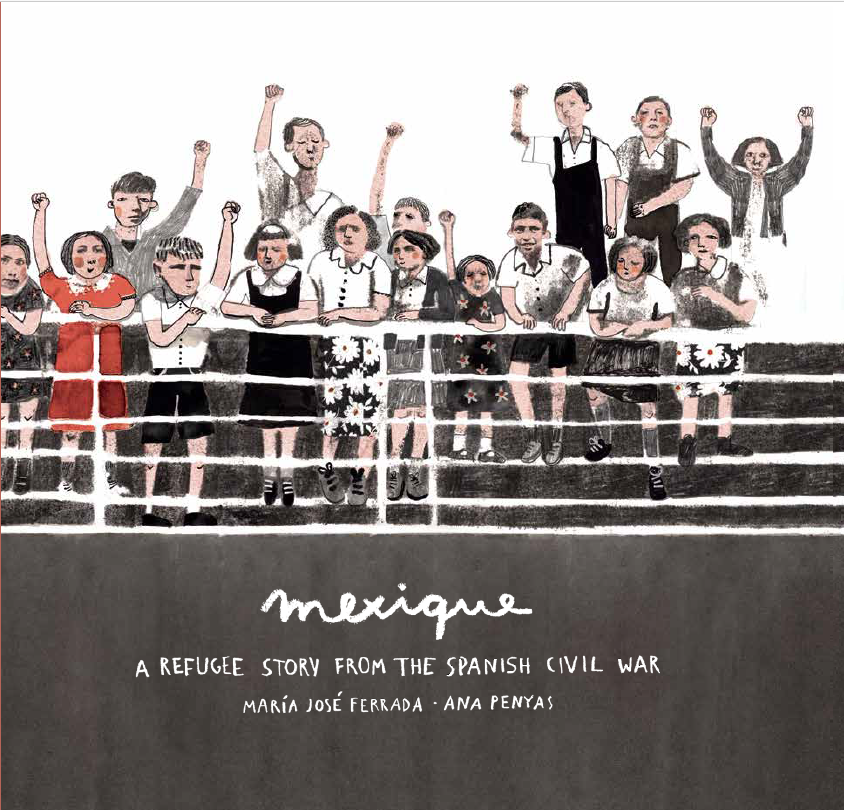
To these we must add the picture book selected for this study, Mexique. A Refugee Story from the Spanish Civil War (also translated into Basque), by María José Ferrada, illustrated by Ana Penyas and
published in 2020 by Eerdmans. This book is about the 456 children who, in May 1937,
set sail from the port of Bordeaux bound for Mexico, fleeing the horrors of the Spanish
Civil War (). Those children who, taken in by the government of Lázaro Cárdenas, settled in the
capital of Michoacán and came to be known as Los niños de Morelia (). Spanning fourteen scenes rich in symbols and allusions to historical sources, this
book explores issues such as forced migration, exile and war, as well as historical
aspects of the Spanish Civil War. There are several teaching proposals based on this
picture book aimed at primary education (; ), although they do not include the students’ responses or reactions after reading
it.
To address this need, therefore, we propose a study based on an analysis of the responses
given by primary education students after reading the picture book Mexique. A Refugee Story from the Spanish Civil War. This study aims at assessing the participating students’ interpretative skills from
a literary perspective, as well as their ability to make connections between passages
from the text, their own life experiences, and their knowledge of historical and current
events. The reading of this picture book forms part of the GATAI project at Universidad
del País Vasco (UPV/EHU) (), in which students on the Bachelor’s Degree in Primary Education at the Faculty
of Education, Philosophy and Anthropology design and implement a teaching session
based on the reading of a picture book that addresses a controversial topic, such
as historical memory. This session, aimed at students in Years 3, 4, 5 and 6 of primary
education, aims at developing literary and civic skills.
METHOD
This is an evaluative study employing a mixed-methods approach, as it combines quantitative
responses— categorised according to dimensions and sub-dimensions, broken down by
levels of development —with qualitative data, enabling us to analyse the content of
the responses provided by primary education students.
Participants
Four schools in the Basque Country took part in the project, selected for their methodological
diversity and socio-cultural context. At these schools, nine groups read Mexique. A Refugee Story from the Spanish Civil War (2017), meaning that 180 students took part in reading and discussion activities
based on the story from which 114 responses were collected.
Instruments
From the total number of responses collected, those relating to the literary aspect
were selected during the part of the session devoted to reading the picture book chosen
for this study. To analyse and categorise the responses, we used a modified version
of the Visual Journeys tool (), which was redesigned to suit our research context and in line with our objectives.
The result is a tool organised into four main dimensions and subdivided into specific
categories related to their content (table 1).
Table 1Dimensions for categorising responses Note: Author’s calculations based on Fittipaldi (2012).
Dimension
Sub-dimension
Description
D1_Referential
D1.1_Cover
The cover consists of the following elements: characters, actions and the setting
in which they take place
D1.2_Title
Title of the work
D1.3_Narrator
Narrator’s voice
D1.4_Book’s topic
Topics covered in the story
D1.5_Mediator’s topic
Topics suggested by reading mentors
D1.6_Characters’ feelings
Feelings and emotions experienced by the characters
D1.7_Characters’ actions
Specific actions or situations involving the characters
D1.8_Book reviews
How do they rate the book overall?
D1.9_Tastes in book
Whether or not they liked the book
D2_Compositional
D2.1_Meanings
Meaning of a word, expression or phrase
D2.2_Picture colour
Book/specific scene colour
D2.3_Visual element
A specific visual element or illustration technique
D2.4_Scene
Specific action
D3_Intertextual and intercultural
D3.1_ Intertextual
Texts, quotations, slogans, mottos or literary works
D3.2_Artistic and cultural representations and expressions
Other artistic and cultural expressions or representations
D3.3_ Social channels
Channels for the dissemination, transmission or sharing of cultural representations
D4_Personal
D4.1_Personal perception
What he/she thinks or feels about the events described
D4.2_Personal experience
Life experience and connection to the events described
D4.3_ An upcoming life experience
Experiences of those close to the person and their connection to the events described
Note: Author’s calculations based on Fittipaldi (2012).
Furthermore, the total number of responses, classified by dimension, has been categorised
according to the following four interpretative levels: NI1: Does not know how to answer/does
not address the question asked; NI2: Identifies; NI3: Relates; NI4: Reflects. To make
it easier to interpret the data and the results, each student’s response has been
coded using a numbering system; we refer to students’ responses as “R01” or the corresponding
number, and use the code “ML” for questions or comments made by the reading mediator.
In addition, the year group to which the students belong has been indicated using
“EP4”, “EP5” and “EP6”. Schools where lessons are organised by cycle have been identified
using the codes “EPC2” and “EPC3”.
Procedure
The reading and discussion of the selected book took place during a one-and-a-half-hour
session in the classroom with the primary education students. It should be noted that
the book had not been read in any of the classrooms before. The sessions were designed
and delivered by 19 trainee teachers on the Primary Education degree programme at
the Faculty of Education, Philosophy and Anthropology at UPV/EHU. During the session,
there was a reading aloud of the picture book Mexique. A Refugee Story from the Spanish Civil War (2017), followed by a group discussion based on DIME strategy and open-ended questions relating to textual and visual elements in
various scenes from the book.
The sessions were recorded on video. An open-source automatic speech recognition model
based on Conformer-Transducer technology was used to transcribe dialogues in Basque;
this is a re-optimised variant of the autoregressive model developed by , re-trained using 804 hours of data recorded in Basque. This model enables the precise
and efficient alignment of spoken content with its textual representation. To facilitate
the subsequent categorisation of the text, we used a suite of Python-based machine
learning tools and the scikit-learn library ecosystem ().
RESULTS AND DISCUSSION
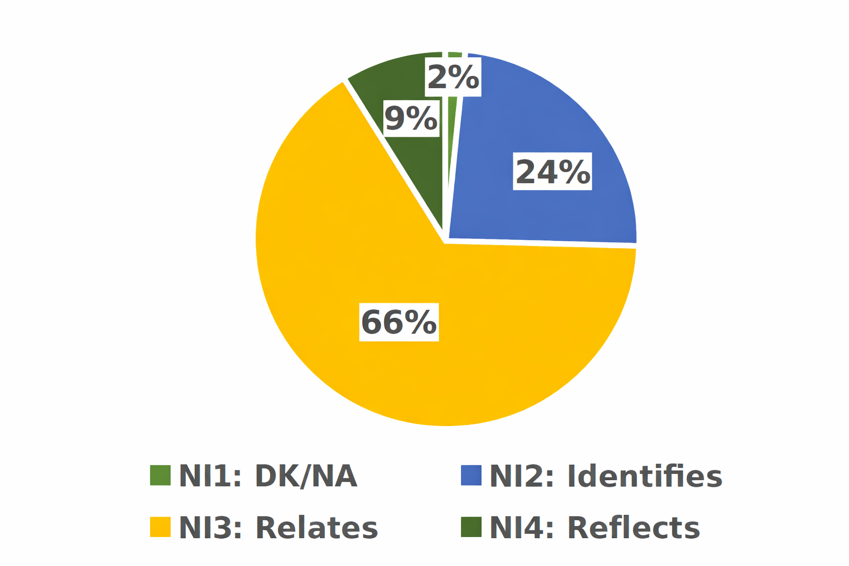
The responses received – 114 in total – have been analysed on the basis of the dimensions
set out in the tool, according to their level of interpretation. These results show
(Figure 1) a clear predominance of responses at interpretative level 3, or relational type
(n=75; 65.8%), followed at a considerable distance by those at level 2, which demonstrate
a basic degree of interpretation and identification (n=27; 23.7%). Conversely, the
responses requiring more careful consideration—those in category 4—were far fewer
(n=10; 8.8%). Finally, it should be noted that on only two occasions were the students
unable to answer the question asked or to comment on the topic (n=2; 1.7%).
Figure 1Response results grouped by interpretative level
As far as the dimensions are concerned, the first two have attracted a very similar
number of responses: D1_Referential (n=42; 36.8%) and D2_Compositional (n=40; 35.1%).
For its part, D4_Personal (n=28; 24.6%) accounted for approximately a quarter of all
the comments analysed. Far behind are the responses relating to D3_ Intertextual and
intercultural (n=4; 3.5%).
Reader responses to the Referential Dimension (D1)
Of the 42 responses analysed in this first dimension, the majority reflect a basic
level of interpretation of the narrative elements (NI2: n=20; 47.6%). Close behind
are those that demonstrate students’ reading ability to explore topics in depth and
make connections between what they read and what they already know (NI3: n=17; 40.5%).
Furthermore, only five of the responses demonstrated thoughtful, well-developed reasoning
that indicated a clear stance on their views (NI4: n=5; 11.9%).
In addition to categorising the responses according to their interpretative level,
we consider it equally important to provide some examples of the types of responses
gathered under these categories and in relation to the sub-dimensions established
for their analysis.
In most sub-dimensions, the responses demonstrate a basic level of interpretation,
as well as a relational understanding. As regards the cover (D1.1), for example, whilst
some people see only people waving or on a boat, others suggest that these people
might be demonstrating or celebrating a potential victory.
Picture 1Cover
With regard to the narrator’s voice (D1.3), whilst one student simply notes the presence
of a single narrator, another links it to a girl or boy travelling on the ship. As
regards the topics, there are certain differences between those identified by the
students (D1.4) and those suggested to them by trainee teachers (D1.5): whilst the
former stem from the connections the students themselves make when reading the picture
book (fear, sadness or the horror of war), those proposed by the mediators involve
superficial interpretative responses that reproduce phrases from the work verbatim
(“the republic is a house” [R01EP4]; “Morelia is a colour” [R02EP4]). That said, it
should be noted that the theme of exile has been highlighted both by the students
(“it’s about refugees” [R03EPC3]) and by those guiding the reading. And it was on
this occasion that, when asked whether they understood what exile meant, they not
only answered in the affirmative but also linked it to the idea of not returning,
and speculated on the reasons for this (“they didn’t have the money to go back” [R04EP4],
“everything was in ruins in their villages” [R05EP4], “their relatives had died” [R06EP4]).
As for the characters, responses at a basic interpretative and relational level have
also been observed. On the one hand, those relating to their feelings (D1.7), which
the students have identified (sadness, calm) and linked to the reasons that may have
caused them (being separated from their families and leaving the war behind). On the
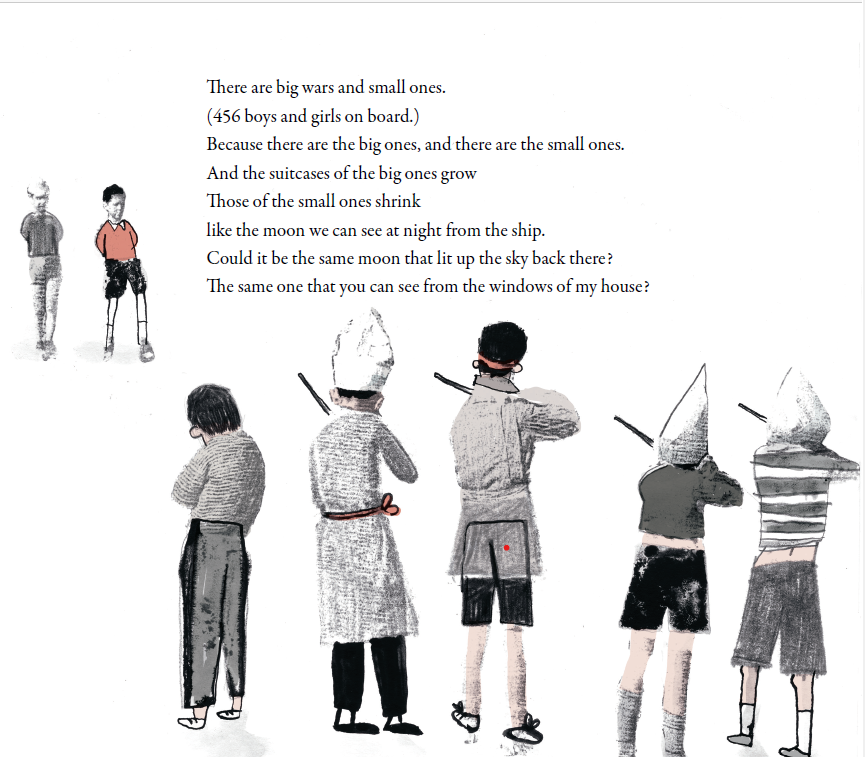
other hand, those relating to specific actions performed by them (D1.8). The execution
scene, for example, although misinterpreted by some who believed that children were
being executed, has widely been identified as a game. As well as noting that “children
play at what they see and do” [R07EPC3], one student accurately points out that this
is a re-enactment of the Spanish Civil War (“they’re playing, and some are Republicans
and are being shot by the Francoists, who are on the opposing side” [R08EPC3]).
Picture 2A scene of children playing at shooting
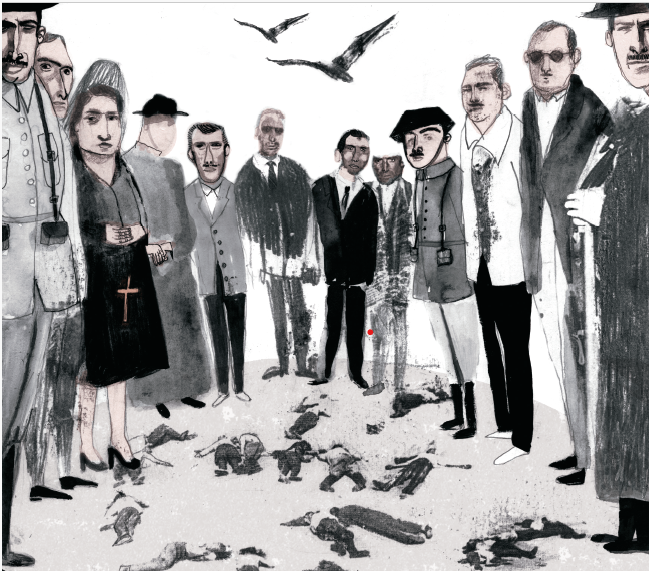
The scene featuring the characters in the epilogue elicits responses which, on the
one hand, are limited to simply identifying them (“people standing up” [R09EP6]) and,
on the other, go beyond this, attributing to them a meaning linked to the events narrated
(“they are the presidents, the ones who won the war” [R10EP6]; “they are the winners
of the war, the nationalists” [R11EP6]) or expressing opinions or value judgements that reveal their stance towards
them (“they are bad, but not all of them because there is a nun who is a woman and
cannot go to war” [R12EP4]).
Picture 3Epilogue scene
Responses indicating a reflective level of interpretation (NI4), with the exception
of the previous example, correspond to sub-dimensions D1.8 and D1.9. These comments
included those relating to an overall assessment of the book (“it’s a very sad story
because you have to leave your home and be separated from your parents” [R13EPC3])
and to the aspects that the students particularly disliked (“the bombings reminded
me of Guernica and it’s very hard for me because most of my family are from there”
[R14EP5]). As we can see, both examples selected demonstrate a high degree of empathy.
However, in these last two sub-dimensions, in addition to reflective responses, negative
assessments and comments have been recorded at level 2 (“what I liked least was the
shotgun” [R15EP5], “I don’t like the bombs” [R16EP5]) and level 3 (“the war story
is a very harsh one” [R17EPC2]).
Finally, it should be noted that, with regard to question D1.2, only answers demonstrating
a basic level of interpretation have been included. The students have therefore identified
it by the name of the country itself, as well as by the name of the ship, as reflected
in the title of the picture book itself: Mexique. A Refugee Story from the Spanish Civil War.
Reader responses to the D2_Compositional Dimension
This section consists of 40 questions. None of them revealed any complex interpretation
that would suggest a stance resulting from deep reflection (NI4: n=0). On two occasions,
the students did not know how to answer the questions asked (NI1: n=2, 5%). Seven
were classified as level 2 (NI2: n=7, 17.5%) and 31 as level 3 (NI3: n=31, 77.5%).
As we have just seen, almost 80% of the responses demonstrate a relational interpretation
between the compositional elements of the picture book and what their reading has
suggested to them. They have focused primarily on the images and the various visual
and technical aspects of illustration that make them up (D2.3). On the one hand, they
have referred to flowers as a symbol of calm (“they bring peace of mind, which is
why they appear on bedspreads whilst people sleep” [R18EPC3]), as well as to suitcases
and a raised fist. The last two have been open to multiple interpretations, without
any of them having a single, unambiguous meaning. They believe that the suitcases
could symbolise war, family, or the thoughts and emotions experienced by the protagonists,
or, more generally, convey a sense of sadness. As for the raised fist, whilst it is
often highlighted as a sign or symbol of something, opinions differ as to its meaning:
“it means to win” [R19EP4], “it is a sign of sadness” [R20EPC3], “it means war and
struggle” [R21EPC2].
On the other hand, most interpretations of the image have focused on colour (D2.2),
and in particular on the predominance of red in the story (n=11). Several responses
link it to blood, war, fear, anger and grief. Others, on the other hand, attribute
to it the traditional meaning of love and even associate it with positive emotions
such as joy. Although, at first glance, this might seem like a misguided interpretation
or one that strays from the story of the book, it makes sense when we consider certain
comments that link its use to the characters whom the child characters love or show
affection towards: “Red is a tribute to those who die in war and their families” [R22EP5]
or “the ship’s carers are in red because they look after them well” [R23EP5]. Nor
should we be surprised that they associate it with joy, given that they link the colour
red to values such as solidarity, help or cooperation (“the smoke from the ship is
red because it means help” [R24EP5] or the carers look after them [R25EP5]) or with
a hopeful vision of the future that awaits them (“the best things happen to the children
on the boat; they have a bright future ahead of them because they are going to live”
[R26EP5]). Similarly, some responses link the use of the colour red to the illustrator’s
intention to highlight or draw attention to something specific (“she uses red to emphasise
the importance of the ship’s crew” [R27EP5], “the train is important, and the red
smoke helps us focus on it and show that it’s leaving” [R28EP5]). In addition to red,
they mentioned black, grey and the use of black and white, linking all of these colours
to sadness and noting that their use evokes something “from a long time ago” [R29EP4].
Although, as we have already noted, most of the responses that demonstrated a relational
level of interpretation referred to the illustrations or visual elements of the image,
some referred to aspects of the text (D2.1). Thus, when asked directly by the reading
mentors about certain specific expressions, they provided fairly detailed answers:
M.L: “At one point, they talk about the new families – what do you think they are?”
R21: “They are the ones who look after them, because when we humans feel protected,
those people are our family.”
As for the responses regarding specific scenes (D2.4), some demonstrate the students’
reading ability to link the actions depicted with what they infer from them; whether
correctly (“the mother puts her hand to her head because she is worried about what
will happen to her son” [R30EPC3] or “the mother running cannot resist; she regrets
sending her son away and goes to fetch him” [R31EPC3]) or incorrectly (“they are leaving
the ship because it is sinking and the mothers are picking up the children who are
dead whilst the fathers are at war” [R32EPC3]).
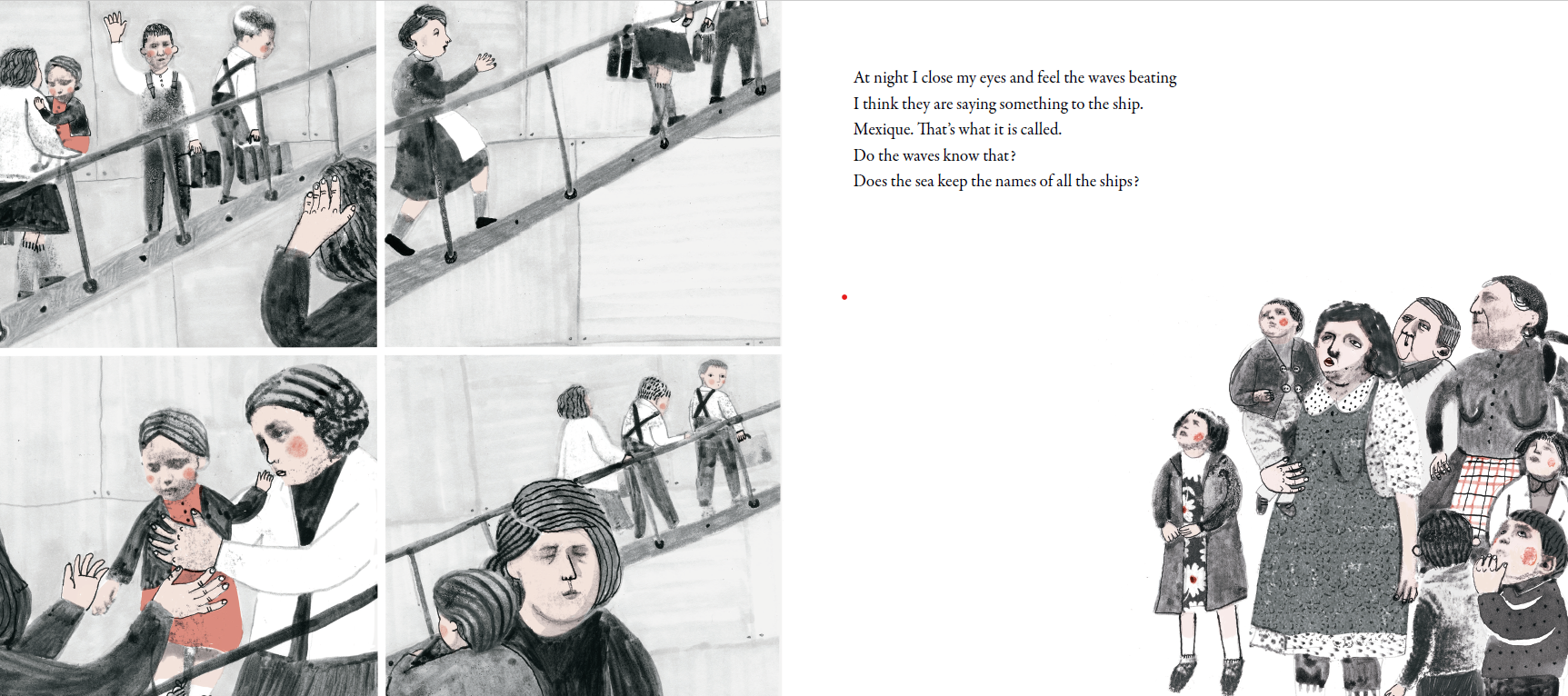
Picture 4A scene of children boarding the Mexique. A mother’s farewell and regret
This was the only sub-dimension in which, when asked about the scene above, most of
the students remained silent, saying they did not understand what was happening. At
the urging of the reading tutors, one student ventured to put forward his interpretation,
which, as has already been mentioned, turned out to be incorrect:
M.L: “What’s going on in this scene?”
To [everyone]: ...
M.L: “Does anything here catch your eye?”
To [everyone]: ...
M.L: “What are the characters doing?”
R43: “They’re jumping off the ship because it’s sinking, and the mothers are clutching
their dead children whilst the fathers are at war”
As noted at the start of this section, very few responses went beyond the basic interpretative
level (NI2: n=7, 17.5%). In these, although the students recognise the importance
of certain visual elements, they do not attach any meaning to them. Thus, they note
the contrast between the colours, and the prevalence and scope of red in the story,
but they do not identify the reasons for this, nor do they suggest what it signifies.
Reader responses to Dimension 3_ Intertextual and intercultural
This dimension has received just four responses. All of them are at intermediate interpretative
level (NI3). Three referred to specific artistic and cultural representations (D3.2),
and one referred to the medium or channel through which they were socialised (D3.3).
Two responses have linked the picture book to Picasso’s Guernica (“the characters’ faces resemble those in Guernica” [R33EP6]) and the events that took place there (“the bombings in the book reminded
me of those in Guernica” [R34EP5]). They have also noted similarities between the events recounted in the
picture book and the song “Maravillas”, dedicated by the band Berri Txarrak to Maravillas
Lamberto, a 14-year-old girl from Navarre who was raped and murdered by rebel fighters
at the start of the Civil War and went on to become a symbol of Franco’s repression.
They have thus drawn a clear parallel between the children’s departure into exile
and the moment when Maravillas bids farewell to her relatives.
Finally, one of the responses highlights television’s role in socialisation and the
transmission of ideas, as one student states that they saw “some feminists at a demonstration
making that gesture” [raising their fist] [R35EPC2].
Readers’ responses to Dimension 4_ Personal
Of the 28 responses comprising D4, five show a reflective level of interpretation
that allows us to understand the views of some of the students regarding the events
in question (NI4: n=5, 17.8%). The remainder relate to the third level: how and in
what ways the various aspects covered in the picture book are connected (NI3: n=23;
82.2%).
As regards the students’ perceptions following the reading (D4.1), they link war to
a wide range of elements. Some personify it by referring to Hitler and the Nazis,
others mention bombs and tanks, and there are those who highlight its devastating
effects, describing desolate landscapes (“there are lots of bricks because the houses
are being destroyed” [R36EP6]) or referring to death and even the end of the world.
It follows, therefore, that this reflects a pacifist or anti-war stance. These are
anti-war views that some have explicitly expressed by stating that “wars are bad”
and unjust and arbitrary (“war does not affect everyone in the same way” [R37EP6],
“some people live well and nothing happens to them, but others are affected and suffer
terribly” [R38EP6]). Among the emotions they have experienced, they say they feel
sadness at the events described and surprise at the high number of children whose
lives have been cut short. In fact, it is precisely their exile that has led the protagonists
to articulate their views more clearly. In an exercise that could be described as
a historical exercise in empathy, they have explained how they would have acted had
they found themselves in the position of having to decide what to do with their children:
“I couldn’t send them away because I think it’s too harsh” [R39EPC3], “I’d rather
they left than be shot” [R40EPC3].
The topic of exile has enabled them to link it to the phenomenon of migration. They
have referred to its multi-causal nature, citing the multitude of factors that account
for the displacement: “Work, weather, war and love” [R41EPC3]. To this end, some have
recounted their parents’ experiences (“my Venezuelan parents came here for money,
to look for work” [R42EP5]; “my father came from Wales for love” [R43EPC3]) or their
own (“I am here because my country is at war” [R44EP5], “I came from Honduras a month
ago and it is difficult because of the language and because my family is far away”
[R45EP5]).
As we have just seen, the students have made strong connections between the picture
book and their personal experiences, whether their own or those of their loved ones.
These constitute the second and third sub-dimensions into which the responses from
D4 have been grouped. In these accounts, we have seen that they have sought to relate
their own circumstances to the events described (“My grandmother told me she was born
during the war and that’s why she doesn’t speak Basque” [R46EP6], “My grandparents,
who are in the war in Ukraine, have had to leave their home” [R47EP4]), they have
felt personally addressed by them (“I’ve thought a lot about this because most of
my family is from Gernika” [R48EP5]) and have delved into their own life stories to
bridge the gap with the text (“I once visited Zerain prison, where Franco’s forces
took prisoners, and there are still marks left” [R49EP6]).
CONCLUSIONS
An analysis and categorisation of the students’ responses demonstrate the educational
potential that picture books can offer, as in this case, at primary school level.
Group reading, together with the mediators’ effective and engaging approach, has proved
essential in (re)activating students’ prior knowledge and encouraging their participation
by making them feel personally engaged with the facts presented, thereby enhancing
their social skills ().
The students have also demonstrated a clear ability to identify and interpret all
the literary and artistic features of the selected picture book, which reinforces
the importance of working with this literary genre in primary school classrooms to
develop literary competence (). Beyond identifying and understanding the key elements of the narrative, they have
shared a space of memory in which, through empathy () —towards their peers and the protagonists of the picture book— they have forged
links between their own experiences and those described, thereby giving new meaning
to the story itself and reinterpreting what they have observed and read in a reflective
manner ().
However, the results reflect the students’ difficulties in formulating more complex
answers that demonstrate a higher level of critical thinking. This may be due both
to a lack of literary literacy and to a lack of reading habits among primary education
students. No significant differences have been observed between the different years,
so age would not, in itself, constitute a determining factor in the degree of development
and depth of their formulations.
Furthermore, some interesting responses have been gathered that link events from the
historical past depicted in the selected picture book with current events, demonstrating
a certain ability to draw connections between the present and the past. However, these
links have sometimes amounted to little more than passing references that have failed
to foster critical thinking more effectively. The urgent need, therefore, to educate
future citizens to become critical thinkers and active advocates for free societies
and democracy—all the more so in today’s turbulent times—highlights the imperative
to address controversial issues, such as historical memory, through picture books
from an early age ().
We therefore emphasise the need to promote teaching approaches that incorporate or
are based on the use of picture books in primary education (); to this end, of course, appropriate teacher training is essential () as well as working with picture books that deal with controversial topics such as
the Spanish Civil War (; ).
NOTES
[1] This is a very common and widespread confusion of terminology among students, who
mistakenly use the term “nationalists” when they mean “nationals”.
AUTHORS’ CONTRIBUTIONS
Berta Echeberria-Arquero: Project management; Conceptualisation; Data curation; Writing – first draft; Writing
– revision and editing; Research; Methodology; Resources; Supervision; Validation;
Visualisation.
Iñigo Lopez-Gazpio: Data cleaning; Methodology; Writing – original draft. Research.
Ursula Luna: Conceptualisation; Writing – first draft; Writing – revision and editing; Research.
FUNDING
This work has been carried out as part of the UPV/EHU’s Educational Innovation project
known as GATAI (IKDi3 23-31) and forms part of the EDUTECON R&D&I project (PID2023-150579NA-I00),
funded by MICIU/AEI/10.13039/501100011033 and by the ERDF/EU. It also benefits from
support from the Histclassroom project, “Educación histórica, identidades y socialización
política en la España contemporánea, 1970-2022” (Project PID2022-138310NB-I00), funded
by MICIU/AEI (grant no. 10.13039/501100011033) and the ERDF, EU. The authors are also
members of the Hariak research group (GIU 22/008) and the Research Group on Medieval
Archaeology, Heritage and Cultural Landscapes (IT1442-22).
REFERENCES
1
Amaro-Agudo, A. E., & Navarro-Mateu, D. (2017). El álbum ilustrado como referente
de la diversidad: planteamiento del trabajo en los centros. En A. Rodríguez-Martín
(Coord.), Prácticas innovadoras inclusivas. Retos y oportunidades (pp. 937-943). Universidad de Oviedo, Servicio de Publicaciones. http://hdl.handle.net/10651/50089
2
Arizpe, E. (2012). Entre imágenes y palabras: la investigación que promueve comunidades
lectoras inclusivas y creativas. En T. Colomer-Martínez, & M. Fittipaldi (Coords.),
La literatura que acoge: Inmigración y lectura de álbumes (pp. 44-68). Banco del libro/Gretel/FSM.
3
Arizpe, E., & Styles, M. (2004). Lectura de imágenes: los niños interpretan textos visuales. Fondo de Cultura Económica.
4
Bel, J. C. & Fita-Carretero, I. (2021). Estudiar las migraciones en perspectiva histórica:
una intervención didáctica para desarrollar la imaginación histórica en 4º de Educación
Primaria. En D. Parra-Montserrat, & X. M. Souto-González (Coords.), El profesorado como agente de cambio (pp. 117-132). Nau Llibres.
5
Centelles-Pastor, J. (2018). El álbum ilustrado, una herramienta para interpretar
la realidad. Iber: Didáctica de las ciencias sociales, geografía e historia, 91, 14-20.
6
Chambers, A. (2007). Dime. Los niños, la lectura y la conversación. Fondo de Cultura Económica.
7
Colomer-Martínez, T. (2012). La literatura que acoge: un proyecto de investigación
en las aulas. En T. Colomer, & M. Fittipaldi (Coords.), La literatura que acoge: Inmigración y lectura de álbumes (pp. 7-25). Banco del libro/Gretel/FSM.
8
Colomer-Martínez, T., & Fittipaldi, M. (Coords.) (2012). La literatura que acoge: Inmigración y lectura de álbumes. Banco del libro/Gretel/FSM.
9
Diaz-Seoane, A., Ferreira-Boo, C., & Mesías-Lema, J. M. (2022). Educar en derechos
humanos para la infancia a través del álbum ilustrado. Human Review: International Humanities Review / Revista Internacional de Humanidades,
13(4). https://doi.org/10.37819/revhuman.v13i4.1153
10
Driggs, C., & Sipe, L. (2007). A unique visual and literary art form: Recent research
on picturebooks. Language Arts, 84(3), 273-280. https://doi.org/10.58680/la20075636
11
Encabo-Fernández, E., López-Valero, A., & Jerez-Martínez, I. (2012). Un estudio sobre
el uso de álbumes ilustrados en Educación Primaria para la mejora de la competencia
intercultural. Una perspectiva europea. Revista de Educación, 358, 406-425. https://doi.org/10.4438/1988-592X-RE-2011-358-084
12
Fernández-Tijero, M. (2016). La didáctica de la literatura a través de la conjunción
del lenguaje verbal y visual: El álbum ilustrado. En A. Díez, V. Brotons, D. Escandell,
& J. Rovira (Eds.), Aprendizajes plurilingües y literarios. Nuevos enfoques didácticos (pp. 667-674). Publicacions de la Universitat d’Alacant.
13
Fernández de Gamboa, K. (2023). Albuma zertan den. En X. Etxaniz & K. Fernández (Eds.),
Egungo euskal albuma (pp. 13-70). UPV/EHU.
14
Ferreira-Boo, M. C. (2016). La guerra en el álbum narrativo en lengua gallega. En
R. Oittinen, & B. A. Roig-Rechou (Coords.), A grey background in children's literature: death, shipwreck, war, and disasters (pp. 151-171). Iudicum.
Fittipaldi, M. (2012). La categorización de las respuestas infantiles ante los textos
literarios: análisis de algunos modelos y propuesta de clasificación. En T. Colomer-Martínez
& M. Fittipaldi (Coords.), La literatura que acoge: Inmigración y lectura de álbumes (pp. 69-86). Banco del libro/Gretel/FSM.
17
Galarraga, H. (2018). Literaturaren Ikas-Irakaskuntzan Aurrera Egiteko Album Ilustratuek Eta Ikasgelako
Elkarrekintzek Eskaintzen Dituzten Aukerak [Tesis doctoral, Universidad de Mondragon]. Repositorio eBiltegia.
18
Galarraga Arrizabalaga, H., Alonso Amezua, I., & Antonio-Agirre, I. (2023). Percepciones
y necesidades formativas del profesorado en torno a las prácticas lectoras y el Plan
Lector del Centro. Revista Electrónica Interuniversitaria De Formación Del Profesorado, 26(2), 143–160. https://doi.org/10.6018/reifop.549961
19
Garrido-Caballero, M. (2022). El exilio infantil de la Guerra Civil española en la
URSS y México. Ayuda internacional, experiencias de vida y legados. El Futuro del Pasado, 13, 421-450. https://doi.org/10.14201/fdp.27284
20
Gil-Juan, M. R. (2012). Álbumes que versionan y acogen: nuevas oportunidades para
los clásicos de siempre. En T. Colomer-Martínez, & M. Fittipaldi (Coords.). La literatura que acoge: Inmigración y lectura de álbumes (pp. 206-212). Banco del libro/Gretel/FSM.
21
González-Vázquez, M. S., & Gutiérrez-Sebastián, R. (2024). Mediación lectora docente
del álbum ilustrado. Estudio de caso. Didáctica. Lengua y Literatura, 36, 261-270. https://doi.org/10.5209/dill.90206
22
Gulati, A., Qin, J., Chiu, C. C., Parmar, N., Zhang, Y., Yu, J., Han, W., Wang, S.,
Zhang, Z., Wu, Y., & Pang, R. (2020). Conformer: Convolution-augmented transformer for speech recognition. https://doi.org/10.48550/arXiv.2005.08100
23
Hanán-Díaz, F. (2007). Leer y mirar el libro álbum. Un género en construcción. Norma.
24
Hansen, H. L. (2013). Auto-reflection on the processes of cultural rememoration in
the contemporary Spanish memory novel. En N. R. White (Ed.), War: Global assessment, public attitudes and psychosocial effects (pp. 87-122). Nova Science Publishers. https://novapublishers.com/wp-content/uploads/2019/08/978-1-62618-199-1_ch3.pdf
25
Hirsch, M. (2021). Marcos familiares: fotografía, narrativa y posmemoria. Prometeo Libros.
26
Hoster Cabo, B. & Lobato Suero, M. J. (2007). Iniciación a la competencia literaria
y artística a través del álbum ilustrado. Lenguaje y textos, 26, 119-134
27
Jiménez, B. I., & Parrado, M. (2022). El álbum ilustrado para el disfrute y la formación
artística y literaria en Educación Primaria. En M. Parrado-Collantes, P. Rivera-Jurado,
E. Trigo-Ibáñez, & C. Sanz (Eds), Formación docente y educación literaria (pp. 141-168). EdUECE. https://doi.org/10.47149/978-85-7826-837-4/cap6
28
Jiménez-Martínez, M. D., & Felices-de-la-Fuente, M. M. (2021). Exilios. Pasado, presente
y futuro de una cuestión socialmente viva (QSV). Su tratamiento educativo. En M. M,
Felices-de-la-Fuente (Coord.), Docentes para el siglo XXI. Propuestas para la formación inicial del profesorado en
competencias críticas y reflexivas (pp. 127-143). Edual.
29
Lapeña-Gallego, G., & Hidalgo-Rodríguez, M. C. (2017a). El tratamiento de la Memoria
Histórica en el álbum ilustrado Rosa Blanca. Ocnos, 16(1), 62-78. https://doi.org/10.18239/ocnos_2017.16.1.1175
30
Lapeña-Gallego, G., & Hidalgo-Rodríguez, M. C. (2017b). Publicaciones complementarias
para la difusión de la Historia en educación: el álbum ilustrado Guernica. Historia y Comunicación Social, 22(2), 479-496. https://doi.org/10.5209/HICS.57856
31
Larragueta-Arribas, M. (2019). El libro-álbum premiado: análisis crítico de las ilustraciones
en el panorama español 2000-2017. Prisma Social, 25, 300-315. https://revistaprismasocial.es/ps/article/view/2715
Lozano, E. (2016). El pato y la muerte de Wolf Erlbruch. Análisis de respuestas lectoras
con un grupo de niños de Educación Infantil y Primaria. En R. Oittinen, & B. A. Roig
(Eds.), A grey background in children's literature: death, shipwreck, war, and disasters (pp. 187-204). Iudicium.
34
Luna, U., Serrano-Mariezkurrena, A., & Echeberria-Arquero, B. (2024). Memoria democrática
y álbumes ilustrados en la formación inicial del profesorado. Clío History & Teaching, 50, 196–210. https://doi.org/10.26754/ojs_clio/clio.20245010748
35
Mendoza-Fillola, A. (1999). Función de la Literatura Infantil y Juvenil en la formación
de la competencia literaria. En P. C. Cerrillo, & J. García (ed.). Literatura infantil y su didáctica (pp. 11-54). Ediciones de la Universidad de Castilla-La Mancha.
36
Mociño-González, I. (2018). Memoria e historia en el álbum ilustrado: relaciones dialógicas
entre texto e imágenes. Perspectiva, Revista do Centro de Ciencias da Educação, 36(1), 15-34. https://doi.org/10.5007/2175-795X.2018v36n1p15
37
Nikolajeva, M. (2003). Verbal and visual literacy: The role of picturebooks in the
reading experience of young children. En N. Hall, J. Larson, & J. Marsh (eds.) Handbook of early childhood literacy (pp. 235-248). SAGE Publications Ltd. https://doi.org/10.4135/9781848608207.n20
38
Nodelman, P. (1989). Words about pictures: Narrative art of children's picture books. University of Georgia Press.
39
Oittinen, R., & Roig, B.A. (2016). A grey background in children's literature death, shipwreck, war, and disasters. Iudicium.
40
O’Neil, K. E. (2011). Reading pictures. Developing visual literacy for greater comprehension.
The reading teacher, 65(3), 214-223. https://doi.org/10.1002/TRTR.01026
41
Pantaleo, S. (2009). Exploring student response to contemporary picturebooks. University of Toronto Press. https://muse.jhu.edu/book/106181
42
Payà-Rico, E. (2002). Los niños españoles de Morelia: El exilio infantil en México. Milenio Publicaciones.
Quílez-Esteve, L. (2014). Hacia una teoría de la posmemoria. Reflexiones en torno
a las representaciones de la memoria generacional. Historiografías, revista de Historia y Teoría, 8, 57-75. https://doi.org/10.26754/ojs_historiografias/hrht.201482417
45
Raschka, S., Liu, Y. H., & Mirjalili, V. (2022). Machine learning with PyTorch and Scikit-Learn: Develop machine learning and deep
learning models with Python. Packt Publishing Ltd.
46
Regueiro-Salgado, B., & García-Carcedo, P. (2020). La Guerra Civil española en la
literatura juvenil del siglo XXI: pacifismo y pluralidad. Didáctica. Lengua y Literatura, 32, 195-295. https://doi.org/10.5209/dida.71797
47
Roche, M. (2015). Developing children’s critical thinking through Picturebooks. Routledge.
Ruíz-Guerrero, L., & Molina-Puche, S. (2018). Álbumes ilustrados y desarrollo de ciudadanía
democrática. Una propuesta para Educación Primaria a partir de un caso paradigmático:
"Eric", de Shaun Tan. Contextos educativos. Revista de Educación, 22, 63-78. http://doi.org/10.18172/con.3084
50
Ruíz-Guerrero, L., & Molina-Puche, S. (2020). Redimensionar simbólicamente el Holocausto.
Álbumes ilustrados para su abordaje en Educación Primaria. Clio History and Teaching, 46, 110-121. https://doi.org/10.26754/ojs_clio/clio.2020465279
51
Ruiz-Guerrero, L., Hoster-Cabo, B., & Molina-Puche, S. (2021). Lectura dialógica de
álbumes ilustrados para fomentar el pensamiento crítico: un enfoque para Educación
Primaria. Journal of Literary Education, 5, 33-53. https://doi.org/10.7203/JLE.5.21057
52
Salisbury, M., & Styles, M. (2012). El arte de ilustrar libros infantiles. Concepto y práctica de la narración visual. Blume.
Serrano-Mariezkurrena, A., Luna, U., Permach, N., y Echeberria, B. (2024). Memoriaren
ahotsak euskal HGLn. Gerrak ez du izenik albumaren azterketa [Vestigios de la memoria
en la LIJ vasca. Análisis de Gerrak ez du izenik]. Fontes Linguae Vasconum, 137, 137-162. https://doi.org/10.35462/flv137.6
56
Silva-Díaz, C. (2005). Libros que enseñan a leer. Álbumes metaficcionales y conocimiento literario [Tesis doctoral, UAB]. Repositorio
TDR.
57
Sipe, L. R. (1998). How picture books work: A semiotically framed theory of text-picture
relationships. Children's Literature in Education, 29(2), 97-108. https://doi.org/10.1023/A:1022459009182
58
Sipe, L. R., & Brightman, A. E. (2009). Young children’s interpretations of page breaks
in contemporary picture storybooks. Journal of Literacy Research, 41(1), 68-103. https://doi.org/10.1080/10862960802695214
59
Tabernero-Sala, R., & Colón-Castillo, M. J. (2023). Leer para pensar. El libro ilustrado
de no ficción en el desarrollo del pensamiento crítico. RED. Revista de Educación a Distancia, 23(75), 1-26. https://doi.org/10.6018/red.545111
60
Urzelai-Vicente, A. (2024). Euskal Herriko gatazka armatuen errepresentazioa euskal haur eta gazte literatura
garaikidean [Tesis doctoral, UPV-EHU]. Repositorio ADDI. https://dialnet.unirioja.es/servlet/tesis?codigo=372579
61
Vouillamoz-Pajaro, N. (2022). Álbumes que descubren la literatura como diálogo entre textos. La intertextualidad
en la formación del lector [Tesis doctoral, UAB]. Repositorio DDD. https://dialnet.unirioja.es/servlet/tesis?codigo=325522